
Did you know that saying just three “polite” words to an insurance adjuster could slash your settlement by thousands of dollars? When you’re hurting and facing a pile of medical bills, it’s natural to want a quick resolution. However, insurance companies often capitalize on this urgency to protect their own interests. Understanding the common mistakes in a car accident claim is the first step toward ensuring you aren’t cheated out of the recovery you deserve.
We understand how overwhelming it feels to balance physical recovery with the financial stress of lost wages and rising repair costs. You shouldn’t have to fight this battle alone. This guide will teach you how to avoid the critical pitfalls that devalue your case and give you the confidence to handle adjusters effectively. We will walk through a clear checklist of what not to do, from missing strict 2026 filing deadlines to unintentionally admitting fault. By the end, you’ll have a roadmap to maximize your financial recovery and protect your family’s future.
Key Takeaways
- Avoid the “apology trap” and handshake deals at the scene to ensure your rights are documented by law enforcement from the start.
- Seek medical attention immediately to prevent “gaps in care” that insurance companies use to minimize your injuries and devalue your claim.
- Learn how to identify common mistakes in a car accident claim, such as providing recorded statements or accepting “quick cash” offers before your recovery is complete.
- Maintain a strategic “social media blackout” to protect your case from being undermined by out-of-context photos or status updates.
- Discover how professional legal advocacy acts as a protective buffer between you and aggressive adjusters while ensuring your future medical needs are accurately valued.
Critical Mistakes at the Accident Scene: The Foundation of Your Claim
The moments following a crash are chaotic and high-stress. Your adrenaline is spiking, your heart is racing, and your brain is trying to process what just happened. This is exactly when the most common mistakes in a car accident claim occur. What you do or say in these first thirty minutes creates the foundation for your entire legal journey. If that foundation is shaky, even the strongest case can crumble under the weight of insurance company scrutiny.
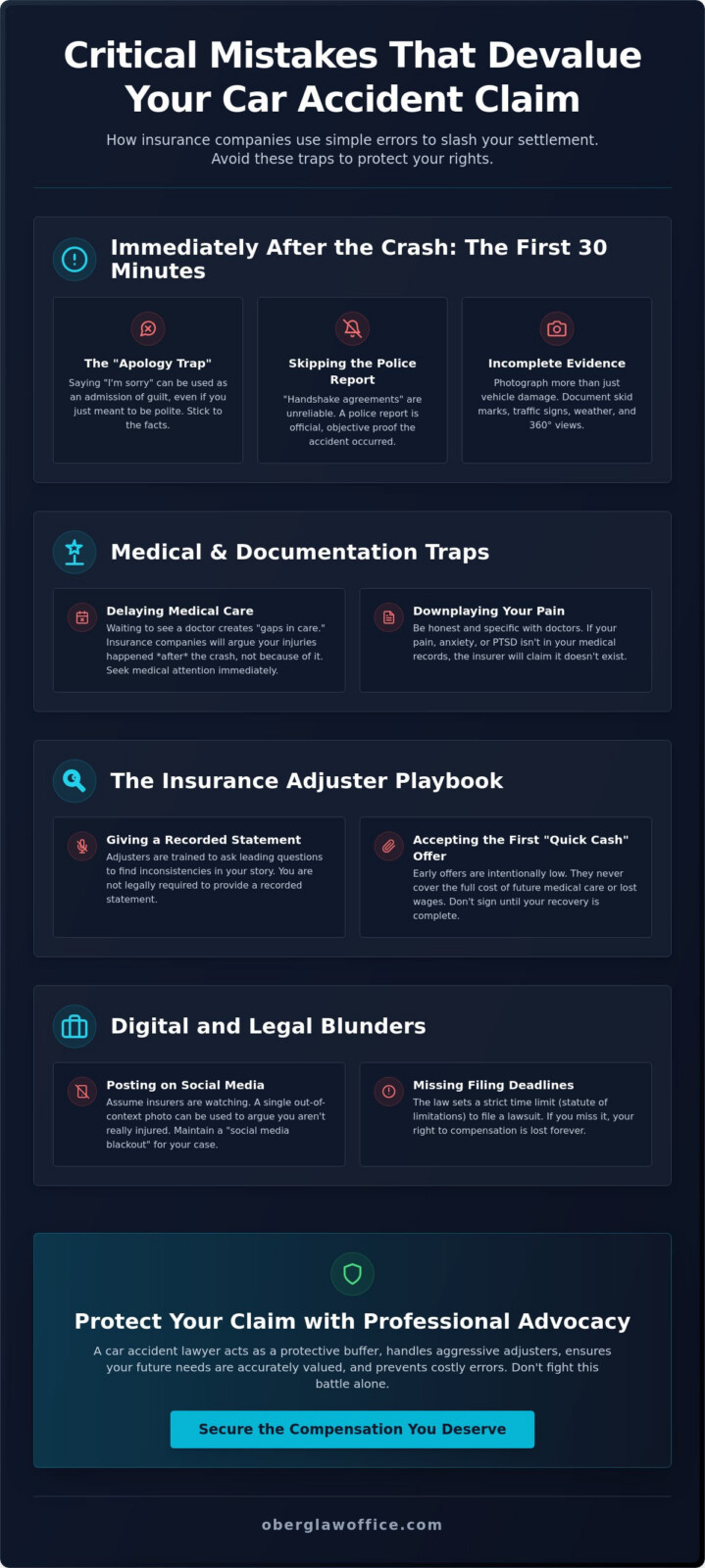
Many people fall into the “apology trap” because they want to be kind or de-escalate tension. You might say “I’m sorry” simply because you feel bad that everyone’s day is ruined. However, an insurance adjuster will interpret that as a confession of negligence. In the context of personal injury law, these spontaneous statements carry significant weight. Even if you didn’t cause the crash, that one phrase can be used to shift blame onto you. Beyond what you say, what you don’t do matters just as much. Relying on a “handshake agreement” with the other driver is a fatal error. They might seem honest at the scene, but their story often changes once they speak to their insurance agent. Similarly, witness amnesia is real. People who saw the whole thing will often drive away once they see everyone is okay. You must secure their names and phone numbers immediately. Don’t wait for the police to arrive; those witnesses might be gone by then.
Capturing evidence is about more than just snapping a photo of a dented bumper. One of the most frequent errors is failing to take 360-degree photos of the entire environment. You need to document skid marks, obscured stop signs, traffic light patterns, and even the lighting or weather conditions. These “invisible” details often prove why the other driver was at fault when the vehicles themselves don’t tell the whole story.
The Danger of Admitting Fault (Even Informally)
Insurance adjusters are trained to look for any reason to apply “comparative negligence.” This legal concept allows them to reduce your payout based on the percentage of fault they can pin on you. You can be polite without discussing the cause of the crash. Stick to facts like “I am checking for injuries” or “Let’s exchange insurance information.” An excited utterance is a statement made by a person during a shocking event that is often admissible in court as an exception to the hearsay rule because it is considered a spontaneous reaction. If you’ve already apologized, don’t panic. Tell your attorney exactly what was said so they can prepare to counter the adjuster’s tactics.
Why the Official Police Report is Non-Negotiable
Without a police report, your claim becomes a “he-said, she-said” scenario. This uncertainty always favors the insurance company. The report acts as an objective timeline of events and often includes the officer’s initial assessment of fault. If the police refuse to come to the scene because it’s a minor accident, you should go to the nearest station and file a counter report yourself. This creates a formal record that prevents the other driver from claiming the accident never happened or that you were the one who fled the scene.
Medical and Evidence Pitfalls: How Gaps in Care Devalue Your Case
After the dust settles at the scene, your focus naturally shifts to getting back to normal. You might feel a bit stiff or sore, but you decide to “wait and see” before calling a doctor. This instinct to be resilient is admirable, but in the legal world, it’s one of the most common mistakes in a car accident claim. Insurance companies don’t see your resilience as strength. Instead, they see it as a lack of injury. If you wait more than a few days to seek treatment, they will argue that your pain was caused by something else entirely, such as a trip at home or a pre-existing condition.
Standard advice on what to do after a car accident always emphasizes immediate medical attention, yet many victims still fall into the “tough it out” trap. When you downplay your pain to a physician, you’re inadvertently creating a permanent record that adjusters use to minimize your suffering later. Be honest and specific. If your back hurts, say so. If you’re struggling with “invisible” injuries like PTSD, anxiety, or sleep disturbances, these must be documented too. If it isn’t in your medical records, the insurance company will act as if it never happened. If you feel overwhelmed by the paperwork, reaching out to a car accident representative can help ensure your medical narrative is handled correctly from day one.
The 72-Hour Rule and Medical Causation
Medical causation is the legal link between the crash and your physical harm. Insurance adjusters often use a “72-hour rule” as a benchmark. If you haven’t seen a doctor within three days, they claim the link is broken. You should visit an ER or urgent care immediately rather than waiting weeks for a primary care appointment. To help your case, keep a daily pain journal. This personal record captures the nuances of your recovery that a brief doctor’s visit might miss.
Following Orders: The Compliance Factor
Your medical records are the primary evidence of your pain and suffering. If a doctor prescribes physical therapy, you must attend every session. Missing even one appointment is logged as “non-compliance” by insurance software. You have a legal duty to mitigate your damages, which means you must actively try to get better. If you stop treatment early because you “feel fine,” the insurer will use that as an excuse to close your file for a fraction of what it’s actually worth.
The Insurance Adjuster Playbook: Avoiding the “Friendly” Traps
The phone rings. It’s an insurance adjuster. They sound genuinely concerned about your well being and might even offer to pay for your car repairs immediately. This is the moment where many people make common mistakes in a car accident claim. It’s vital to remember that the adjuster works for a corporation with one goal: minimizing the amount of money they pay you. Their friendliness is a professional tool used to lower your guard so you’ll share information that could damage your case. They aren’t your friend, regardless of how empathetic they sound on the phone.
One of the most dangerous requests they’ll make is asking you to sign a “blanket” medical release. They claim it’s just to verify your current injuries. In reality, these forms often give them access to your entire life’s medical history. They’ll go fishing through records from a decade ago to find a minor muscle strain and claim your current pain is just a pre-existing condition. Protect your privacy and your claim by refusing to sign anything that gives them unlimited access to your past.
The Recorded Statement: A One-Way Street
Adjusters often ask for a recorded statement early on, claiming it’s just to “get your side of the story.” You aren’t legally required to provide this to the other driver’s insurance company. They use trick questions to trap you into admitting fault or downplaying your pain. If they ask “How are you doing today?” and you reflexively say “I’m okay,” they’ll use that as evidence that you aren’t actually hurt. The Illinois State Bar Association’s Guide to Auto Accidents emphasizes that you should be extremely cautious about what you disclose. When in doubt, it’s perfectly acceptable to say: “I am not prepared to give a statement at this time without my attorney present.”
The Hidden Cost of the Early Settlement
Another common tactic is the “quick cash” offer. They might offer a few thousand dollars to “help with immediate bills.” This lure is designed to close your file before you reach Maximum Medical Improvement (MMI). MMI is the point where your doctors believe your condition has stabilized and won’t improve further. If you settle before reaching MMI, you lose the right to seek more money even if you later discover you need a $50,000 surgery. Signing a release is final. Once that document is signed, your claim is over forever. This is why reading your guide to hiring a car accident lawyer is essential; a professional knows how to value the long-term impact of your injuries rather than just the immediate costs.
Digital and Legal Blunders: Social Media and Deadlines
You might think your personal life is off-limits during a legal case. In 2026, that couldn’t be further from the truth. One of the most damaging and common mistakes in a car accident claim is forgetting that the internet is a public record. Insurance companies aren’t just browsing your profile anymore. They’re using sophisticated AI tools to scrape data from every corner of the web to find reasons to deny your claim. A single photo of you smiling at a family BBQ or standing at a grocery store can be weaponized to argue that you haven’t actually lost your “enjoyment of life.”
Your legal recovery depends on more than just medical records. It depends on your silence. While it feels natural to update your community on your progress, every post is a potential landmine. If you’re worried about how your digital presence might affect your case, reaching out to a car accident representation specialist can help you lock down your privacy before it’s too late.
Your Digital Footprint Under the Microscope
Modern insurance adjusters use AI-driven monitoring to track your activity across all platforms. Even if you set your accounts to private, realize that these posts can still be subpoenaed during litigation. The danger often comes from people you know. A friend “tagging” you in a video where you appear to be moving without pain can destroy a claim for physical limitations. You should tell your family and friends explicitly not to post any photos or videos of you during your recovery. A total social media blackout is the safest way to protect your financial future.
The Clock is Ticking: Legal Deadlines
The “Statute of Limitations” is an unforgiving barrier. If you miss this deadline, you are permanently barred from seeking any compensation. These timelines vary significantly by state. For example, as of 2026, Kentucky and Tennessee have a strict 1-year deadline for personal injury claims. Florida has recently reduced its limit to 2 years for accidents occurring after March 2023. You can find more details on these critical timelines in our Mesquite personal injury lawyer guide.
Beyond the legal deadline, there is the “evidence deadline.” Dashcam footage, retail surveillance, and vehicle black box data are often overwritten within 30 days. Many people make the mistake of “going it alone” until the last minute. By the time they hire an attorney, the physical evidence needed to prove the other driver’s fault is long gone. Waiting until the month your statute expires leaves your legal team with no time to conduct a proper investigation or secure disappearing data.
Professional Advocacy: How a Lawyer Prevents Costly Errors
Facing a billion-dollar insurance corporation alone is like walking into a storm without a coat. You’re already dealing with physical pain and financial stress. The last thing you need is a professional negotiator trying to trick you into a low settlement. An attorney acts as your personal shield. Once you have representation, the insurance company is legally barred from contacting you directly. This buffer stops you from making the common mistakes in a car accident claim we discussed earlier, such as giving recorded statements or accepting “quick cash” before you’re fully healed. Our job is to handle the legal heavy lifting so you can focus on your family.
Leveling the playing field is about resources. Billion-dollar corporations have teams of lawyers and adjusters working to save them money. By partnering with a dedicated advocate, you gain access to the same level of professional expertise. We use accident reconstructionists and medical specialists to prove the true impact of your collision. Professional valuation goes beyond today’s bills. We work with experts to calculate future medical costs and lost earning capacity. If you need surgery in five years or can’t return to your old job, that must be factored into your settlement today. This ensures your recovery reflects your actual needs, not just a number that looks good on an insurance company’s balance sheet.
Direct Interaction with Senior Professionals
At Oberg Law Office, we believe you deserve a personal connection during this difficult time. You won’t be handed off to a support staff member who doesn’t know your name. You’ll work directly with an attorney who is personally invested in your recovery. This level of attention ensures that every detail of your pain and suffering is documented and fought for. To see how this approach has helped others in our community, you can read Gregg Oberg’s personal injury guide, which reflects over 25 years of experience in providing local justice.
The Contingency Fee Advantage
Many people hesitate to call a lawyer because they fear another bill they can’t afford. We use a performance-based fee structure to ensure justice is accessible to everyone. You pay nothing upfront. Our firm only gets paid if we win your case. This model aligns our goals perfectly with yours; we are both motivated to secure the maximum possible recovery for your injuries. It removes the financial risk of seeking justice and prevents you from making common mistakes in a car accident claim that could leave you with nothing. You don’t have to face this alone. We are here to guide you, protect you, and help you restore what was lost.
Take Control of Your Path to Restoration
You’ve worked hard to build your life; don’t let a single moment of confusion after a crash take it away. By securing the scene, seeking immediate medical care, and maintaining a digital blackout, you’ve already done more than most to protect your rights. Avoiding common mistakes in a car accident claim isn’t just about following rules. It’s about ensuring your family’s financial security isn’t sacrificed for an insurance company’s profit margins. You have the power to change the outcome of your case by acting with intention and staying informed.
You don’t have to navigate this complex 2026 legal landscape alone. With over 25 years of experience in Texas law, Attorney Gregg Oberg provides the personalized, direct representation you need to level the playing field against massive corporations. We believe in your case, which is why we offer a performance-based fee structure. You won’t owe us any legal fees unless we win your case. Schedule your free initial strategy session with Oberg Law Office today. You deserve a steadfast protector who is personally invested in your recovery. Let’s start the journey toward restoration together.
Frequently Asked Questions
Can I still win my car accident claim if I accidentally said “I’m sorry” at the scene?
Yes, you can still win your case, but it requires careful damage control. An apology is often a polite reflex rather than a legal admission of negligence. Your attorney can argue that your statement was a spontaneous reaction to a stressful event rather than a factual statement about the crash. We focus on the physical evidence and police reports to redirect the focus back to the other driver’s actions.
How long do I have to see a doctor before the insurance company denies my claim?
You should seek medical attention within 72 hours to prevent a “gap in care” defense. While there isn’t a strict law that triggers an automatic denial after three days, adjusters use any delay to argue your injuries aren’t serious. Promptly visiting an ER or urgent care establishes a clear link between the accident and your physical condition, making it much harder for the insurer to devalue your recovery.
What happens if I already gave a recorded statement to the other driver’s insurance?
If you’ve already provided a statement, you should share the details with your lawyer immediately. While you can’t undo the recording, your legal team can review what was said to prepare for any “trap” questions the adjuster might use later. Correcting the record early is vital because providing a recorded statement is one of the most common mistakes in a car accident claim that can haunt your settlement negotiations.
Is it a mistake to post about my accident on social media if my account is private?
Yes, posting any details about your accident or recovery is a significant mistake regardless of your privacy settings. Defense teams can often obtain subpoenas for “private” content, and friends might inadvertently share your posts with others. Insurance companies use AI tools to find any photo or status update that suggests you’re more active or less pained than your medical records indicate, potentially destroying your claim for suffering.
Can I change my mind after I have signed a settlement release?
In almost every situation, a signed settlement release is final and cannot be undone. Once you accept the money and sign the document, you forever waive your right to ask for more compensation for that accident. This is why it’s critical to wait until you’ve reached Maximum Medical Improvement. You need to know the full cost of your future medical needs before you ever put pen to paper.
What is the most common mistake that causes a car accident claim to be denied?
Failing to call the police and secure an official report is the most frequent reason for an outright denial. Without a neutral third-party record, the insurance company will likely believe their own driver’s version of the story. A police report provides the objective foundation your case needs. It prevents the other driver from changing their story later or claiming the accident was your fault entirely.
Do I really need a lawyer for a minor car accident with clear liability?
Even when liability seems clear, insurance companies often use aggressive tactics to minimize your payout. They might dispute the necessity of your medical treatment or offer a “quick cash” settlement that doesn’t cover the true cost of your car repairs. Having a professional advocate ensures that the adjuster treats you fairly. We handle the stressful negotiations so you don’t have to face a billion-dollar corporation alone.
How does a contingency fee work if my case doesn’t result in a settlement?
If your case doesn’t result in a settlement or a winning verdict, you generally don’t owe any attorney fees. This structure is designed to provide you with risk-free access to high-quality legal representation. We take on the financial burden of investigating your crash and filing the necessary paperwork. This ensures that your goals and our goals are perfectly aligned; we only succeed when you receive the compensation you deserve.