
How do you put a price tag on the sleepless nights, the chronic back pain, or the sudden fear you feel every time you merge onto a Texas highway? It’s incredibly isolating when an insurance adjuster treats your life-altering trauma as a mere line item on a spreadsheet. With over 18,000 people seriously injured in Texas car accidents last year, you aren’t alone in this struggle. You’re dealing with more than just medical bills; you’re managing the emotional weight of a recovery that feels like it has no end. We know the stress of mounting bills and complex legal jargon only makes it harder to focus on healing.
You deserve to understand exactly how to calculate pain and suffering from a car accident texas so you can seek the full restoration you’re owed. This guide breaks down the specific methods used by insurance companies and courts, such as the multiplier and per diem formulas. We’ll show you how to gather the right evidence to build a narrative that even the toughest adjusters cannot ignore. By the time you’re finished, you’ll have a clear roadmap to move from a state of uncertainty to a position of strength.
Key Takeaways
- Understand how Texas law defines non-economic damages so you can identify every way your life has been impacted since the accident.
- Learn how to calculate pain and suffering from a car accident texas using the multiplier and per diem methods to set a baseline for your settlement.
- Discover why the severity of your injuries and your personal credibility are the most influential factors in how adjusters value your claim.
- Master the best ways to document your daily struggles and why avoiding gaps in medical treatment is vital for protecting your rights.
- See how professional advocacy can dismantle the software insurance companies use to minimize your pain and help you secure a truly fair outcome.
Understanding Pain and Suffering Damages Under Texas Law
Recovering from a wreck is about more than just fixing a dented bumper or paying a hospital bill. It’s about the invisible burden you carry every day. In the Texas legal system, these intangible losses are officially known as non-economic damages. Under the Texas Civil Practice & Remedies Code Chapter 41, the law recognizes that your injuries cost you more than just money. They cost you your comfort, your peace of mind, and your quality of life. Pain and suffering isn’t just a legal phrase; it’s a way to hold the at-fault party accountable for the human cost of their negligence.
When you’re trying to figure out how to calculate pain and suffering from a car accident texas, it’s helpful to know that the state generally does not place a “cap” or limit on these damages for motor vehicle collisions. This is a vital distinction. While Texas law limits non-economic damages in medical malpractice cases, those same restrictions don’t usually apply to your car accident claim. This allows us to seek a settlement that truly reflects the depth of your experience without an arbitrary ceiling holding you back. We view your recovery as a restoration of fairness, not just a mathematical exercise.
The Physical Dimension of Suffering
Physical suffering is the tangible bodily toll an accident takes. It includes the burning sensation of a nerve injury or the sharp ache in your back that makes getting out of bed a chore. Chronic pain often leads to physical impairment, which is a legal term for being unable to move or function like you did before. If the accident left you with permanent scarring or disfigurement, the impact is both physical and psychological. You’re reminded of the trauma every time you look in the mirror, and that ongoing distress is a valid part of your claim. We work to ensure the insurance company sees the person behind the medical chart.
The Mental and Emotional Dimension
The scars you can’t see are often the hardest to heal. Many of our neighbors struggle with post-traumatic stress disorder (PTSD) or intense anxiety after a crash. You might find yourself gripping the steering wheel too tight or avoiding certain roads altogether. This loss of enjoyment of life means you’re missing out on family bike rides, playing with your kids, or simply sleeping through the night without a nightmare. Depression and sleep disturbances are common reactions to a life-altering event. We treat these emotional injuries with the same seriousness as a broken bone because we know they affect your ability to feel like yourself again.
The Two Most Common Methods for Calculating Non-Economic Damages
Insurance adjusters often seem like they’re speaking a different language. They look at your life through the lens of a computer program, while you’re just trying to get through the day. When you’re looking for answers on how to calculate pain and suffering from a car accident texas, you’ll likely encounter two primary strategies used to bridge the gap between your experience and a dollar amount. Remember that these aren’t strict laws. Even though the Texas Civil Practice and Remedies Code defines what these damages are, it doesn’t tell a jury exactly how to value them. Juries in Texas have the freedom to award what they feel is fair. Meanwhile, insurance companies often rely on internal software designed to devalue human suffering by turning it into a cold data point.
The Multiplier Method Explained
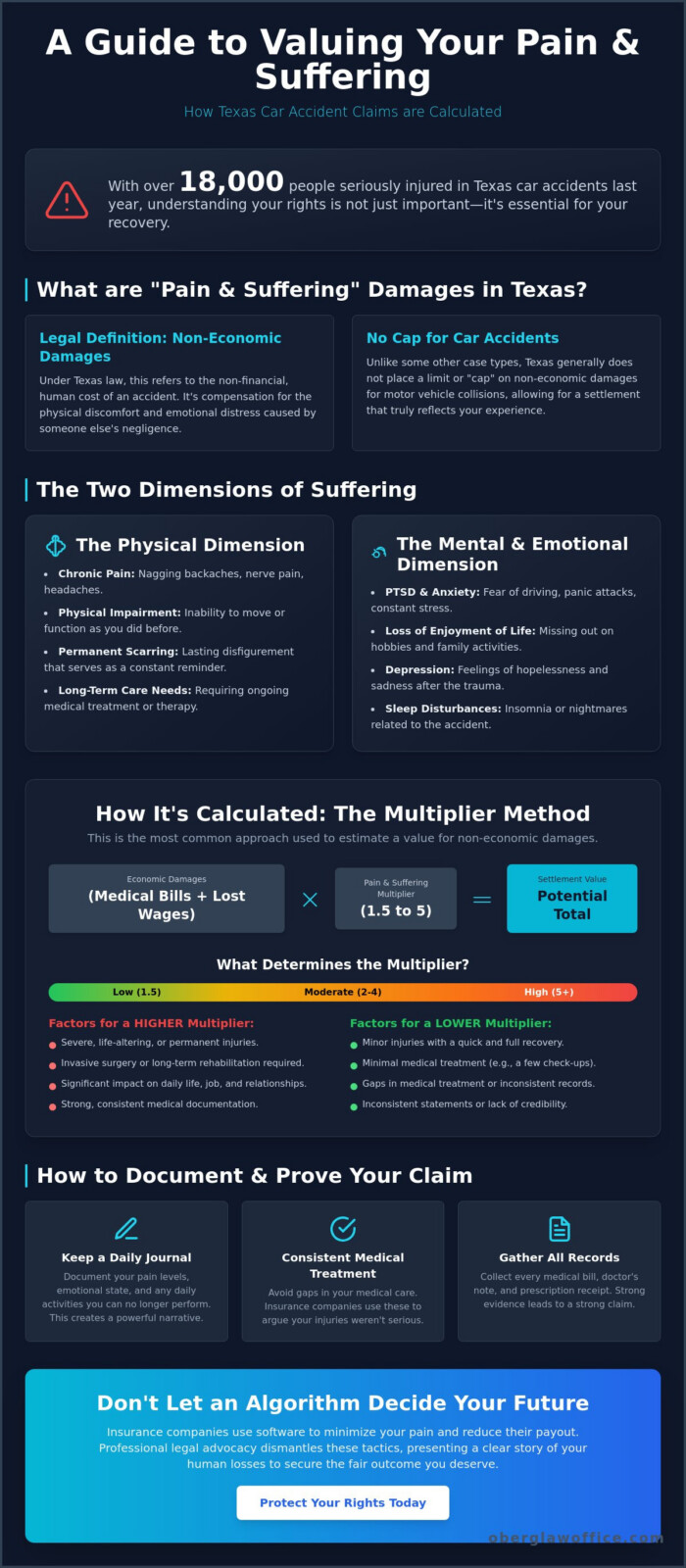
This is the most frequent approach used when determining how to calculate pain and suffering from a car accident texas. We start with your “economic” damages, which include your hospital bills and lost wages. That total is then multiplied by a number, usually between 1.5 and 5. Several factors influence where you fall on that scale:
- The severity of the initial trauma and the pain involved.
- Whether your injuries required invasive surgery or long-term care.
- The impact of the injuries on your daily job duties and family life.
- Whether you have been left with permanent physical limitations or scarring.
Many people hear the “Multiplier 3” myth and assume they’ll automatically get triple their medical bills. In modern Texas settlements, that isn’t a guarantee. A higher multiplier reflects a deeper, more permanent change in your quality of life. Every case is unique, and the multiplier depends entirely on the strength of the evidence we gather to tell your story.
The Per Diem (Daily Rate) Method
The per diem method takes a different route by assigning a specific dollar value to every day you live with pain. This calculation starts on the day of the wreck and continues until you reach Maximum Medical Improvement (MMI). MMI is the point where a doctor decides your condition has stabilized as much as it’s going to. For example, if you spent 90 days in a back brace, assigning a daily value to that specific hardship makes the abstract concept of “suffering” feel real and quantifiable. This method is often very effective for shorter recovery periods where the pain was exceptionally intense, even if the total medical bills were lower. It helps an adjuster visualize the daily struggle of your recovery.
Understanding these methods gives you a baseline, but they’re just the beginning of the conversation. If you’re struggling to deal with an adjuster who’s lowballing your claim, reaching out to a car accident lawyer can provide the clarity and protection you need during this difficult time.
Key Factors That Influence Your Settlement Value in Texas
The math formulas we discussed previously provide a helpful baseline, but they don’t tell the whole story. In the real world, how to calculate pain and suffering from a car accident texas depends heavily on the unique human elements of your case. An insurance adjuster isn’t just looking at a calculator; they’re trying to predict how a Texas jury would react to your testimony. If your injuries are permanent, such as a loss of mobility or chronic nerve damage, the value of your non-economic damages will naturally be higher than a case involving temporary soft tissue strain. We focus on showing the long-term reality of your recovery to ensure no part of your struggle is overlooked.
Your credibility as a witness plays a massive role in this process. If you’re sincere, consistent, and relatable, an insurance company knows a jury is more likely to award a higher amount. They also look at the specific history of the insurance carrier involved. Some companies are notorious for lowballing every claim until a lawsuit is filed, while others may be more reasonable if the evidence is undeniable. We carefully document the direct link between the crash and your current pain, leaving no room for the insurer to claim your suffering came from elsewhere.
The Impact of Proportionate Responsibility (51% Bar Rule)
Texas operates under a “modified comparative fault” system, which can directly shrink your settlement. If you are found partially responsible for the wreck, your total award for pain and suffering is reduced by that same percentage. For instance, if a jury decides you were 10% or 30% at fault because you were slightly over the speed limit, you will only receive 90% or 70% of your total damages. You must be careful here because the stakes are high. Being over 50% at fault bars all recovery in Texas. This means if you’re found 51% responsible, you walk away with nothing, regardless of how much you’ve suffered.
The Role of Pre-Existing Conditions
Insurance companies love to dig through your medical history to find an old sports injury or a previous back ache. They use these to argue that your current pain isn’t new. However, Texas law follows the “Eggshell Plaintiff” doctrine. This rule means the at-fault driver is responsible for the injuries they caused, even if you were more susceptible to injury than the average person. If the wreck aggravated an old condition that was previously under control, that “aggravation” is a valid claim. Proving that the accident made a manageable issue much worse is a key part of how to calculate pain and suffering from a car accident texas accurately.
How to Document and Prove Your Pain and Suffering Claim
Calculating a fair settlement is only half the battle. To actually secure that amount, you have to prove that your pain is real, persistent, and directly caused by the wreck. While a computer program might look at your medical bills, a Texas jury looks for a human story. This is where many people struggle because they focus only on the receipts and forget the narrative. If you want to know how to calculate pain and suffering from a car accident texas effectively, you must understand that the most powerful evidence often exists outside of a hospital bill. We help our neighbors gather the specific proof needed to turn an abstract claim into an undeniable reality.
Consistency is your best friend during this process. Insurance adjusters look for “gaps in care” as an excuse to claim you aren’t actually suffering. If you skip physical therapy or wait weeks to see a specialist, they’ll argue your injuries weren’t that serious. Beyond your own records, we often utilize expert testimony from medical professionals and vocational experts who can explain how your injuries will affect your ability to work and live for years to come. Witness statements from friends, family, and coworkers are also vital. These “before and after” stories provide a clear picture of the person you were before the crash compared to the person struggling to recover today.
Starting a Daily Pain Journal
Memory fades, but a journal provides contemporaneous evidence that is hard to dispute. We recommend recording your pain levels on a scale of 1 to 10 every day. Be specific about the activities you missed, such as being unable to pick up your toddler or having to sit out of a family dinner because the pain was too high. Keep your entries factual and professional. Instead of just saying “I feel bad,” describe how the injury limited your movement or affected your mood. This makes it much harder for the defense to mischaracterize your experience during negotiations.
The Importance of Mental Health Records
Mental anguish is just as real as a broken bone, but it requires a different type of proof. If you’re struggling with PTSD, anxiety, or depression after the wreck, seeing a therapist or counselor is a crucial step. These records validate your emotional distress and link it directly to the accident timeline. Prescriptions for sleep aids or anti-anxiety medications also serve as tangible markers of your psychological struggle. We understand that your privacy is important, and we work to protect your sensitive information while still using these records to prove the full extent of your damages.
Proving the invisible isn’t easy, but you don’t have to do it alone. If you’re ready to build a case that reflects your true experience, contact a Texas car accident lawyer to start protecting your future today.
Why Professional Legal Advocacy is Essential for Maximizing Recovery
You shouldn’t have to face a multi-billion dollar insurance company alone while you’re still trying to recover your health. While learning how to calculate pain and suffering from a car accident texas gives you a baseline, applying that knowledge during a high-stakes negotiation is a different challenge. Insurance companies don’t look at your injuries with empathy. Instead, they often use secretive software programs like “Colossus” to strip the humanity out of your claim. These algorithms assign a dollar value based on data points and codes rather than your actual daily struggle. We know how these “black box” systems work, and we know how to challenge their results with the undeniable reality of your experience.
Having a dedicated mesquite personal injury lawyer on your side changes the dynamic of your case immediately. When an insurance adjuster knows you’re represented by a firm that isn’t afraid to go to court, their valuation of your “non-economic” damages often shifts. The credible threat of litigation forces them to move beyond their software’s lowball estimates. We don’t let our clients be treated like a file number; we ensure you interact directly with senior legal professionals who are personally invested in building a custom narrative for your recovery.
Negotiating with Insurance Adjusters
You should never feel pressured to accept the first offer an adjuster throws your way. These are often “nuisance value” settlements designed to make your claim go away as cheaply as possible. We counter these tactics by drafting comprehensive demand letters that focus on the “Human Story” of your injury. These documents combine your medical evidence with the personal testimony we discussed in previous sections to show the true cost of your pain. For more help on choosing the right partner for this fight, see Your Guide to Hiring a Car Accident Lawyer in Mesquite (2026 Edition).
The Oberg Law Office Difference
Gregg Oberg has spent over 25 years in Texas courtrooms, standing up for neighbors who have been pushed aside by large institutions. Our firm is built on a foundation of compassionate advocacy and neighborly service. We believe that everyone deserves access to high-quality legal protection, which is why we work on a contingency-based fee structure. You don’t pay us anything upfront. We only receive a fee if we successfully secure a settlement or verdict for you. This ensures that our interests are perfectly aligned with yours as we work together toward the restoration and fairness you deserve.
Take Control of Your Recovery and Secure Your Future
You’ve been through enough stress already. Understanding the math is just the beginning; the real power lies in the evidence-backed story you tell. By documenting your daily struggles and working with experts, you ensure your non-economic damages are treated with the seriousness they deserve. Now that you understand how to calculate pain and suffering from a car accident texas, you have the tools to push back against lowball offers and demand true fairness.
Gregg Oberg offers over 25 years of Texas legal experience to help you navigate this complex journey. You’ll work directly with your attorney, receiving the personal attention your case requires. Since we operate on a contingency-based fee structure, you pay nothing unless we win. We’re here to serve as your steadfast protector against large insurance companies. Schedule Your Free Texas Accident Strategy Session with Oberg Law Office today. You’ve faced a significant challenge, but you don’t have to face the recovery alone. Let’s work together to restore what was taken and move toward a brighter future.
Frequently Asked Questions
Is there a limit on pain and suffering damages in Texas car accident cases?
No, Texas law generally does not place a cap on non-economic damages for motor vehicle accidents. While medical malpractice cases have strict limits, those restrictions don’t typically apply to your car wreck claim. This allows you to seek the full value of your suffering without an arbitrary ceiling holding you back. We believe you deserve a settlement that reflects your actual experience, not a pre-set limit.
Can I claim pain and suffering if I was partially at fault for the accident?
Yes, you can still recover damages as long as you are 50% or less at fault for the crash. Under the Texas modified comparative fault rule, your total settlement is reduced by your percentage of responsibility. However, if you’re found 51% or more at fault, you’re barred from any recovery. It’s vital to have a steadfast protector who can shield you from unfair blame.
How much is a typical pain and suffering settlement in Texas?
There is no “average” settlement because every person’s experience is unique. Factors like your total medical bills, the permanence of your injuries, and the strength of your evidence all influence the final number. When determining how to calculate pain and suffering from a car accident texas, the focus is on your specific narrative rather than a generic industry average. Every case requires its own custom strategy.
Do I have to pay taxes on the pain and suffering portion of my settlement?
Usually, settlements for physical sickness or injury are not taxable under federal law. This includes the portion of your award meant for physical pain and emotional distress caused by the accident. However, if you receive punitive damages or interest on an award, those specific portions may be taxable. You should always consult with a tax professional to review the specific structure of your settlement.
How long do I have to file a claim for pain and suffering in Texas?
You generally have two years from the date of the accident to file a lawsuit in Texas. This deadline is set by the Texas Civil Practice and Remedies Code. If your accident involved a government entity, such as a city bus, you may need to provide formal notice in as little as six months. Missing these deadlines can permanently bar you from seeking the justice you deserve.
What is considered “mental anguish” in a Texas personal injury lawsuit?
Mental anguish goes beyond simple disappointment or temporary sadness. It includes intense emotional pain, such as PTSD, severe anxiety, or depression that disrupts your daily life. To prove this in a Texas courtroom, you must show that the emotional trauma is significant and directly linked to the collision. It’s about the deep, life-altering distress that prevents you from feeling like yourself again after the wreck.
Can I prove pain and suffering without a doctor?
While personal journals and witness statements are powerful, medical records are the foundation of a successful claim. A doctor’s notes provide objective proof that your pain exists and requires professional treatment. Without consistent medical documentation, insurance adjusters will likely dismiss your claim as unsubstantiated. We help you connect your medical recovery with the human story of your suffering to build a stronger case for fairness.
What happens if the insurance company denies my pain and suffering claim?
If an insurer denies your claim, you have the right to challenge their decision through formal negotiations or a lawsuit. They often use this denial as a tactic to see if you’ll give up or accept a lower offer. This is when professional advocacy becomes essential for your recovery. We can file a lawsuit to force the company to take your suffering seriously and move toward a fair resolution.