
What if making a minor mistake before an accident doesn’t give the other driver an automatic pass to avoid paying for your injuries? If an aggressive insurance adjuster is already trying to shift blame onto your shoulders, you are likely asking what is the last clear chance doctrine and whether it can protect your financial future. It’s completely natural to feel anxious when confusing legal rules stand between you and the care you need. You might fear that an honest slip-up bars you from compensation entirely, but the law often looks past initial errors to see who held the true power to prevent harm.
In this guide, you will understand how the last clear chance doctrine works, when it applies, and how it shields injured people from unfair blame. We will break down the critical differences between contributory and comparative negligence, reveal how to prove the opposing party had the definitive opportunity to stop a crash, and show you how to push back against bad-faith defense tactics.
Key Takeaways
- Learn what is the last clear chance doctrine and how it can safeguard your financial recovery even if an insurance adjuster accuses you of an initial mistake.
- Discover the specific chronological proof required to establish that the opposing party held the definitive, final opportunity to avoid a crash.
- Understand the vital differences between pure contributory negligence rules and modern comparative fault systems across the nation.
- See how final avoidance arguments apply to real-world traffic collisions involving stalled vehicles, pedestrians, and intersection hazards.
- Find out how to protect your rights from common insurance tactics designed to shift blame and unfairly diminish your settlement.
What Is the Last Clear Chance Doctrine in Personal Injury Law?
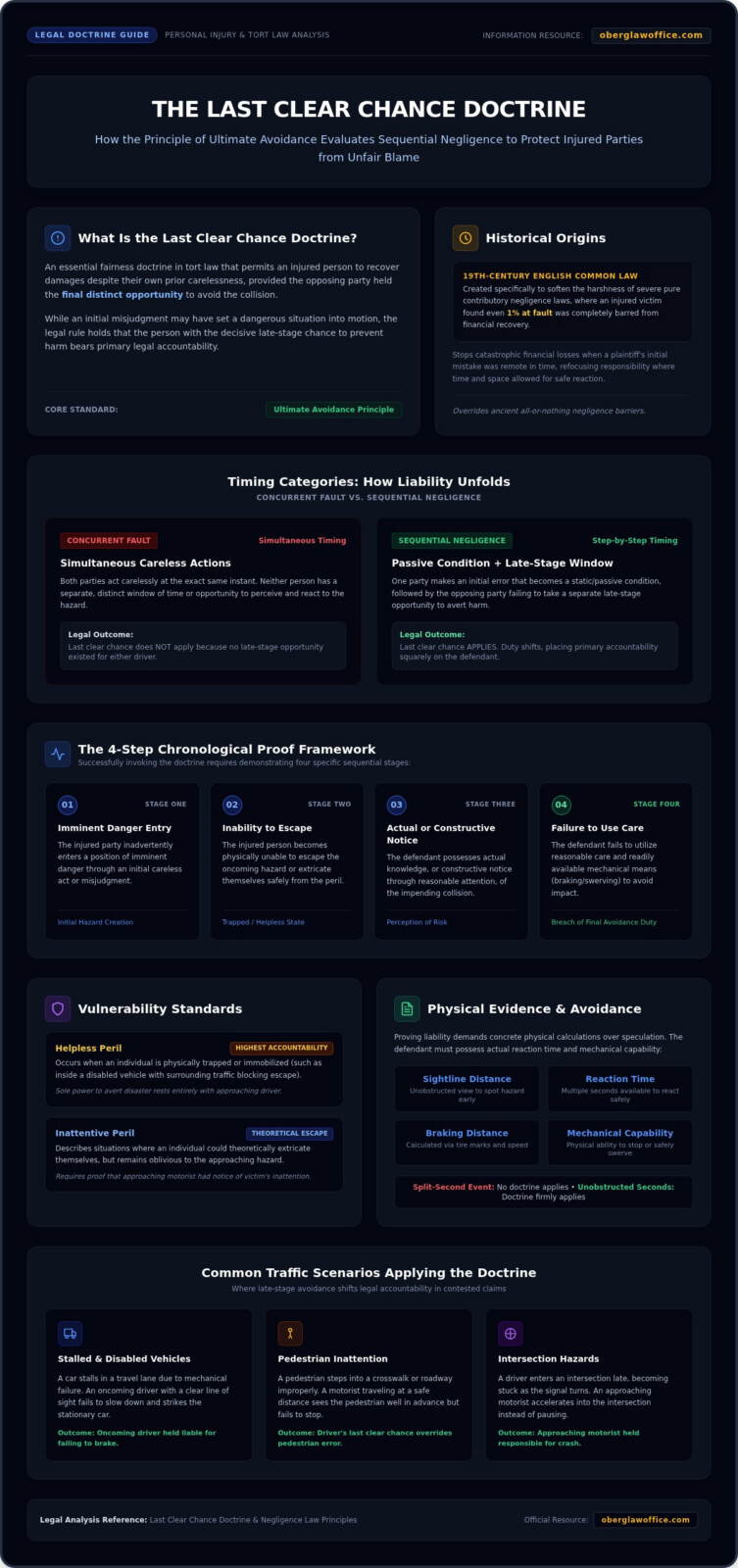
If an insurance company claims you share fault for an accident, you may wonder how you can possibly recover fair compensation. To understand what is the last clear chance doctrine, consider how liability unfolds in real time. The last clear chance rule is an essential fairness doctrine in tort law that permits an injured person to recover damages despite their own prior carelessness, provided the opposing party had the final distinct opportunity to avoid the crash.
Historically, strict legal rules often blocked people from collecting any financial relief if they made even a minor misjudgment. The doctrine steps in to prevent that unjust result. It acknowledges that while your initial conduct might have set a dangerous situation into motion, the defendant had the definitive, final chance to stop the collision from happening.
Historical Origins and the Principle of Ultimate Avoidance
The rule traces back to nineteenth-century English common law, developed specifically to soften the blow of severe contributory negligence laws. Under archaic legal standards, an injured victim found even one percent at fault lost everything. Recognizing how unfair this was, courts established the last clear chance doctrine to evaluate which party held the decisive final action before impact.
This principle of ultimate avoidance stops catastrophic financial outcomes when a plaintiff’s mistake was remote in time. If you made an error early on, but another driver had ample space and time to react safely, the law places the responsibility where it truly belongs.
The Core Distinction Between Concurrent Fault and Sequential Negligence
Applying this legal rule hinges on showing that the events happened sequentially rather than simultaneously. Personal injury claims generally split into two timing categories:
- Concurrent fault: Both parties act carelessly at the exact same instant, leaving neither person with a separate, distinct window to react.
- Sequential negligence: One party makes an initial error that becomes a passive condition, followed by an opposing party failing to take a late-stage opportunity to prevent harm.
When an initial careless act settles into a static hazard, the immediate duty shifts. If an oncoming motorist has a clear line of sight and adequate stopping distance, their failure to brake overrides the prior mistake. That late-stage window places primary accountability squarely on the defendant.
How the Last Clear Chance Rule Operates in Negligence Claims
Proving liability in a contested personal injury claim often comes down to timing. To understand practically what is the last clear chance doctrine during a legal dispute, you must examine how events unfolded second by second. Successfully invoking this rule requires demonstrating four specific chronological steps:
- The injured person inadvertently entered a position of imminent danger through an initial careless act.
- The injured party was physically unable to escape the oncoming hazard or extricate themselves safely.
- The defendant possessed actual knowledge, or constructive notice through reasonable attention, of the impending collision.
- The defendant failed to utilize reasonable care and readily available means to avoid the impact.
Helpless Peril vs. Inattentive Peril: Understanding the Legal Standard
Courts evaluate an injured victim’s vulnerability through two distinct legal lenses. Helpless peril occurs when you are physically trapped or immobilized, such as sitting inside a disabled car with stalled traffic blocking your exit. Inattentive peril describes situations where an individual could theoretically escape, but remains oblivious to the approaching threat. The legal doctrine of last clear chance imposes the highest accountability on drivers who spot a helpless victim, because the sole power to prevent disaster rests entirely in the approaching motorist’s hands.
Reaction Time, Stopping Distance, and the Window of Avoidance
Holding an opposing party responsible demands concrete physical evidence rather than guesswork. The defendant must have possessed sufficient real-world reaction time and mechanical capability to avert disaster. Legal teams analyze tire marks, vehicle speeds, and sightlines to calculate exact braking distances. A split-second, unavoidable collision does not trigger this doctrine. If evidence proves an observant driver had several unobstructed seconds to brake or swerve, the legal window of avoidance firmly applies.
Establishing Proximate Cause When Evaluating Dual Negligence
Assigning accountability ultimately hinges on determining proximate cause. Even if an initial misjudgment placed you in harm’s way, the opposing driver’s subsequent failure to slow down serves as the true legal cause of your injuries. That late-stage inattention legally supersedes your prior error. When insurance carriers attempt to weaponize mutual fault to escape liability, seasoned car accident representation can help uncover vehicle black-box data and physical evidence to prove who held the definitive opportunity to prevent the crash.
Last Clear Chance vs. Modern Comparative Negligence Systems
State laws handle shared responsibility in vastly different ways. When evaluating what is the last clear chance doctrine and its place in modern litigation, you have to look at the legal framework governing your jurisdiction. The doctrine acts as an all-or-nothing financial lifeline under strict fault rules, while in comparative fault venues, its underlying logic directly shapes percentage-based recovery.
| Negligence System | Effect on Injured Victims | Role of Last Clear Chance |
|---|---|---|
| Pure Contributory | Even 1% plaintiff fault bars recovery. | Complete exception that restores 100% recovery. |
| Modified Comparative | Damages reduced by fault; barred at 50% or 51%. | Convinces juries to keep plaintiff fault below threshold. |
| Pure Comparative | Damages reduced strictly by percentage of fault. | Maximizes financial recovery by minimizing plaintiff share. |
The Survival of the Doctrine in Pure Contributory Negligence States
Only Alabama, Maryland, North Carolina, Virginia, and the District of Columbia still follow pure contributory negligence. In these jurisdictions, an insurer can deny a claim completely if you contributed just one percent to the incident. Reviewing legal guides like Understanding Negligence Doctrines highlights how the rule operates as an absolute shield. Proving the defendant had the decisive, final opportunity prevents catastrophic zero-dollar verdicts and forces the negligent party to pay.
How Comparative Fault Absorbed the Avoidance Principle
Most states have replaced pure contributory rules with comparative fault models. While the formal defense is rarely pleaded by name in these venues, its core logic remains central to courtroom strategy. Juries naturally look at who held the superior opportunity to avert harm. When trial lawyers demonstrate that a defendant ignored an obvious hazard, juries frequently assign eighty percent or more of the total liability to that inattentive driver.
Overcoming the Modified Comparative Negligence Bar Rule
In states using a modified comparative system, exceeding a fifty or fifty-one percent fault threshold wipes out your entire financial claim. Insurers exploit this rule by exaggerating minor claimant errors to push fault over the cutoff. Demonstrating that the opposing party possessed the last clear opportunity suppresses your fault allocation well below the statutory limit. If an insurer claims you caused your own crash, seeking dedicated car accident representation ensures the physical timeline proves who truly held the power to stop the collision.
Applying the Last Clear Chance Doctrine to Traffic Collisions
Abstract legal theories rarely help when you are recovering from a severe crash and facing aggressive blame. To truly see what is the last clear chance doctrine in practice, you must examine how it plays out on actual roadways. Insurance adjusters frequently point fingers at injured victims, claiming their presence in an intersection or on a roadway caused the collision. Real-world crash investigations, however, routinely demonstrate how final avoidance arguments defeat these unfair blame-shifting tactics.
Intersection and Left-Turn Collision Disputes
Left-turn disputes represent one of the most common applications of this rule. Picture a driver initiating a left turn across multiple lanes, misjudging oncoming traffic by a split second. The turning vehicle ends up stranded across the lane due to a sudden traffic pause ahead. If an oncoming motorist has five hundred feet of clear visibility, ignores the visible obstruction, and accelerates instead of braking, that oncoming driver possessed the last clear chance to avert disaster. Sightline analysis and traffic light cycle data quickly confirm whether the approaching driver had ample space to avoid the impact.
Pedestrian and Stranded Motorist Collisions
Vulnerable road users and disabled vehicle operators frequently rely on this legal protection. Consider an engine failure that leaves a motorist stuck on an active highway shoulder at dusk, or a slow-moving pedestrian caught mid-crosswalk when a signal changes. Approaching headlights and open road sightlines eliminate common excuses about invisible hazards. When an attentive driver possesses clear illumination and several car lengths to change lanes or stop, striking that stranded person constitutes definitive negligence under the doctrine.
Essential Evidence Required to Prove the Opportunity Existed
Proving that the other party had the time and means to avoid you requires objective physical evidence. Modern accident reconstruction relies heavily on digital records rather than conflicting witness memories:
- Event Data Recorders (EDRs): These onboard vehicle systems capture exact travel speeds, throttle application, steering input, and the precise moment brakes were engaged.
- Video Surveillance: Commercial dashcams, intersection traffic cameras, and nearby security systems establish the exact seconds an obstacle remained visible before impact.
- Physical Reconstruction: Skid mark measurements, vehicle crush profiles, and final resting positions verify whether an impact was truly unavoidable or the result of delayed driver attention.
Commercial vehicles present complex challenges because massive weights dramatically increase necessary stopping times. Consulting an experienced truck accident advocate ensures critical electronic control module data gets preserved before trucking companies can overwrite it. When adjusters try to pin a collision on your initial misstep, having senior counsel step in to subpoena footage and analyze telematics can expose who truly held the definitive opportunity to prevent the crash. Connect with a dedicated team at Oberg Law Office to safeguard your right to fair compensation.
Protecting Your Rights When Insurers Blame You for the Crash
Facing aggressive blame from an insurance adjuster while nursing severe injuries is exhausting. Adjusters routinely allege shared fault to lower settlement payouts or deny claims entirely. Knowing what is the last clear chance doctrine gives you the legal foundation to challenge these tactics. When an insurer insists your actions contributed to the wreck, remember that their assessment is a negotiation stance, not an unchangeable legal verdict.
You have the right to challenge their narrative. Establishing the physical timeline stops adjusters from using minor driving hesitations to erase valid claims.
Tactics Insurers Use to Distort Timelines and Fabricate Shared Blame
Adjusters rely on well-worn strategies to shift liability away from their policyholder. They frequently push for early recorded statements, asking leading questions designed to extract an admission that you might have braked harder or swerved sooner. They misrepresent visibility and road friction to claim their driver had insufficient reaction time. Often, they push rapid, lowball offers before injured victims can secure black-box data or consult independent experts.
How Professional Legal Investigation Reconstructs the True Sequence
Overcoming these bad-faith arguments requires building an unassailable factual record. Independent accident reconstruction specialists step in to calculate actual stopping distances and sightlines, transforming speculative insurance claims into measurable physics:
- Digital telemetry analysis: Downloading crash data confirms whether the opposing motorist touched their brakes or stayed on the gas pedal.
- Cell phone extractions: Subpoenaing mobile carrier logs reveals whether text messages or apps distracted the driver when they should have been watching the road.
- Evidence spoliation letters: Issuing formal preservation demands stops insurance companies from scrapping damaged vehicles before crash angles get measured.
Taking Action with Contingency-Based Legal Representation
Leveling the playing field against large corporate carriers requires steadfast guidance. At Oberg Law Office, Attorney Gregg Oberg brings over 25 years of trial experience defending injured people against blame-shifting defense tactics. Clients work directly with experienced senior legal counsel rather than being passed down to inexperienced case managers. Contingency fee representation ensures you face zero upfront costs, aligning your legal team completely with your recovery. To evaluate your collision and dismantle unfair fault accusations, reach out to Oberg Law Office to discuss your path forward.
Take Control of Your Injury Claim Today
Unfair blame should never prevent you from getting the medical care and financial support you need. Understanding what is the last clear chance doctrine gives you the upper hand when insurance carriers try to turn an initial driving mistake into an excuse to deny payment. Whether your collision involves strict contributory negligence rules or modern comparative fault thresholds, establishing who held the final, clear opportunity to prevent disaster protects your right to full financial recovery.
You don’t have to navigate aggressive corporate adjusters on your own. Attorney Gregg Oberg brings over 25 years of proven personal injury legal experience to defend your rights against unfair defense tactics. When you partner with our firm, you receive direct personal communication with senior counsel throughout your entire case, not a rotating group of case managers. With performance-based contingency fees, you face zero out-of-pocket costs to pursue justice. Schedule a free strategy session with Oberg Law Office today and take the first decisive step toward restoring your life.
Frequently Asked Questions
What is the simplest definition of the last clear chance doctrine?
At its simplest, the rule states that the person who had the final opportunity to prevent an accident bears full legal responsibility for causing it. When asking what is the last clear chance doctrine, think of it as a crucial fairness safeguard. Even if you made an initial mistake, you can still recover full damages if the defendant saw the danger and failed to use reasonable care to avoid hitting you.
Can I recover compensation if an accident was partially my fault?
Yes, you can still recover compensation in most circumstances. In comparative fault states, your total payout is simply reduced by your percentage of fault, provided your responsibility stays below statutory cutoffs like fifty or fifty-one percent. In strict contributory negligence jurisdictions, the last clear chance rule provides a vital exception that can restore your full financial recovery if the other motorist had the final window to prevent the crash.
What is the difference between helpless peril and inattentive peril?
Helpless peril occurs when you are physically trapped or immobilized, such as sitting in a stalled vehicle without any safe way to escape. Inattentive peril happens when you could physically remove yourself from danger, but your attention is momentarily diverted. Courts hold approaching drivers to a much stricter standard during helpless peril situations because only the defendant possesses the physical capability to prevent catastrophic harm.
Does the last clear chance doctrine still apply under comparative negligence?
In comparative negligence jurisdictions, courts rarely use the formal doctrine name, but attorneys rely heavily on its core logic. When personal injury lawyers demonstrate that an opposing driver held the definitive opportunity to stop, juries assign the vast majority of blame to that driver. Understanding what is the last clear chance doctrine helps your legal team push your assigned fault percentage down, protecting your compensation from being reduced or eliminated.
What types of evidence prove the other driver had the final chance?
Proving final avoidance relies on clear objective evidence rather than conflicting roadside stories. Critical records include vehicle black-box data that logs throttle and braking, dashcam and surveillance video footage showing exact lines of sight, and cell phone records exposing driver distraction. Skid mark measurements and roadway geometry calculations also establish how many seconds the approaching motorist had to react safely before impact.
Why do insurance companies try to blame accident victims for contributing to crashes?
Insurance companies are profit-driven corporations that use shared fault allegations to minimize their financial exposure. If an adjuster can shift even partial blame onto you, they can dramatically reduce the settlement amount they must pay out. In strict fault jurisdictions, pinning even a single percentage of blame on you allows an insurer to deny your injury claim entirely and walk away with zero financial responsibility.
How does a lawyer prove the defendant had enough time to stop?
A dedicated attorney collaborates with independent accident reconstruction specialists to calculate vehicle velocity, perception-reaction timing, and mechanical braking distances. By overlaying roadway sightlines and physical skid measurements onto digital vehicle data, your lawyer demonstrates the exact physical timeline. This scientific proof shows a judge or jury that an attentive motorist had more than enough clear space to stop safely.