Did you know that only 5% of Americans can correctly identify every blind spot on a semi-truck? These “No-Zones” aren’t just driving hazards; they’re the site of roughly 300 deaths every year. If you’ve been hurt because a driver claimed they simply didn’t see you, you’re likely facing a mountain of medical bills and aggressive tactics from insurance companies. Finding a dedicated truck blind spot accident lawyer is the first step in proving that a blind spot is never a valid excuse for a catastrophic collision.
We understand the weight of what you’re carrying right now. It feels deeply unfair that your life changed in an instant because a professional driver failed to use the tools at their disposal. This guide will show you how to hold negligent trucking companies accountable by leveraging 2026 safety standards, such as the latest FMCSA rear visibility technology mandates. You’ll learn how to navigate the legal complexities of commercial vehicle blind spots to secure the full financial recovery you need for your medical care and lost wages. We’ll walk through the specific evidence required to win your case and explain how to protect your rights from the very start.
Key Takeaways
- Identify the four massive “No-Zones” where truck drivers have zero visibility and learn why these areas are significantly more dangerous than standard car blind spots.
- Understand how a truck blind spot accident lawyer applies federal safety standards and 2026 visibility mandates to hold negligent carriers accountable.
- Discover the critical role of electronic data, like the vehicle’s “black box,” in proving that a driver failed to monitor their surroundings before a crash.
- Learn about the “spoliation letter,” a vital legal tool that prevents trucking companies from destroying evidence that is essential to your claim.
- See how professional advocacy can protect you from aggressive insurance tactics while ensuring you receive the full compensation you deserve for medical bills and lost wages.
Understanding the ‘No-Zone’: The Dangerous Physics of Truck Blind Spots
When you’re on the road with a 40-ton vehicle, the stakes are incredibly high. Truckers often use the “No-Zone” as a defense after a collision, claiming they simply couldn’t see the other vehicle. However, these truck blind spots aren’t just minor inconveniences; they’re massive areas of zero visibility that require constant vigilance from professional drivers. Understanding the physics behind these zones is the first step toward holding a negligent carrier accountable. A dedicated truck blind spot accident lawyer knows that these mechanical limitations don’t excuse a driver’s failure to maintain safety.
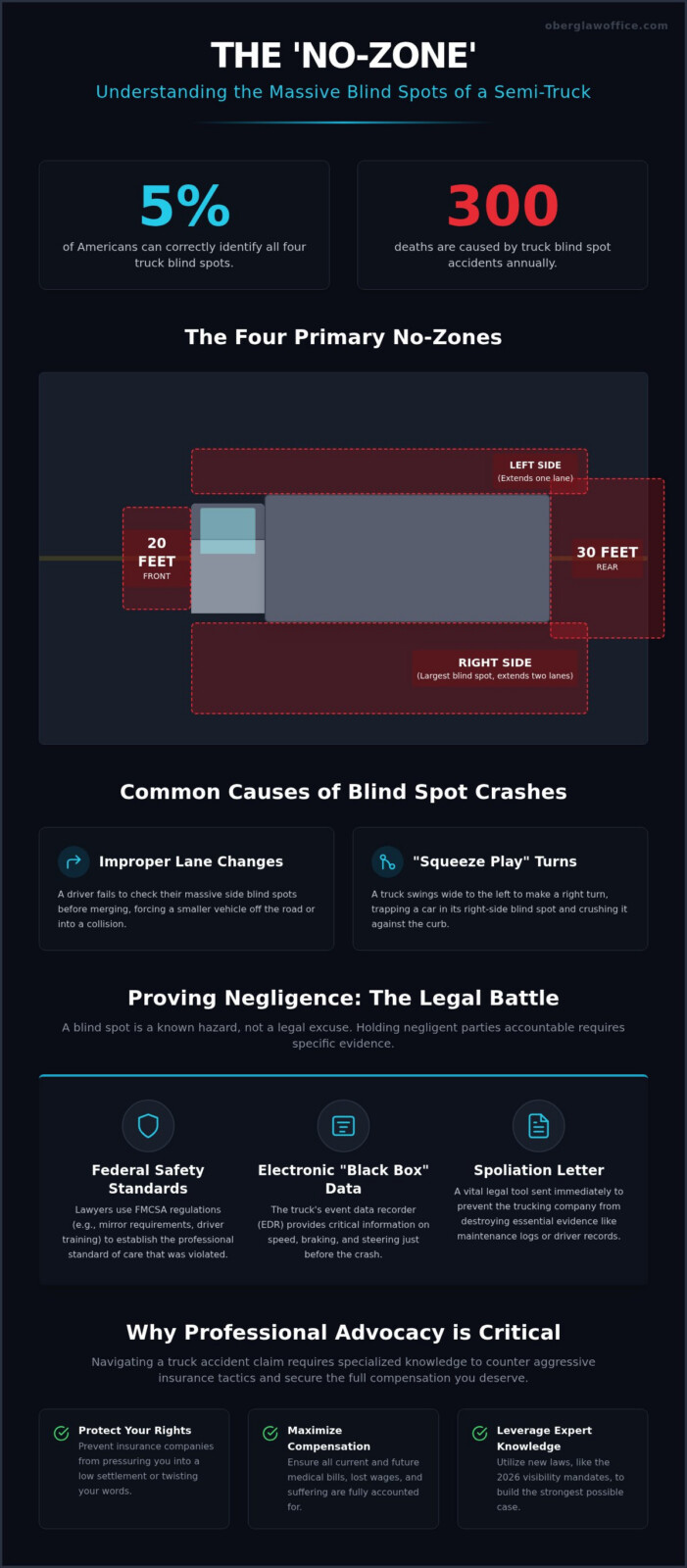
The scale of these zones is staggering. While your car has small gaps in visibility, a semi-truck has a 20-foot blind spot in front and a 30-foot blind spot in the rear. These gaps exist because of the high cab height and the sheer length of the trailer, which creates a permanent visual obstruction that mirrors can’t always fix. When a driver is seated several feet above the road, the area directly beneath their windows disappears, making it easy to overlook smaller passenger vehicles, motorcycles, or pedestrians.
The Four Primary No-Zones of a Semi-Truck
Every commercial rig has four primary danger zones where you’re essentially invisible to the driver. These areas are much larger than the blind spots on a standard SUV or pickup truck.
- Front No-Zone: Truckers sit so high that they can’t see the 20 feet directly in front of their bumper, which often leads to devastating rear-end collisions if a car merges too closely.
- Rear No-Zone: Without a center rearview mirror, the driver is completely blind to anyone within 30 feet of the trailer’s end. Tailgating a truck is especially dangerous because the driver has no way of knowing you’re there.
- Side No-Zones: These extend along both sides of the trailer. The right side is significantly larger and more dangerous because the driver is seated so far to the left, creating a massive pocket of zero visibility.
How Speed and Weight Magnify Blind Spot Risks
When a driver fails to check their surroundings, the results are often fatal due to the vehicle’s mass. The “squeeze play” happens when a truck swings wide to the left to make a right turn, trapping smaller cars in the massive right-side blind spot. Lane changes also become deadly when a driver doesn’t account for the “sweep” of their trailer. Under federal law, a fully loaded commercial truck can weigh up to 80,000 pounds, which significantly limits a driver’s ability to react or stop if they suddenly realize a car is in their path.
If you’ve been injured in one of these crashes, a truck blind spot accident lawyer can help you prove that the driver’s failure to manage these known hazards was the direct cause of your suffering. We focus on the evidence that proves a professional driver should’ve been aware of your presence, regardless of the mechanical limitations of their rig.
Federal Safety Standards: How Regulations Govern Truck Visibility
The Federal Motor Carrier Safety Administration (FMCSA) exists to prevent the very tragedies that change lives in an instant. They establish strict regulations that every trucking company must follow. These rules cover everything from how long a driver can stay behind the wheel to the specific equipment required on a rig. When these standards are ignored, the consequences are often catastrophic. A skilled truck blind spot accident lawyer uses these federal mandates as a roadmap to prove negligence and secure justice for victims. These laws ensure that “I didn’t see them” is never a valid legal defense for a professional driver.
Beyond hardware, federal law impacts how drivers are trained. To earn a Commercial Driver’s License (CDL), operators must demonstrate an understanding of defensive driving. They’re taught that “if you can’t see my mirrors, I can’t see you” isn’t just a bumper sticker; it’s a warning of a known hazard they are professionally responsible for managing. When a driver makes an improper lane change because they failed to properly clear their blind spot, they aren’t just making a mistake. They’re failing their professional duty of care to everyone else on the road.
FMCSA Mirror and Equipment Compliance
Federal regulation 49 CFR § 393.80 is a critical piece of safety legislation. It requires every truck to have at least two mirrors, one on each side, positioned to provide a clear view of the road to the rear. This isn’t just about having mirrors; it’s about their daily maintenance and placement. Drivers are legally obligated to perform thorough pre-trip inspections. If a driver hits the road with a cracked, vibrating, or missing mirror, they’re in direct violation of federal law. Even the American Trucking Associations highlights the importance of industry safety standards to help professional drivers manage the No-Zone safely and avoid collisions.
Advanced Driver Assistance Systems (ADAS) in 2026
Technology is rapidly changing how we view road safety. As of 2026, the FMCSA has expanded its acceptance of camera-monitor systems (CMS) as a robust alternative to traditional mirrors. These systems can significantly increase a driver’s field of view and help eliminate the massive gaps in visibility we discussed earlier. While some technologies like blind-spot information systems (BSIS) are becoming standard on newer fleets, the legal question often centers on whether a company failed to adopt available safety tech that could’ve prevented a crash. If a carrier prioritizes profits over the latest safety equipment, they may be held to a higher standard of liability. If you’re feeling overwhelmed by the technical details of your accident, a personal legal consultation can provide the clarity you need to move forward.
Common Causes of Blind Spot Crashes and Proving Negligence
When you’re recovering from a catastrophic collision, hearing a driver say they “didn’t see you” feels like a hollow excuse. It’s a professional driver’s duty to be aware of their surroundings at all times. Identifying the specific reason why a driver failed to monitor their No-Zones is how a truck blind spot accident lawyer builds a case for your full financial recovery. These crashes are rarely random; they’re usually the result of a chain of negligent decisions made by the driver or the trucking company.
Fatigue is often the primary culprit. When a trucker has been behind the wheel for too many hours, their ability to scan mirrors and process visual information slows down significantly. This exhaustion leads to improper lane changes, which are the most frequent blind-spot-related accidents on our interstates. Drivers might drift into another lane or merge without checking their side No-Zones, assuming the road is clear. They should be following the Federal Motor Carrier Safety Administration (FMCSA) safety guidelines to avoid these preventable errors. We also see many cases involving the “Wide Turn” trap. This happens when a truck swings left to prepare for a right-hand turn, leaving a temporary gap that looks like an open lane. When the truck finally turns right, it can crush a smaller vehicle that moved into that space.
Cargo shifts can also play a hidden role in visibility issues. If a trailer is poorly loaded, the weight can shift during a turn or sudden maneuver. This causes the trailer to lean or sway, which instantly changes the angle of the mirrors and creates new, unexpected blind spots that the driver isn’t prepared for. Proving these factors requires a deep dive into the evidence, from driver logs to cargo manifests.
Driver-Related Negligence Factors
Distracted driving is a growing threat. A trucker looking at a phone for even two seconds can travel the length of a football field without seeing the car in their side No-Zone. Failure to signal is another common issue; communication is vital when visibility is limited. We also find that inadequate training is a major factor. Some carriers put “rookie” drivers in complex traffic situations before they’ve mastered the defensive driving skills needed to manage an 80,000-pound rig safely. When these drivers make mistakes, the results are life-altering for you and your family.
Carrier and Manufacturer Liability
Liability often extends beyond the person behind the wheel. Under the legal principle of vicarious liability, the trucking company is generally responsible for the actions of their employees. We investigate whether the carrier engaged in negligent hiring by ignoring a driver’s history of blind-spot incidents or safety violations. Mechanical failure is another critical area. If poor maintenance leads to mirror vibration or a camera system outage, the company is at fault for sending an unsafe vehicle onto the road. Our firm stands as a steadfast protector, ensuring that multi-billion dollar corporations are held accountable for these systemic failures.
The Legal Battle: Evidence and Strategy in Blind Spot Cases
Fighting a trucking company is fundamentally different from a standard car accident claim. These corporations employ insurance adjusters who are trained to be far more aggressive than typical auto reps. They often have investigators on the scene before the police have even finished their report. A dedicated truck blind spot accident lawyer acts as your steadfast protector, stepping between you and these high-pressure tactics. Our first priority is securing the Electronic Control Module (ECM), often called the “black box.” This device holds the raw truth about the truck’s speed, braking patterns, and steering maneuvers in the seconds leading up to the collision.
Timing is everything for your recovery. We immediately issue a “spoliation letter” to the trucking carrier. This critical legal tool serves as a formal command to preserve every piece of evidence related to the crash. Without it, companies may destroy maintenance logs or purge Electronic Logging Device (ELD) data as part of their routine record-keeping. This ELD data is vital because it reveals if a driver was violating federal hours-of-service rules, which directly links fatigue to the failure to check a blind spot.
Preserving Critical Evidence After the Crash
We leave no stone unturned when building your case. Our team gathers dashcam footage from the rig itself and scouts for nearby highway surveillance or business security cameras that may have captured the impact. We also demand the Driver Qualification File (DQF) to see if the driver had a history of safety violations. To make the invisible visible, we often work with expert accident reconstructionists. These professionals create a digital map of the truck’s No-Zone at the time of the crash, proving that your vehicle was in a position where a diligent driver should’ve accounted for your presence.
Calculating Damages for Catastrophic Injuries
The physical and emotional toll of a big rig collision is often overwhelming. We help you calculate the full scope of your losses, moving beyond immediate medical bills to account for the long-term reality of catastrophic injuries. This includes non-economic damages like pain, suffering, and the loss of enjoyment of life. Because commercial insurance policies for big rigs often have coverage limits exceeding $1 million, there’s a path toward securing the resources you need for a total restoration of your quality of life. If you’re facing the weight of a corporate legal team, schedule your free strategy session with us to start leveling the playing field.
Why You Need a Truck Blind Spot Accident Lawyer for Your Recovery
Facing a multi-billion dollar trucking corporation alone is an overwhelming task. These companies have deep pockets and legal teams dedicated to minimizing your claim. You need a steadfast protector who understands that your recovery isn’t just about a settlement; it’s about restoring your quality of life. A specialized truck blind spot accident lawyer levels the playing field by matching the carrier’s resources with professional authority and unwavering determination. We don’t let these institutions push you around while you’re trying to heal.
At Oberg Law Office, we believe in a personal touch that larger firms often ignore. When you work with us, you get direct access to Attorney Gregg Oberg. You won’t be handed off to a paralegal or support staff who doesn’t know the details of your case. We take a neighborly approach to our clients but remain formidable against opposing parties. Because we use a contingency fee model, you don’t have to worry about upfront costs. We only get paid if we secure a recovery for you, which means we share the risk and are personally invested in your success.
Immediate Steps to Take for Your Legal Protection
The days following a crash are critical for your future. You should seek medical attention immediately, even if you feel fine, to document hidden internal injuries that often follow high-impact collisions. Avoid giving any recorded statements to the trucking company’s insurance adjusters. Their goal is to trap you into admitting fault or downplaying your pain. Instead, consult a truck accident lawyer who understands the ‘No-Zone’ defense and can prevent the carrier from shifting the blame onto you.
The Path to Financial and Physical Restoration
Managing the stress of a legal battle shouldn’t be your job while you’re in physical therapy. A dedicated personal injury lawyer takes that burden off your shoulders by handling all communication with the insurance giants. We look beyond your current hospital bills to negotiate settlements that account for future medical needs and your lost earning capacity. This comprehensive approach ensures that your financial security is protected for years to come. Having a knowledgeable guide by your side provides the peace of mind you need to focus on what matters most: your health and your family. We’re here to ensure the legal process moves you from a state of uncertainty to a feeling of total empowerment.
Take Control of Your Recovery After a No-Zone Crash
A truck’s massive blind spots are a known hazard, not a legal excuse for your injuries. The physics of the No-Zone show that professional drivers must remain vigilant; federal safety standards and 2026 visibility mandates confirm this responsibility. By securing digital evidence like ELD data and black box records, you can prove that negligence caused your collision. You shouldn’t have to face the weight of a multi-billion dollar trucking corporation alone while you’re focused on healing.
Gregg Oberg stands ready to act as your steadfast protector. With over 25 years of experience, he provides the personalized attention your case deserves, ensuring you interact directly with a senior professional. Our contingency fee structure means there is no recovery and no fee, so you’ll never face upfront costs. To start your journey toward justice, secure your recovery with a free strategy session at Oberg Law Office. Working with a dedicated truck blind spot accident lawyer gives you the formidable advocacy needed to win. You deserve clarity and fairness.
Frequently Asked Questions
What exactly is a ‘No-Zone’ in trucking?
A “No-Zone” refers to the massive blind spots on all four sides of a commercial truck where a passenger vehicle effectively disappears from the driver’s view. These areas include 20 feet directly in front of the cab, 30 feet behind the trailer, and large sections along both sides of the rig. Drivers are professionally trained to account for these gaps. If they fail to do so, they put every nearby motorist at extreme risk of a catastrophic collision.
Can I still sue if I was in the truck’s blind spot when the accident happened?
Yes, you can still pursue a claim because a truck’s blind spot is never a valid legal excuse for a collision. Professional drivers have a strict duty to check their surroundings and use available mirrors or camera technology before changing lanes or turning. A truck blind spot accident lawyer can help you prove that the driver’s failure to manage these known hazards constitutes negligence under federal and state safety laws.
Who is responsible for a blind spot accident: the driver or the company?
Liability often falls on both the driver and the trucking company. While the driver is responsible for their immediate actions behind the wheel, the company is usually liable for the conduct of its employees through vicarious liability. Additionally, a company may be directly negligent if they failed to maintain safety equipment like mirrors or cameras, or if they hired a driver with a documented history of safety violations.
What kind of evidence is needed to prove a truck driver didn’t check their blind spot?
Proving negligence requires technical evidence such as data from the truck’s Electronic Control Module (ECM) and Electronic Logging Device (ELD). This data reveals speed, braking patterns, and whether the driver was fatigued from being over their legal hours of service. We also look for dashcam footage, witness statements, and expert accident reconstruction to show exactly where your vehicle was located and why the driver should’ve seen you.
How long do I have to file a claim after a semi-truck accident?
In Texas, you generally have two years from the date of the accident to file a personal injury lawsuit. However, it’s vital to act much sooner because evidence like “black box” data and surveillance footage can be lost or destroyed within weeks. Starting the process early allows your legal team to issue a spoliation letter. This document legally forces the trucking company to preserve critical evidence needed for your case.
What should I do if the trucking company offers me a settlement right away?
You should avoid accepting any early offers or signing documents without a professional legal review. These initial offers are typically “low-ball” settlements designed to save the insurance company money before the full extent of your medical needs is known. Once you sign a release, you lose the right to ask for more compensation. This remains true even if your injuries require surgery or long-term care later on.
Why are right-side blind spots more dangerous than left-side ones?
Right-side blind spots are more dangerous because they’re significantly larger and harder for the driver to monitor from their seat on the left side of the cab. This creates a high risk for “squeeze play” accidents. These happen when a truck swings wide to the left to make a right turn and traps a smaller car in the closing gap. Drivers must use specialized convex mirrors to manage this risk safely.
How much does it cost to hire a truck accident attorney?
Hiring a truck blind spot accident lawyer at our firm costs you nothing upfront because we work on a contingency fee basis. We only receive a fee if we successfully recover compensation for your medical bills and lost wages. This model ensures that high-quality legal representation is accessible to everyone. You don’t have to worry about hourly bills while you’re trying to restore your health and your family’s security.