A jackknife accident is rarely just a “random act of nature”; it’s often a forensic trail of neglected maintenance, regulatory violations, and corporate shortcuts. When an 80,000-pound trailer swings across lanes of Texas highway, the results are life-altering for you and your family. You’re likely facing mounting medical bills and the stress of aggressive insurance adjusters who want to settle for as little as possible. It feels like the system is rigged against you, but you don’t have to face these massive trucking corporations alone. Finding an experienced jackknife accident lawyer texas is the first step in leveling the playing field and reclaiming your peace of mind.
We’re here to help you hold negligent parties accountable and secure the full compensation you deserve for your injuries and lost wages. This guide breaks down the complexities of Texas liability laws and the latest 2026 FMCSA safety regulations that could be the key to your recovery. You’ll learn how to identify the parties at fault, from the driver to the cargo loaders, and understand the clear path toward justice. Let’s walk through the legal process together so you can focus on healing while we handle the heavy lifting.
Key Takeaways
- Understand the unique mechanics of a jackknife collision and why these “V-shaped” accidents are often the result of preventable braking failures or driver error.
- Learn how Texas liability laws, including vicarious liability, allow you to hold trucking companies responsible for the negligent actions of their drivers.
- Discover how a dedicated jackknife accident lawyer texas can help you navigate aggressive insurance adjusters and secure a settlement that covers your long-term medical needs.
- Identify the critical steps to protect your claim immediately after a crash, such as documenting every symptom and obtaining a formal Texas Peace Officer’s Crash Report.
- See how working directly with a senior attorney provides the personalized advocacy and 25+ years of experience needed to win complex 18-wheeler cases.
What is a Jackknife Accident and Why is it Unique to Semi-Trucks?
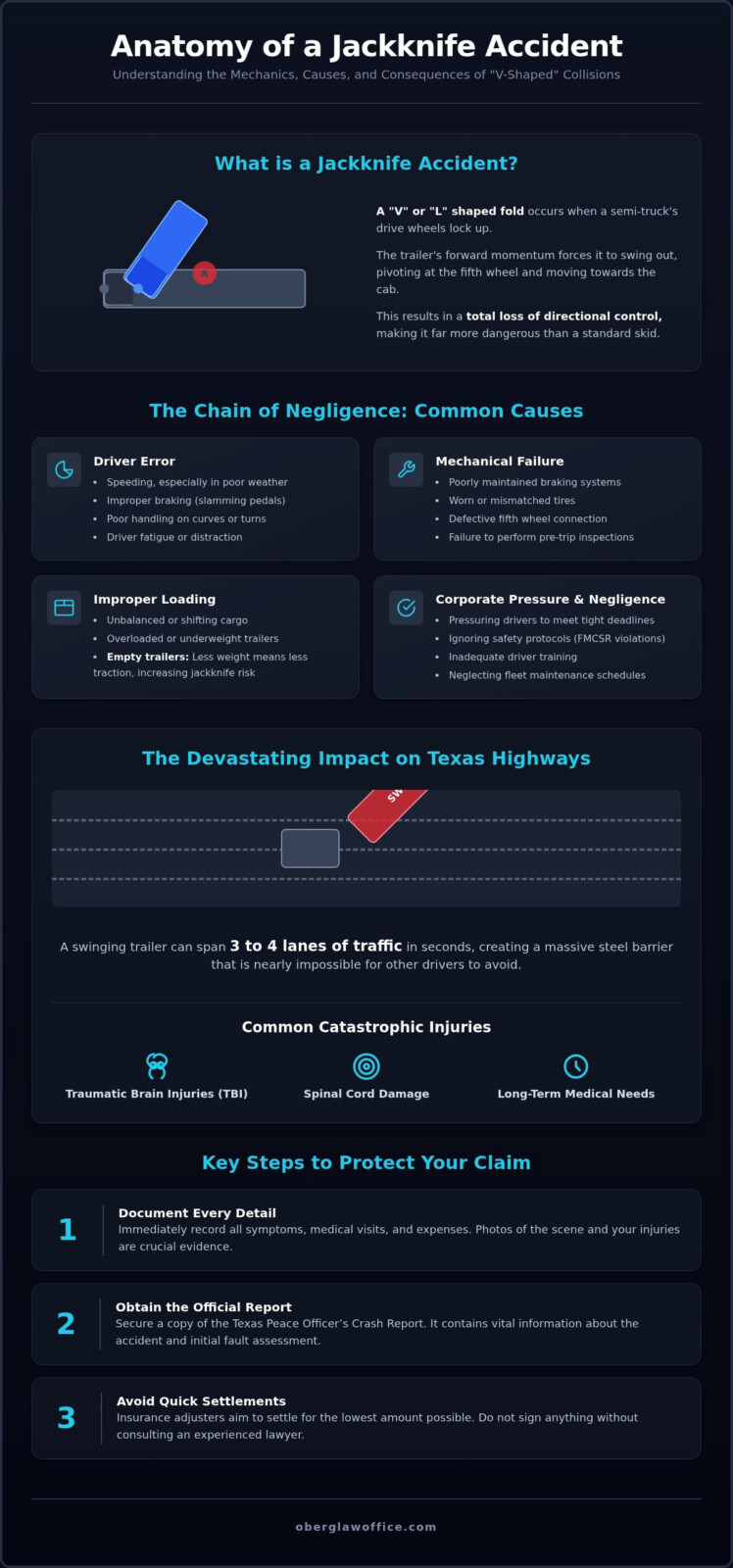
A jackknife accident occurs when the drive wheels of a semi-truck tractor lock up while the trailer continues its forward momentum. This creates a dangerous folding motion where the trailer swings toward the cab at an acute angle. To understand the legal and mechanical complexities involved, one must first ask: What is a Jackknife Accident? Unlike a standard skid where a vehicle simply slides in a straight line, a jackknife involves a total loss of directional control of the trailer. In legal terms, this distinction is vital. A simple skid might be attributed to road conditions, but a true jackknife often points to improper braking techniques or poorly maintained equipment. If you’ve been caught in the path of one of these folding trailers, a jackknife accident lawyer texas can help you investigate the specific mechanical failures that led to the crash.
Texas highways are high-risk zones for these specific 18-wheeler accidents due to the sheer volume of commercial traffic and our varied weather conditions. Whether it’s a sudden rainstorm in Houston or heavy winds in West Texas, truck drivers must adjust their behavior to prevent the trailer from swinging out of its lane. When they fail to do so, the truck forms a “V” or “L” shape that creates a multi-lane hazard. This positioning makes it nearly impossible for other drivers to avoid a collision, turning a single driver’s mistake into a pile-up involving several vehicles.
The Physics of a Jackknife Crash
Semi-trucks are articulated vehicles, meaning they’re joined at a pivot point called the fifth wheel. When a driver slams on the brakes too hard or handles a curve poorly, the friction between the tires and the road is lost. Momentum takes over. Surprisingly, empty trailers are often more dangerous than fully loaded ones. Without the heavy weight of cargo to press the tires firmly against the pavement, the trailer can easily lose traction and begin to swing out. Once that pivot begins at the fifth wheel, the driver is often powerless to stop it. This loss of stability is a primary reason why we look closely at maintenance records for the braking system.
Why Jackknife Accidents are Catastrophic
The “sweep area” of a swinging trailer is what makes these wrecks so devastating on Texas highways like I-35 or I-10. A trailer can span three or four lanes of traffic in seconds, acting like a massive steel barrier that oncoming cars cannot avoid. High-speed jackknifes result in high-impact collisions that often lead to catastrophic injuries such as traumatic brain injuries or spinal cord damage. Even at lower speeds, the sheer mass of an 18-wheeler can crush smaller passenger vehicles. A dedicated jackknife accident lawyer texas understands that these injuries require long-term care and significant financial recovery. We focus on uncovering the truth behind the crash to ensure you aren’t left holding the bill for a trucking company’s negligence.
The Mechanics of Negligence: Why Do Semi-Trucks Jackknife?
Negligence on the road is rarely a single mistake; it’s usually a chain of failures that ends in a catastrophic collision. While a trucking company might claim the wind or a slick road caused the trailer to swing, the truth is often found in driver behavior or mechanical neglect. Speeding is a primary factor. When a driver travels too fast for Texas weather conditions, they lose the ability to brake safely. Improper braking, such as slamming the pedals instead of feathering them, can lock the tractor’s drive wheels while the trailer’s momentum continues forward. This loss of control is a hallmark of many truck accident causes that could have been prevented with proper training.
We also see a “Cowboy” culture in some trucking fleets where companies pressure drivers to ignore safety protocols to meet tight deadlines. This pressure leads to cutting corners on vehicle maintenance and cargo loading. An unbalanced load shifts the center of gravity, making the trailer much more likely to pivot during a sharp turn or sudden stop. Partnering with a jackknife accident lawyer texas allows you to dig into these corporate records and prove that the crash wasn’t an “accident,” but a predictable result of corporate greed. If you’re feeling overwhelmed by the aftermath of a crash, reaching out for a free strategy session can provide the clarity you need to move forward.
Federal Motor Carrier Safety Regulation (FMCSR) Violations
The Federal Motor Carrier Safety Regulations (FMCSR) serve as the “safety bible” for interstate trucking. When companies violate these rules, they put everyone on the road at risk. Fatigue is a major issue; drivers who violate hours-of-service (HOS) rules lack the reaction time to prevent a jackknife. New 2026 mandates have increased civil penalties for willfully falsifying inspection reports to as much as $19,000 per violation. These stricter digital trail requirements for electronic Driver Vehicle Inspection Reports (DVIRs) make it harder for companies to hide the fact that they skipped essential brake inspections before the truck hit the road.
Environmental and Roadway Factors
Texas roads present unique challenges, from flash floods to steep grades. Hydroplaning is a common trigger for jackknifing when the tractor loses grip but the trailer maintains its speed. Drivers also struggle with downhill grades, where the improper use of engine brakes, also known as Jake brakes, can cause the wheels to slide on slick surfaces. In some cases, negligent road maintenance by a government entity or contractor contributes to the loss of control. We look at every factor, from the pavement quality to the driver’s logbooks, to ensure every responsible party is held accountable for your recovery.
Determining Liability in a Texas Jackknife Accident
Determining who pays for your recovery after a crash depends on unraveling a complex web of responsibility. In many cases, several parties share the blame. Texas follows a modified comparative negligence rule, which means you can still recover damages as long as you aren’t found to be more than 50% at fault for the collision. However, your total compensation is reduced by your percentage of responsibility. This is why trucking insurance companies work so hard to shift the blame onto you. An experienced jackknife accident lawyer texas understands these tactics and builds a case based on hard evidence to protect your right to full restoration.
Most claims rely on the concept of vicarious liability. This legal principle holds trucking companies responsible for the actions of their employees while they’re on the job. To avoid this, many companies try to label their drivers as “independent contractors.” They do this to distance themselves from the driver’s negligence and protect their bottom line. We look past these labels to see who actually controlled the driver’s schedule, equipment, and routes. According to FMCSA jackknife accident statistics, these events are a major factor in crashes involving significant property damage and serious injuries, making it vital to identify every pocket of insurance coverage available.
Can the Trucking Company Be Held Directly Liable?
Beyond the driver’s actions, the company itself may be directly negligent. Negligent hiring occurs when a carrier puts a driver behind the wheel who has a history of safety violations or reckless driving. If the driver wasn’t properly trained to handle a pivot or recover from a skid, that’s negligent training. We also scrutinize maintenance logs. If the company ignored repeated warnings about worn brake pads or thinning tire treads, they’ve prioritized profits over your safety. Proving these systemic failures is often the key to securing a settlement that truly covers your long-term needs.
Product Liability: When the Truck Itself Fails
Sometimes the failure starts at the factory. Defective braking systems or steering components can cause a tractor to lock up even when a driver does everything right. In these instances, the manufacturer of the truck or a specific part may be held liable. We also look at the role of the trailer manufacturer, especially regarding underride protection failures that often occur when a trailer swings across traffic lanes. A knowledgeable truck accident lawyer investigates whether a manufacturing defect turned a bad situation into a fatal one. We work with mechanical experts to inspect the wreckage and find the “smoking gun” in the machinery.
Steps to Protect Your Claim After a Texas Jackknife Crash
In the chaotic moments following a jackknife collision, your world likely feels like it’s spinning. While you’re dealing with the shock and physical pain, the trucking company is already moving to protect its interests. You must take immediate steps to safeguard your future. Your first priority is always medical care. Even if you feel okay, some internal injuries or spinal issues don’t show symptoms right away. Documenting every ache and pain from day one creates a medical paper trail that insurance adjusters cannot easily dismiss. Next, ensure you call the police. You need a formal Texas Peace Officer’s Crash Report to establish an official record of the event.
If you’re physically able, gather as much evidence as possible at the scene. Take clear photos of the trailer’s position, the truck’s logos, and any skid marks on the pavement. These marks tell the story of the driver’s braking patterns. Most importantly, do not speak with insurance adjusters before consulting an attorney. They’re trained to lead you into statements that could damage your case. Hiring a jackknife accident lawyer texas early allows for the immediate delivery of a spoliation letter. This legal notice prevents the trucking company from destroying or altering critical evidence like the truck itself or digital logs.
If you’re ready to take control of your recovery, contact us today for a free strategy session to discuss your legal options.
The “Black Box” and Digital Evidence
Modern 18-wheelers are equipped with an Electronic Control Module (ECM), often called a “black box.” This device records speed, braking patterns, and even steering angles at the time of impact. We also look at Electronic Logging Devices (ELD) to check for hours-of-service violations. Under the 2026 FMCSA digital trail requirements, these records are more difficult to falsify, but they can still be lost if not preserved quickly. GPS data and dashcam footage provide a digital reconstruction of the accident that often contradicts the driver’s version of events.
Preserving Physical Evidence
The truck itself is a goldmine of evidence. It must be inspected by an independent expert before the trucking company has a chance to repair or scrap it. We analyze tire tread depth and brake pad thickness to look for signs of maintenance neglect. These physical details prove whether the carrier was cutting corners on safety. We also prioritize gathering witness statements while their memories are still fresh. A bystander’s perspective can be the deciding factor in proving that the trailer’s swing was caused by driver error rather than unavoidable road conditions.
How Oberg Law Office Fights for Your Recovery
Facing a massive trucking corporation is intimidating. You shouldn’t have to do it alone. With over 25 years of experience in Texas personal injury law, Gregg Oberg has seen how these companies try to dodge responsibility after a wreck. We act as your steadfast protector throughout the entire legal process. When you choose our firm, you aren’t just another case file handed off to a paralegal. You’ll work directly with Gregg. This personalized advocacy ensures that your specific story is heard and that every detail of your case is handled with senior-level expertise by a dedicated jackknife accident lawyer texas.
We believe everyone deserves access to high-quality legal representation regardless of their current financial situation. That’s why we operate on a contingency fee basis. We don’t get paid unless we win your case. This shared risk means we’re personally invested in your success. We handle the aggressive negotiations with insurance giants who are notorious for pushing lowball settlements. Our goal is to secure the maximum compensation possible by working with a jackknife accident lawyer texas who isn’t afraid to take on the giants. We want you to focus on your family while we focus on the fight.
What Compensation Can You Recover?
Victims often wonder what their case is worth after such a devastating event. Economic damages cover your tangible losses like medical bills, future rehabilitation costs, and lost earning capacity if you can’t return to work. Non-economic damages address the human side of the tragedy. This includes pain and suffering, emotional distress, and the loss of enjoyment of life. In rare cases where a trucking company’s behavior was “grossly negligent,” we may also pursue punitive damages. These are designed to punish the offender and prevent other companies from making the same dangerous choices in the future.
Start Your Journey to Justice Today
The road to recovery starts with a single conversation. We offer a free initial strategy session to help you understand your rights without any pressure or cost. Our team takes over the mountain of paperwork and complex legal filings so you can focus entirely on your physical and emotional healing. You’ve been through enough stress already. Let us carry the legal burden for you and fight for the restoration you deserve. Schedule your free consultation with Oberg Law Office today and take the first step toward justice.
Take the First Step Toward Your Recovery
You’ve seen how a single moment on a Texas highway can lead to a lifetime of physical and financial challenges. From the complex physics of a trailer swing to the corporate neglect that often causes it, the path to justice is rarely straightforward. You don’t have to navigate the maze of federal regulations and aggressive insurance adjusters on your own. Partnering with a dedicated jackknife accident lawyer texas ensures that your rights are protected while you focus on what matters most: your health and your family.
At Oberg Law Office, we bring over 25 years of Texas legal experience to your side. We operate on a contingency fee basis, which means there’s no recovery and no fee for you. You’ll work directly with senior attorney Gregg Oberg, receiving the personalized advocacy you deserve. Don’t let a trucking company’s negligence dictate your future. Contact Oberg Law Office for a Free Strategy Session today. We’re ready to stand as your steadfast protector and fight for the full compensation you need to move forward with confidence.
Frequently Asked Questions
How long do I have to file a jackknife accident lawsuit in Texas?
You generally have two years from the date of the collision to file a personal injury lawsuit in Texas. This deadline is strictly enforced under Texas Civil Practice and Remedies Code § 16.003. If you miss this window, you lose your right to seek compensation forever. It’s vital to start your case early so your legal team can secure evidence before it disappears or is destroyed by the trucking company.
What if the truck driver claims the accident was caused by bad weather?
Bad weather is rarely a valid excuse for a jackknife crash because federal regulations require drivers to use extreme caution in hazardous conditions. Truckers are trained to reduce their speed or pull over entirely when rain, ice, or wind makes the road unsafe. If a driver chose to stay on the road and failed to adjust their driving, the weather actually helps prove their negligence rather than excusing it.
Can I still recover compensation if I was partially at fault for the accident?
Yes, you can still recover damages as long as you are not more than 50% responsible for the crash. Texas follows a modified comparative fault rule, which means your total compensation is reduced by your percentage of fault. For example, if a jury finds you were 20% responsible, you would still receive 80% of the awarded damages. We work hard to minimize your fault and maximize your recovery.
How much does it cost to hire a jackknife accident lawyer in Texas?
Most people can afford a jackknife accident lawyer texas because we work on a contingency fee basis. This means you don’t pay any hourly rates or upfront costs out of your own pocket. Our firm only receives a fee if we successfully win a settlement or jury award for you. This structure allows you to focus on your physical recovery without worrying about the cost of high-quality legal representation.
Who is responsible if the truck driver was an independent contractor?
Trucking companies often use the “independent contractor” label to try to dodge responsibility, but federal law often holds them liable regardless of the driver’s employment status. We look at the reality of the relationship, such as who owned the truck and who controlled the driver’s schedule. In many cases, the company that hired the driver is still vicariously liable for the damages caused by that driver’s negligence.
What is a spoliation letter and why is it critical in a truck accident case?
A spoliation letter is a formal legal notice that orders the trucking company to preserve all evidence related to the accident. This includes the truck itself, maintenance records, and digital data. Without this letter, companies may repair the vehicle or delete electronic logs that prove they were at fault. Sending this letter immediately after you hire us is one of the most effective ways to protect your claim.
What kind of evidence is found in a truck’s “black box”?
The truck’s Electronic Control Module, or black box, records technical data from the moments leading up to the impact. This includes the truck’s exact speed, when the driver hit the brakes, and even the steering angle. This objective data is incredibly difficult for the trucking company to dispute. It often provides the “smoking gun” evidence needed to prove that driver error or mechanical failure caused the trailer to pivot.
Will my jackknife accident case have to go to court?
Most truck accident claims are settled through negotiations before a trial ever begins. Settlement is often faster and less stressful for you and your family. However, we prepare every case as if it is going to court. This level of preparation shows the insurance company that we are serious and won’t accept a lowball offer. If they refuse to offer a fair settlement, we are fully ready to fight for you in front of a jury.