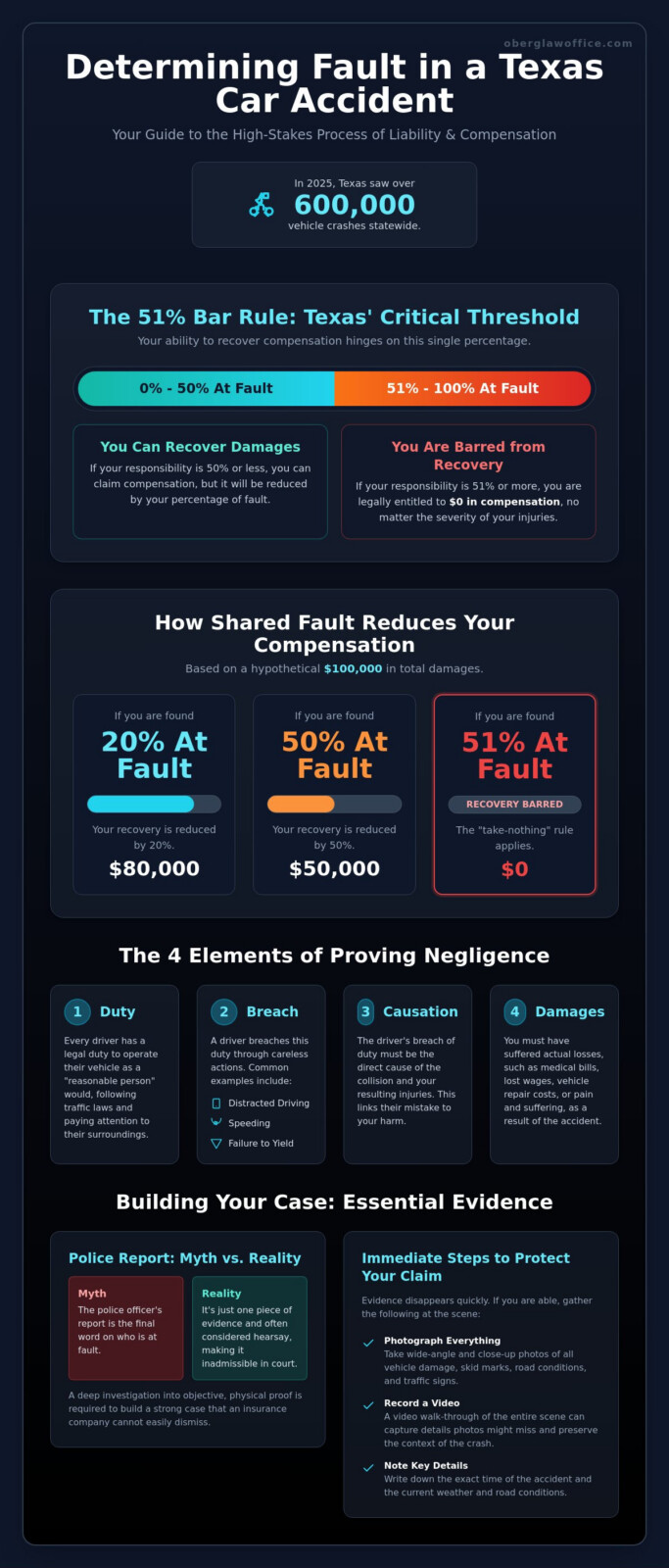
A police officer’s report is not the final word on who caused your collision. If you’re currently staring at a stack of medical bills while an insurance adjuster ignores your messages, you aren’t alone. Many neighbors feel the same anxiety when they realize that determining fault in a Texas car accident is a complex process where the insurance company’s bottom line often comes before your well-being. With over 600,000 crashes occurring across our state in 2025, it’s clear that the road to recovery is crowded with people just like you who deserve a fair shake and a clear path forward.
We understand that you’re looking for more than just legal advice; you’re looking for a way to restore your security and your peace of mind. This 2026 guide will help you master the complexities of state liability laws so you can protect the compensation you need to move forward. We’ll explain the 51% bar rule in plain English, provide a checklist of evidence you should gather immediately, and give you the confidence to challenge a liability denial. You don’t have to face the insurance companies by yourself, and you certainly don’t have to accept an unfair share of the blame for an accident you didn’t cause.
Key Takeaways
- Understand the 51% bar rule and why keeping your level of responsibility below this threshold is vital for securing your financial recovery.
- Learn how deep investigations into evidence like cell phone records and EDR data play a central role in determining fault in a texas car accident.
- Identify the specific tactics insurance adjusters use to shift blame and discover how to navigate recorded statements without compromising your rights.
- Gain a clear perspective on how liability shifts in complex scenarios, from multi-car chain reactions to accidents involving commercial trucking companies.
- Discover how a dedicated legal partner uses their investigative advantage to challenge a liability denial and restore your sense of security.
Understanding Texas Modified Comparative Negligence: The 51% Rule
Texas operates under a legal doctrine known as modified comparative negligence. This system is different from “pure” negligence states, where you could be 99% responsible and still collect a tiny sliver of your damages. In our state, the law is designed to be fair but firm. It acknowledges that many collisions aren’t strictly one-sided. Sometimes, both drivers made a small mistake that contributed to the crash. However, Texas sets a hard limit on who can seek financial recovery, and understanding this limit is the first step toward protecting your future.
This limit is widely called the “51% Bar.” It serves as a legal wall. If a jury or an insurance adjuster decides you are 51% or more responsible for the accident, you are legally barred from recovering any compensation at all. It doesn’t matter if your medical bills are astronomical or if the other driver was also careless. Being 50% at fault is the “golden threshold” for recovery. At exactly 50%, you can still collect half of your damages. Once you cross into 51%, you get nothing. This is why determining fault in a texas car accident is such a high-stakes battle. Insurance companies will fight tooth and nail for even a 5% shift in blame because it can save them millions of dollars in payouts across thousands of claims.
The Math of Shared Fault
Numbers tell the story of how your settlement changes based on your level of responsibility. Imagine your total losses, including hospital stays and lost wages, equal $100,000. If you are found 20% at fault because you were slightly over the speed limit, your final check is reduced by 20%, leaving you with $80,000. If that fault percentage climbs to 40%, you only receive $60,000. Under the Texas Civil Practice and Remedies Code, a claimant may not recover damages if his percentage of responsibility is greater than 50 percent. This “take nothing” rule is the primary reason adjusters try to pin even minor infractions on you.
The Legal Duty of Care on Texas Roads
To prove the other driver was responsible, we must establish they were negligent. This process involves four specific elements: Duty, Breach, Causation, and Damages. Every person behind the wheel has a legal duty to act as a “Reasonable Person” would. This standard asks what a careful, attentive driver would do in your specific situation. When determining fault in a texas car accident, we look for clear breaches of this duty. Common examples include:
- Distraction: Looking at a phone instead of the road.
- Speeding: Driving too fast for weather or traffic conditions.
- Failure to Yield: Ignoring right-of-way rules at intersections.
When a driver fails this duty and causes you harm, they should be held accountable. We are here to make sure the focus stays on their mistakes, not yours.
Essential Evidence: How Fault is Actually Proven in 2026
Evidence is the foundation of any claim, but it’s incredibly fragile. It disappears the moment the tow truck arrives or the rain washes away a skid mark. When determining fault in a texas car accident, many people assume the police officer’s report is the final word. In reality, it’s just one piece of a much larger puzzle. While a crash report provides a helpful summary, it is often inadmissible in court because it’s considered hearsay. This means you cannot always rely on an officer’s opinion to win your case. You need a deeper investigation that looks at the physical facts of the crash.
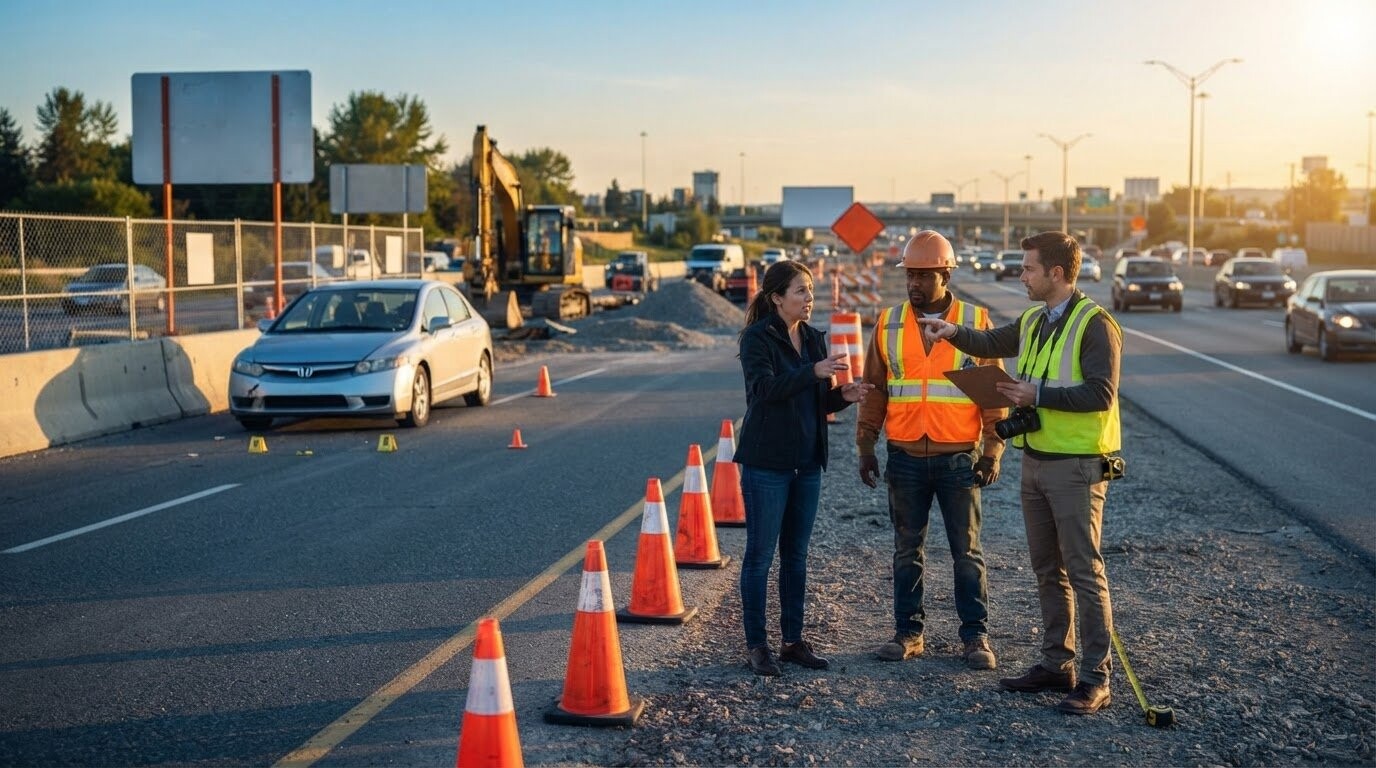
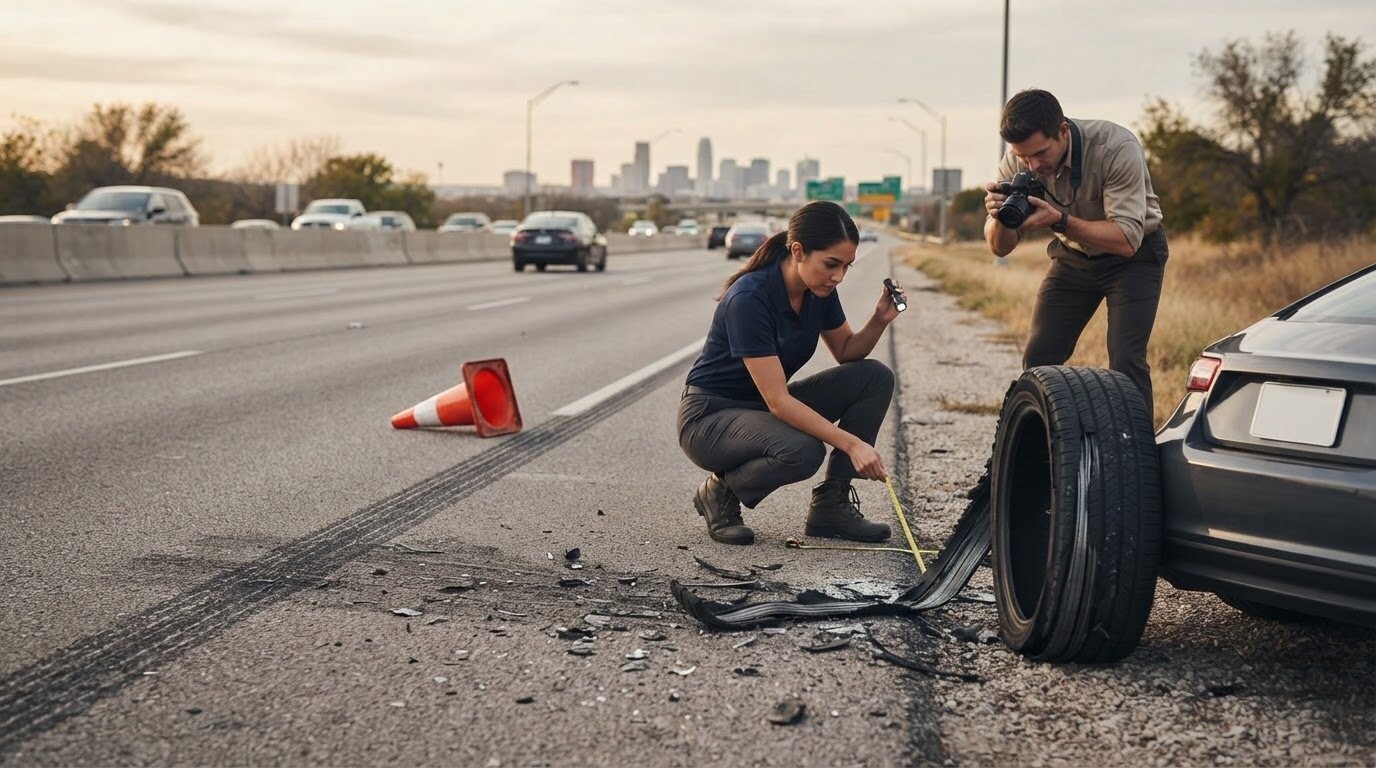
The hierarchy of evidence favors data that cannot lie. Understanding how fault is established in a car accident lawsuit involves looking at objective proof first. This is why we often bring in accident reconstruction experts. These professionals use physics to calculate speed and impact angles based on vehicle damage and road marks. They provide a level of scientific certainty that an insurance adjuster cannot easily dismiss. If you find yourself overwhelmed by conflicting accounts, discussing your case with a professional can help you identify the strongest points of your claim. To protect your rights at the scene, always try to:
- Take wide-angle and close-up photos of all vehicle damage.
- Photograph road conditions, skid marks, and traffic signs.
- Record a video walk-through of the entire accident scene.
- Note the exact time and current weather conditions.
Modern Tech: EDRs, Dashcams, and Telematics
Your vehicle is smarter than you might think. Most modern cars are equipped with an Event Data Recorder (EDR), also known as a “black box.” This device records critical data like your speed, braking force, and steering angles in the seconds before impact. We also see an increasing reliance on dashcam footage and smartphone telematics. This digital evidence is vital for rebutting “he-said, she-said” arguments and proving whether a driver was distracted by their phone at the time of the collision. These records provide a transparent view of the events that led to the crash.
The Power of Witness Testimony
While tech is powerful, human testimony still matters. Neutral third-party witnesses, like people in other cars or pedestrians, are far more credible than the occupants of your own vehicle. We also look for surveillance footage from nearby businesses or residential Ring cameras. Securing this contact information and video early is essential because many systems overwrite their data within days. By gathering these diverse pieces of proof, we build a comprehensive picture that makes determining fault in a texas car accident much clearer for a jury or an adjuster.
Why Insurance Adjusters Try to Shift Blame (and How to Fight Back)
Insurance adjusters often sound neighborly on the phone, but they aren’t your friends. Their primary goal is to minimize their company’s financial exposure, which means paying you as little as possible. They often use a strategy known as “Delay, Deny, Defend.” By delaying your claim, they hope you’ll grow desperate under the weight of medical bills. By denying liability, they force you to fight for every penny. When determining fault in a texas car accident, an adjuster might offer you a partial settlement, such as 70% of your damages. If you accept this, you’re essentially admitting you were 30% to blame, which can cost you thousands of dollars you deserve for your recovery.
You have the right to challenge these tactics. Adjusters rely on the fact that most people don’t know the intricacies of the law. They might use confusing language to make you feel like your case is weak, but remember that their assessment isn’t the final word. We see this every day; a “final” denial is often just the beginning of a successful negotiation when you have the right evidence to back you up.
The Danger of the Recorded Statement
You aren’t legally required to provide a recorded statement to the other driver’s insurance company. These recordings are designed to “trick” you into admitting fault. An adjuster might ask leading questions or catch you while you’re still shaken up or on pain medication. Even an innocent phrase like “I’m sorry” can be twisted into a legal admission of guilt. The best way to decline a recorded statement request is to politely inform the adjuster that you’ll provide a written statement through your legal representative once you’ve had time to fully review the facts of the accident.
Challenging a Liability Denial
Receiving a formal denial letter can be overwhelming, but it doesn’t mean your case is over. You can reopen a claim by presenting a supplemental police report or new witness testimony that the adjuster overlooked. A strong demand letter is often the most effective way to force a re-evaluation of your case. This letter outlines the evidence and applies Texas proportionate responsibility laws to show exactly why the other driver is at fault. When an insurance company realizes you’re prepared to prove your case using the state’s own legal standards, they’re much more likely to offer a fair settlement. Determining fault in a texas car accident is about facts and advocacy, not just accepting the first answer an insurance company gives you.
Determining Liability in Complex Texas Car Accidents
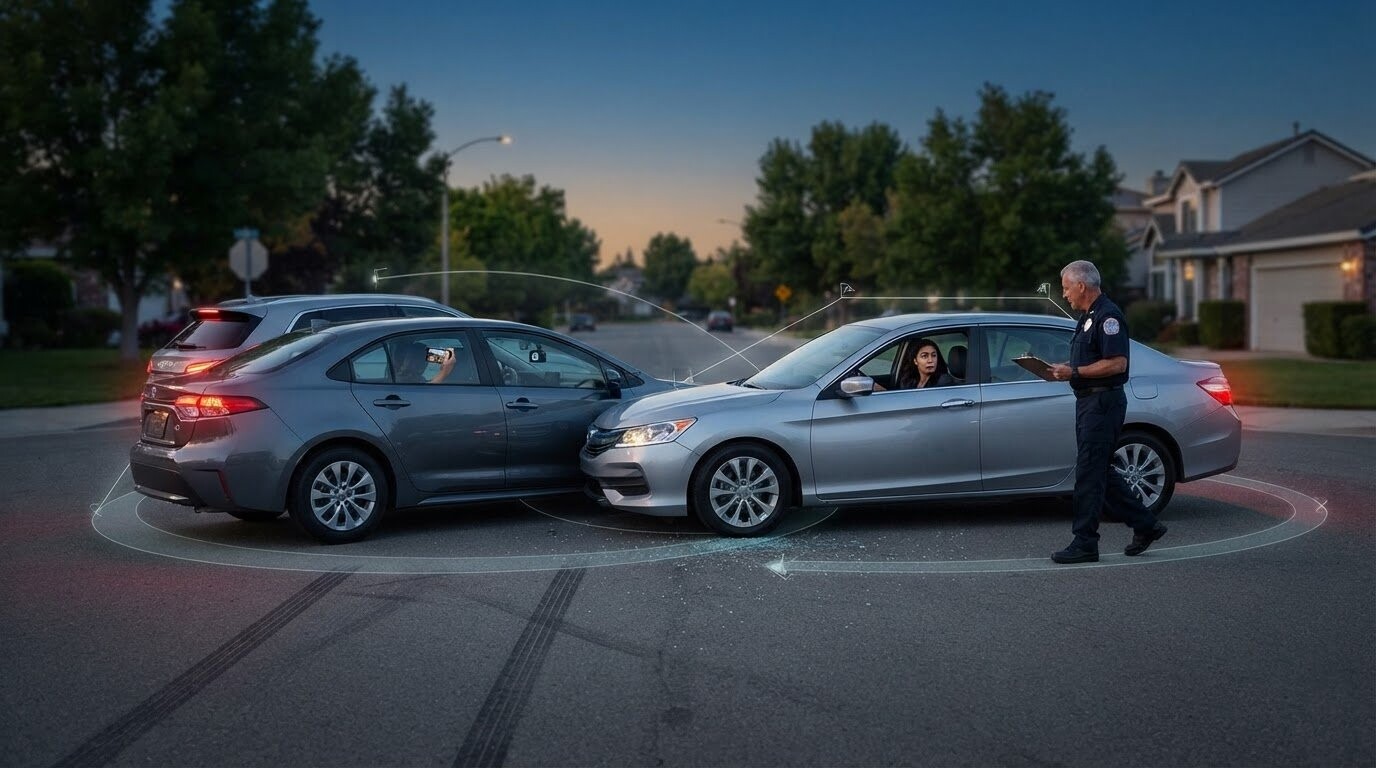
Simple two-vehicle collisions are difficult enough, but when you’re caught in a multi-car pileup, the situation becomes a puzzle with many moving parts. In these chain-reaction crashes, determining fault in a texas car accident isn’t always as simple as looking at the car directly behind you. Liability is often distributed among several drivers based on who triggered the initial impact or who failed to maintain a safe following distance. Each driver’s insurance company will try to point the finger at someone else, which can leave you feeling caught in the middle of a never-ending dispute.
Commercial crashes bring an even heavier layer of complexity because of the corporate interests involved. If you were hit by a delivery van, a semi-truck, or a service vehicle, the driver’s employer might be legally responsible for your medical bills and lost wages. This involves navigating the vicarious liability texas framework, which holds companies accountable for the negligence of their staff. Similarly, rideshare accidents involving Uber or Lyft require an understanding of their three-tier insurance system. Coverage amounts change depending on whether the driver was waiting for a match, heading to a pickup, or currently transporting a passenger.
We also see many cases where people assume the “larger vehicle” is automatically at fault, especially in pedestrian or bicycle accidents. This is a common myth. While drivers have a high duty of care, Texas law still examines the actions of the pedestrian or cyclist. If someone crossed against a light or a cyclist swerved into traffic, they could be found partially responsible. Protecting your recovery means looking at the facts from every angle to ensure the right parties are held accountable.
Vicarious Liability and Corporate Negligence
When an employee causes a crash while performing work duties, the legal doctrine of Respondeat Superior typically applies. This means the company is responsible for the damages. We also look for “negligent entrustment,” which happens if a vehicle owner allows someone to drive despite knowing they have a dangerous history of collisions or impairments. If a corporate vehicle was involved in your crash, speak with our experienced attorneys to explore every available source of compensation.
The “Sudden Emergency” Defense
Sometimes, a driver will try to escape fault by claiming a “sudden emergency,” such as an unexpected medical event or a mechanical failure. Texas courts set a very high bar for this defense. It isn’t enough to just say the brakes failed; the driver must prove the failure was totally unforeseeable. We often debunk these claims by subpoenaing maintenance records to show that the “emergency” was actually the result of poor vehicle upkeep. Determining fault in a texas car accident requires this level of detailed investigation to prevent negligent drivers from hiding behind excuses.
How a Personal Injury Attorney Protects Your Rights and Recovery
Facing a multi-billion dollar insurance company alone is an uphill battle. They have teams of adjusters and lawyers whose primary goal is to protect their company’s bottom line. You deserve a steadfast protector who is personally invested in your restoration. We level the playing field by providing the professional authority and investigative resources you need to challenge unfair blame. Determining fault in a texas car accident isn’t just about what’s in the police report; it’s about the evidence we uncover through deep forensic investigation.
Our investigative advantage is significant. While an insurance company might try to brush off your account of the crash, they cannot ignore hard data. We use legal subpoenas to secure cell phone records that can prove the other driver was distracted at the moment of impact. We also pull data from “Black Box” Event Data Recorders (EDRs) to show exactly when a driver hit the brakes or how fast they were traveling. These are technical steps that most individuals cannot handle on their own, but they’re essential for building an undeniable case.
We also look at the big picture of your recovery. An insurance adjuster only cares about the medical bills you’ve already received. We work with medical experts to calculate your future needs, including long-term physical therapy or potential surgeries. Because we operate on a performance-based fee structure, you don’t have to worry about upfront costs. We share the risk with you; this means we’re fully committed to securing the maximum compensation possible for your injuries.
From Investigation to Litigation
Building a “trial-ready” case from day one is the most effective way to secure a fair settlement. When an insurance company realizes that your car accident lawyer is prepared to take the matter to court, their willingness to negotiate often increases. Filing a lawsuit signals that you won’t be bullied into accepting a lowball offer. Having an experienced advocate by your side prevents you from settling for less than you truly deserve to cover your losses and secure your family’s future.
Your Path to Recovery Starts with a Strategy Session
You don’t have to navigate this stressful process by yourself. At the Oberg Law Office, we provide the personalized, neighborly attention you need during this difficult time. You’ll interact directly with senior professionals who will guide you through every step of the legal journey. We’re here to reduce your anxiety and move you from a state of uncertainty to a feeling of empowerment. Schedule your free accident strategy session today with Oberg Law Office to begin your journey toward justice and restoration.
Take the First Step Toward Your Restoration
You’ve learned that the 51% bar rule and aggressive insurance tactics don’t have to be the final word on your claim. Determining fault in a texas car accident is a technical battle, but it’s one you can win with the right evidence and a steadfast protector by your side. Whether you’re navigating the aftermath of a multi-car pileup or a complex commercial truck collision, your priority should be your physical and emotional healing while we handle the legal heavy lifting.
Gregg Oberg brings over 25 years of Texas legal experience to your side. You’ll enjoy direct access to a senior attorney who is personally invested in your case, not just a support staff member. Our contingency-based fee structure means you pay nothing unless we win, ensuring that expert legal help is accessible to everyone in our community. We’re here to level the playing field and hold multi-billion dollar institutions accountable for the harm they’ve caused.
Contact Oberg Law Office for a Free Case Review today. Let’s work together to restore your security and get you the compensation you need to move forward with confidence.
Frequently Asked Questions
Can I still get compensation if the police report says I was at fault?
Yes, you can still pursue a claim. A police report is simply one officer’s opinion based on the information they had at the scene, and it isn’t the final legal word on liability. In many cases, these reports are actually inadmissible in court because they’re considered hearsay. Our team often uses accident reconstruction and vehicle data to challenge an officer’s initial findings and show what really happened.
What happens if the other driver claims I was speeding?
An accusation is not the same as proof. If the other driver tries to shift blame by claiming you were speeding, they must provide evidence to back it up. We can often rebut these claims by downloading your vehicle’s Event Data Recorder (EDR) information, which shows your exact speed in the seconds before the impact. Even if you were traveling slightly over the limit, you can still recover damages as long as the other driver was more responsible than you were.
How long does it take for an insurance company to determine fault in Texas?
Most insurance adjusters try to make a liability decision within 30 days of the crash. However, this timeline can stretch much longer if the accident involved multiple vehicles or if the evidence is complex. If you feel the insurance company is intentionally delaying your claim to pressure you into a lower settlement, having a legal advocate can help push the process forward and hold them accountable to state deadlines.
Does Texas follow a “no-fault” insurance system?
No, Texas is a traditional “fault” state. This means the person who caused the collision is financially responsible for the resulting injuries and property damage. Because of this, determining fault in a texas car accident is the most critical step in your case. Unlike no-fault states, you must prove the other driver’s negligence before their insurance company will pay for your medical bills or lost wages.
What if there were no witnesses to my car accident?
Physical evidence often speaks louder than a witness ever could. When no one else was around to see the crash, we look for “silent witnesses” like nearby business surveillance cameras, Ring doorbells, or dashcam footage. We also analyze skid marks, vehicle crush patterns, and debris fields to scientifically recreate the collision. These objective facts are much harder for an insurance company to argue against than a person’s potentially flawed memory.
Can I sue the other driver even if I was 40% responsible for the crash?
Yes, you are still entitled to seek compensation under the state’s modified comparative negligence laws. As long as your share of the responsibility is 50% or less, you can recover your damages. If you are found 40% at fault, your final settlement check will simply be reduced by that same 40%. It’s only when you cross the 51% threshold that you are legally barred from receiving any recovery at all.
What should I do if the other driver’s insurance company calls me for a statement?
You should politely decline the request and end the call. You have no legal obligation to provide a recorded statement to the other driver’s insurance provider, and they often use these recordings to “trap” you into admitting fault. The safest path is to tell the adjuster that your attorney will provide all the necessary information. This protects you from having innocent comments twisted and used against you later in the process.
How is fault determined in a rear-end collision in Texas?
In most cases, the driver who hits another vehicle from behind is presumed to be at fault for following too closely or failing to pay attention. However, this isn’t an absolute rule. If the lead driver had non-functioning brake lights or suddenly swerved into your lane without signaling, they may share the blame. Determining fault in a texas car accident involving a rear-end impact requires a careful look at the actions of both drivers to ensure the responsibility is placed fairly.
Watch: when the report gets it wrong
A real Texas case where the crash report blamed the wrong driver — What If the Police Report Says the Crash Was Your Fault? (6:56).