
In 2024, Texas recorded 39,393 commercial vehicle crashes, a staggering number that represents thousands of lives changed in an instant. If you’ve been caught in the middle of one of these collisions, you’re likely facing massive medical debt and the pressure of aggressive insurance adjusters. You’re probably asking, how is fault determined in a truck accident in texas? It’s a complex question because the driver is rarely the only party involved. While you focus on your recovery, trucking companies often deploy “rapid response teams” to the scene to protect their own interests, making the legal process feel stacked against you.
We believe you shouldn’t have to face a massive corporation alone. It’s frustrating to deal with the overlap of federal regulations and state laws while trying to heal, but you have the right to hold every negligent party accountable. This 2026 guide will give you clarity on the modified comparative fault rule and help you identify all possible sources of compensation, from the carrier to the cargo loader. We’ll preview the essential evidence needed to build a formidable claim, ensuring you have the knowledge and confidence to pursue the restoration you deserve.
Key Takeaways
- Learn how Texas law uses the concept of negligence to establish accountability and ensure the responsible party covers your damages.
- Discover why identifying every liable party-from the trucking company to cargo loaders-is essential for securing full compensation for catastrophic injuries.
- Understand how is fault determined in a truck accident in texas through the use of “black box” data and digital records that provide objective proof of carrier negligence.
- See how the 51% Bar Rule affects your claim and why you can still recover compensation even if you are found partially responsible for the crash.
- Find out how professional legal guidance helps you counter corporate rapid-response teams by leveraging specific nuances in the Texas Transportation Code.
What Does ‘Fault’ Mean in a Texas Truck Accident?
Texas operates under what’s called an “at-fault” insurance system. This means the person or company who caused your accident is the one responsible for paying for your recovery. When you’re dealing with the aftermath of a collision with an 18-wheeler, the stakes are much higher than a standard car wreck. You aren’t just fighting a driver; you’re often facing a massive corporation with its own legal team. To hold them accountable, we have to look at how is fault determined in a truck accident in texas through the lens of negligence. Negligence isn’t just a mistake. It’s a failure to exercise the reasonable care that a person of ordinary prudence would have used in the same situation.
In our state, fault is the legal determination that a party’s breach of duty was the proximate cause of the victim’s injuries. While car accidents usually focus on traffic light violations or simple speeding, truck accidents involve a complex web of federal and state safety standards. If a driver or their employer ignores these rules, they’ve failed in their duty to keep you safe on the road. Understanding this is the first step toward restoration and security. It’s about fairness for your family.
The Four Elements of Negligence
To build a successful claim, we must prove four specific things to establish that the other party was at fault. We look at the evidence to show:
- Duty of Care: Every truck driver and trucking company has a legal obligation to operate safely on our Texas highways.
- Breach of Duty: This happens when a driver speeds, stays behind the wheel too long, or gets distracted by a phone. It also applies if a company fails to maintain their fleet.
- Causation: We must show that the breach of duty, and not some other outside factor, directly caused the crash.
- Damages: This involves quantifying your medical bills, lost wages, and the emotional toll the accident took on your life.
Negligence Per Se in Trucking Cases
Sometimes, proving a breach of duty is more straightforward. Under the doctrine of “negligence per se,” if a driver violates a safety statute designed to protect the public, the law automatically considers that a breach of duty. The Federal Motor Carrier Safety Administration (FMCSA) sets strict rules for the industry. If we can prove the driver was hauling an overweight load or was driving over the legal hour limit, the burden of proof becomes much simpler for you. This process often leads into the concept of Texas modified comparative fault, which determines how much you can recover if multiple parties share the blame. By focusing on these specific violations, we can move your case from a state of uncertainty to a position of strength.
Beyond the Driver: Identifying Every Liable Party in a Commercial Wreck
Many people assume a truck accident is just a dispute between two drivers. In reality, these collisions often involve a chain of command and multiple corporate entities. If you’ve suffered a catastrophic injury, identifying every possible defendant isn’t just about legal technicality; it’s about making sure there’s enough insurance coverage to pay for your lifetime of medical care. Under the Texas Proportionate Responsibility Statute, a jury can assign a percentage of blame to several different parties. This makes the investigation much more intense than a standard fender-bender.
One of the most important tools we use is the “Respondeat Superior” doctrine. This legal rule generally holds a trucking company vicariously liable for the actions of their driver, provided the driver was working within the scope of their employment at the time of the crash. However, the company’s responsibility doesn’t always stop there. When we analyze how is fault determined in a truck accident in texas, we dig into the company’s internal records to see if they empowered a dangerous driver to be on the road in the first place. We want to ensure that every institution that prioritized profit over your safety is held accountable.
Direct vs. Vicarious Liability
Vicarious liability is about the driver’s mistake, but direct negligence is about the company’s own systemic failures. We often find evidence of “negligent hiring,” where a company ignored a driver’s history of safety violations, or “negligent training,” where they skipped essential safety briefings. Pursuing these direct claims is a powerful way to hold large institutions accountable. It highlights that the problem wasn’t just a single human error, but a corporate culture that ignored safety. If you are feeling overwhelmed by the complexity of your claim, seeking specialized truck accident representation can help you uncover these hidden layers of liability.
Third-Party and Manufacturing Fault
The Digital Smoking Gun: Technology Used to Prove Trucking Negligence
When you’re involved in a collision with a commercial vehicle, the scene can be chaotic and overwhelming. While witnesses might have different stories and police reports only capture a snapshot of the aftermath, the truck itself often holds the most reliable witness of all. Modern commercial trucks are essentially computers on wheels. They record a massive amount of data leading up to a crash, providing an objective account of the events that is much harder for defense attorneys to dispute than human memory. When investigating how is fault determined in a truck accident in texas, we prioritize securing this digital evidence before it disappears.
Electronic Control Module (ECM) data can reveal a truck’s exact speed, braking patterns, and throttle position at the moment of impact. This “black box” data is vital for proving that a driver was speeding or failed to hit the brakes in time. However, you must act quickly. Many trucking companies have short data retention windows, and some dashcam systems overwrite footage in as little as 14 to 30 days. We send a formal “spoliation letter” immediately to the carrier to legally require them to preserve this data. This step is a cornerstone of your path toward restoration, ensuring that the truth isn’t buried under a company’s standard data-wiping procedures.
Electronic Logging Devices (ELD) and Hours of Service
Fatigue is a leading cause of catastrophic accidents, and Federal trucking regulations strictly limit how many hours a driver can stay behind the wheel. Electronic Logging Devices (ELDs) automatically track a driver’s time, making it much harder to “cook the books” like the old paper logs. We analyze these logs for “form and manner” violations. These discrepancies often suggest a driver was being pressured by their employer to exceed legal limits to meet a deadline. When we find these patterns, it directly supports your claim that the company’s culture of cutting corners led to your injuries.
Dashcams and Fleet Management Software
Many fleets now use sophisticated management software and inward-facing dashcams to monitor their drivers. This technology can provide undeniable proof of distracted driving, such as cell phone usage or eating while operating the vehicle. GPS data from these systems can also show a history of reckless behavior, like frequent hard braking or consistent speeding on specific routes. We also look at secondary digital markers, such as weigh station records and toll booth timestamps, to verify the truck’s actual route and speed. This layers of evidence help us build a formidable case that focuses on facts and tangible results for your recovery.
Navigating Texas Modified Comparative Fault: The 51% Bar Explained
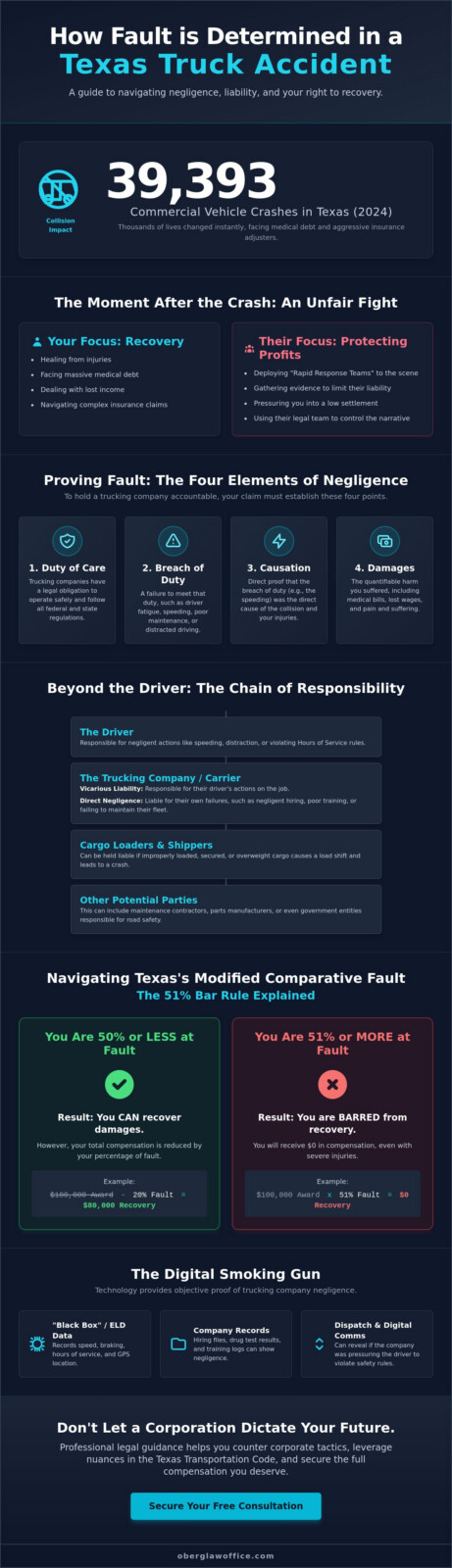
When you’re recovering from a crash with a commercial vehicle, it’s often a shock to hear insurance adjusters start pointing the finger at you. In our state, this isn’t just a tactic to frustrate you; it’s a calculated legal strategy. Texas follows a system known as “Modified Comparative Fault,” which is sometimes called the “51% Bar Rule.” This rule acts as a threshold for your ability to recover any money at all. If a jury or an insurance company can prove that you were 51% or more responsible for the accident, you are legally barred from receiving a single dollar in compensation. It’s a high-stakes “all or nothing” cliff that can determine the future of your financial security.
Understanding how is fault determined in a truck accident in texas requires looking at how these percentages are assigned. You can still recover damages even if you were partially responsible, but your final award will be reduced by your percentage of blame. Insurance companies are experts at “victim blaming” because every percentage point they can pin on you is money they get to keep. They’ll look for any small mistake you might have made to push your fault over that 51% line, effectively ending your claim. We believe this is fundamentally unfair to victims who are already suffering, and we work tirelessly to ensure the truth is told accurately.
How Percentages Reduce Your Recovery
The math of comparative fault is straightforward but carries heavy consequences. For example, if a jury decides your total damages are $100,000 but finds you 20% at fault for the collision, your final check is reduced to $80,000. These percentages aren’t pulled out of thin air; they are decided by a jury based on the evidence presented at trial. This is why having a truck accident lawyer texas is vital to your case. We present a clear, evidence-backed narrative to minimize your assigned fault and maximize your recovery. If you’re concerned about how an insurance company is framing your actions, reach out to us today for a conversation about protecting your rights.
Common Arguments Against Plaintiffs
Defense teams for large trucking corporations often use the “failure to avoid” argument. They claim you had the “last clear chance” to prevent the crash, even if the truck driver was the primary aggressor. They will scrutinize your vehicle maintenance records, your speed at the time of the impact, and even your cell phone records. Perhaps most dangerously, they use your own statements from the scene against you. A simple phrase like “I didn’t see him coming” can be twisted to suggest you weren’t paying attention to the road. We help you navigate these traps by focusing on the facts and ensuring the corporate parties are held to the high safety standards the law requires.
Taking Action: How Professional Advocacy Secures Your Recovery
Trucking companies are massive, billion-dollar entities. Within minutes of a crash, they often dispatch specialized “rapid-response teams” to the scene. These investigators work to gather evidence that protects the company’s bottom line, not your rights. This is why you need an advocate who understands the specific nuances of the Texas Transportation Code. We step in to level the playing field. When you’re trying to understand how is fault determined in a truck accident in texas, you shouldn’t have to worry about the cost of a legal battle. Our performance-based fee structure means you pay nothing upfront. We share the risk with you, which allows you to fight powerful insurers without added financial stress.
A personalized approach makes a world of difference. You aren’t just another file in a cabinet to us. By working directly with a senior professional, you ensure that your case receives the focused attention it requires for a fair restoration. This partnership is built on integrity and a genuine desire to help you face these significant challenges. We’re here to guide you from a state of uncertainty to a feeling of empowerment.
The Investigative Phase
Our process moves quickly to secure the facts. We hire accident reconstruction experts who use the physics of the crash to visualize exactly what happened on the road. We don’t just take the driver’s word for it. We subpoena driver qualification files and scrutinize company safety ratings from the FMCSA. This includes looking for a history of violations in the Safety Measurement System (SMS), which was overhauled throughout 2025 and 2026 to better track carrier safety. Our team also interviews witnesses and secures surveillance footage from nearby businesses before it’s overwritten or deleted.
Negotiation vs. Litigation
Most truck cases settle before they ever reach a courtroom. However, a favorable settlement only happens when the defense knows you’re ready for a fight. They need to see that your evidence is indisputable. A dedicated personal injury lawyer prepares every case as if it’s going to trial. This level of preparation provides the maximum leverage needed to secure a settlement that covers your medical debt and future needs. You deserve the peace of mind that comes from having a steadfast protector handle the insurance companies. While we navigate the legal complexities, you can focus entirely on your physical and emotional healing.
Secure Your Path to Restoration
Recovering from a commercial vehicle collision is a heavy burden to carry alone. You’ve learned that the answer to how is fault determined in a truck accident in texas involves more than just a police report; it requires a deep dive into corporate records and digital “black box” data. Whether it’s holding a cargo loader accountable or navigating the 51% Bar Rule, your recovery depends on a thorough investigation that looks beyond the driver’s seat. You deserve a partner who sees you as a person, not a case number, and who understands how to challenge the rapid-response tactics of large corporations.
Don’t let a trucking company dictate the value of your claim. With over 25 years of experience fighting for Texas accident victims, Gregg Oberg provides the direct, senior-level communication you need during this difficult time. We operate on a contingency basis, meaning there are zero upfront fees; we only get paid if you win. Schedule your free strategy session with Oberg Law Office today. Together, we can move from a state of uncertainty toward the security and fairness your family deserves. You have the right to be whole again, and we’re here to help you get there.
Frequently Asked Questions
What happens if the truck driver was an independent contractor?
The trucking company can often still be held liable even if the driver is labeled an independent contractor. Federal regulations often treat leased drivers as employees to ensure safety standards are met. We examine the level of control the company had over the driver’s schedule and equipment. This prevents large corporations from hiding behind a contract to avoid their responsibility to you.
Can the truck manufacturer be held liable for a mechanical failure?
Yes, a manufacturer is responsible if a defective part caused your crash. This is known as a strict liability claim. If a steering component or brake system fails due to a design flaw, the manufacturer is liable regardless of the driver’s skill. We work with engineering experts to inspect the wreckage and prove that a mechanical defect was the primary cause of the collision.
How long do I have to determine fault and file a claim in Texas?
You generally have two years from the date of the accident to file a personal injury lawsuit in Texas. If the accident resulted in a wrongful death, the two-year period begins on the date of the person’s death. It’s critical to start the investigation early to ensure evidence isn’t lost. Waiting too long can make it much harder to prove how is fault determined in a truck accident in texas.
Will the police report tell me exactly who is at fault?
A police report is a helpful piece of evidence, but it doesn’t legally decide fault for your claim. Officers often miss technical details like Electronic Logging Device violations or subtle mechanical defects. While the report provides a starting point, our independent investigation often uncovers deeper layers of corporate negligence that the initial police report overlooked. We focus on getting the full story for your recovery.
What if the truck driver was under the influence of drugs or alcohol?
If a driver was under the influence, it establishes a clear breach of duty and may lead to punitive damages. Beyond the driver’s actions, we investigate if the company failed to perform required drug testing or ignored a history of substance abuse. This level of gross negligence is a major factor in how is fault determined in a truck accident in texas. We ensure every negligent party is held accountable.
Can I still recover money if I wasn’t wearing a seatbelt during the truck crash?
Yes, you can still recover compensation, but your final award might be reduced. Texas law allows the defense to argue that not wearing a seatbelt contributed to the severity of your injuries. However, this doesn’t excuse the truck driver’s negligence in causing the wreck. We work to ensure this doesn’t unfairly bar your recovery or distract from the trucking company’s primary fault.
What is a spoliation letter and why do I need one immediately?
A spoliation letter is a formal legal notice that requires the trucking company to preserve all evidence related to the crash. This includes dashcam footage and logbooks that might otherwise be deleted. You need one immediately because companies often have document retention policies that allow them to destroy incriminating data within weeks. This letter is a vital tool for protecting your right to a fair restoration.
Does the trucking company have to share their ‘Black Box’ data with me?
Trucking companies aren’t required to hand over data voluntarily. You typically need a court order or a subpoena to gain access to the Electronic Control Module. This is why having a steadfast protector is essential. We know how to navigate the legal process to secure this data before the defense can claim it was lost or overwritten by their internal systems.


