
Imagine waking up on a Tuesday morning in Mesquite, exactly 731 days after your accident, only to discover your legal right to seek justice expired at midnight. It is a heartbreaking reality for many Texans who believe the insurance company is working in their best interest while the clock quietly runs out. You’re likely feeling the weight of mounting medical bills and the relentless pressure from adjusters who want you to settle your case for pennies on the dollar before you know the full extent of your injuries.
We understand the anxiety these ticking clocks cause, and we’re here to help you regain control. This guide provides a clear answer to the question: how long do i have to file an insurance claim? You’ll learn the vital difference between a 24 hour reporting window and the strict two year legal filing deadline established by Texas law. We will walk through the specific steps you must take today to protect your family’s future and ensure your path to a full recovery remains open.
Key Takeaways
- Learn the vital difference between reporting an accident to your insurer and filing a legal claim to ensure you meet every “prompt” notice requirement.
- Discover exactly how long do i have to file an insurance claim under Texas law and why the statute of limitations is the ultimate “drop-dead” date for your recovery.
- Identify hidden internal deadlines, such as the “Proof of Loss” statement, that could jeopardize your payout if not handled correctly.
- Understand the physical risks of waiting, including how disappearing evidence and gaps in medical treatment can give insurance companies an excuse to devalue your claim.
- Find out how a dedicated local attorney manages the legal clock and preserves critical evidence so you can focus on healing with your family.
Reporting vs. Filing: Understanding the Two Different Deadlines
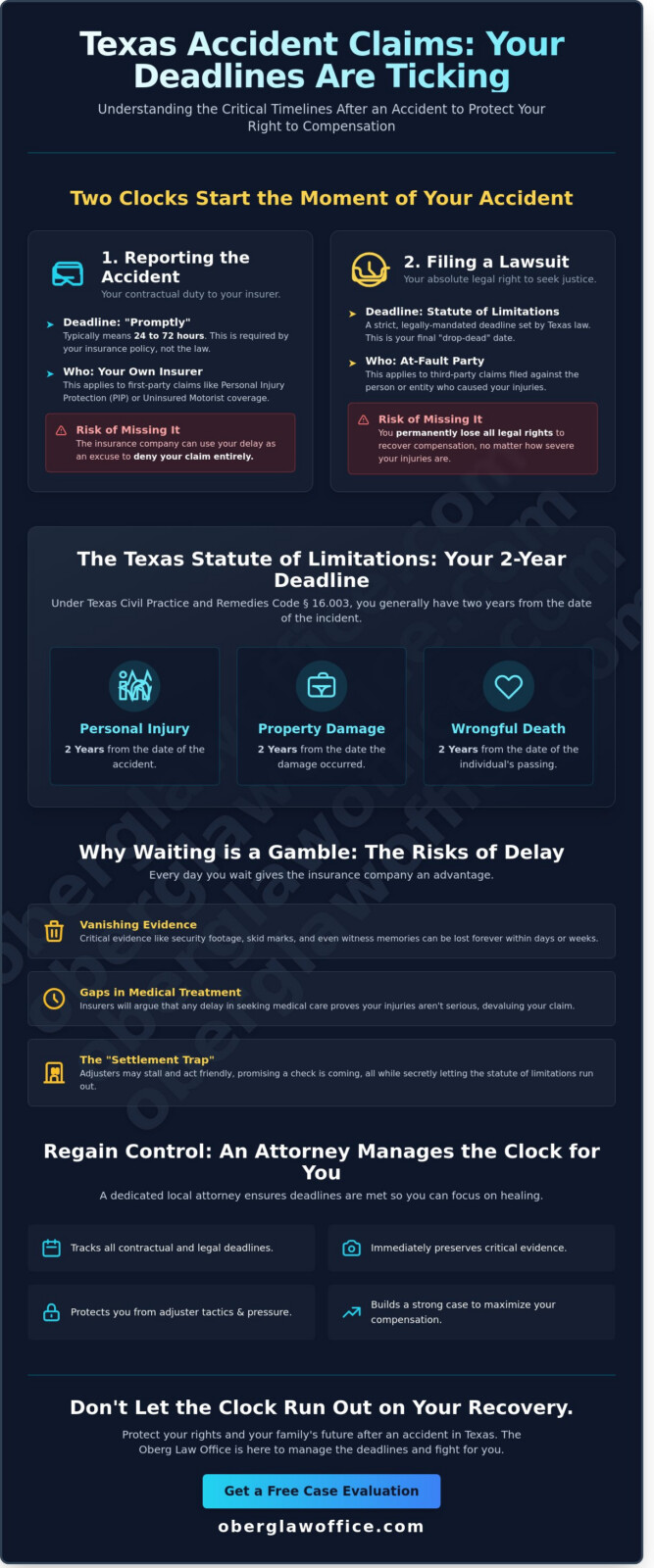
After a car accident in Mesquite, your world feels like it’s spinning. You’re dealing with pain, car repairs, and the stress of missing work. In the middle of this chaos, you’re likely wondering, how long do i have to file an insurance claim? The answer isn’t a single date on a calendar. Instead, you’re dealing with two distinct clocks: your contractual obligation to report the accident and your legal right to seek justice.
Reporting an accident is a requirement found in your insurance policy. It’s not a law, but it’s a binding agreement you made with your provider. When you notify them of a crash, you’re providing a “notice of claim.” This is just the first step in a much longer journey toward recovery. This notification is entirely separate from the Statute of Limitations, which is the strict legal deadline set by Texas law for filing a formal lawsuit. While the law might give you years to sue, your contract usually gives you only days to report.
What Does “Promptly” Actually Mean?
Most insurance policies avoid using a specific number of days. They prefer vague language like “promptly” or “within a reasonable timeframe.” In the Texas legal system, “prompt” usually means between 24 and 72 hours after the incident. If you wait too long, you give the insurance company an excuse to protect their profits instead of your health. They might argue that your delay made it impossible for them to investigate the scene or verify your injuries. Failing to meet this “prompt notice” requirement can lead to a denied claim, leaving your family to foot the bill for someone else’s mistake.
First-Party vs. Third-Party Claims
The rules change depending on whose insurance company you’re talking to. A first-party claim involves your own insurance provider. Since you signed a contract with them, you must follow their specific deadlines for reporting. This includes claims for Personal Injury Protection (PIP) or Uninsured Motorist coverage.
A third-party claim is filed against the at-fault driver’s insurance. You don’t have a contract with them, so their internal “promptness” rules don’t apply to you in the same way. However, these timelines intersect quickly. If the other driver’s insurance drags their feet, you may need to rely on your own policy to get immediate medical care. Knowing how long do i have to file an insurance claim requires looking at both your policy and the state’s legal limits. We help you manage both so you can focus on healing while we handle the deadlines.
The Statute of Limitations: Your Absolute Legal Deadline
Think of the statute of limitations as a ticking clock that starts the moment your accident occurs. It is the absolute “drop-dead” date for filing a lawsuit in court. While you might ask how long do i have to file an insurance claim to get a quick check, the legal deadline is what actually protects your right to fair compensation. This date is set by state law, not by your insurance company. If you miss this window, even by a single day, a judge will likely dismiss your case regardless of how badly you were hurt.
Insurance adjusters often use a tactic we call the “settlement trap.” They might act like your best friend, promising that a check is “just around the corner” while the deadline approaches. They know that once the statute of limitations expires, you lose all your leverage. You can no longer threaten to take them to court; this means they don’t have to pay you a dime. Our team at the Oberg Law Office focuses on moving your case forward quickly to ensure this never happens to your family.
Typical Deadlines for Injury and Property Damage
In Texas, the legal window is generally straightforward but unforgiving. Under the Texas Civil Practice and Remedies Code Section 16.003, the standard timeline for personal injury cases is two years from the day of the incident. This same two-year window typically applies to property damage claims, such as a totaled vehicle or a damaged home structure. [verify] As of January 2026, these statutes remain the standard in Texas; however, you should always check for any emergency stays or legislative amendments that may have occurred during the most recent session.
- Personal Injury: Two years from the date of the accident.
- Property Damage: Two years from the date the damage occurred.
- Wrongful Death: Two years from the date of the individual’s passing.
Exceptions: When the Clock Stops Ticking
There are rare instances where the clock pauses, a process known as “tolling.” The most common exception is the Discovery Rule. This applies when an injury isn’t immediately apparent. If a person couldn’t have reasonably known they were injured until a later date, the clock may start upon that discovery. Additionally, if the victim is a minor, the two-year clock typically doesn’t begin until their 18th birthday.
Claims against government entities are a different story entirely. If you are involved in a wreck with a city vehicle in Mesquite, you don’t have years to act. The Texas Tort Claims Act often requires a formal “notice of claim” within six months. Some local city charters are even stricter, requiring notice in as little as 90 days. Don’t let a procedural rule stand in the way of your recovery. We are here to help you understand exactly how long do i have to file an insurance claim based on the specific details of your situation.
Internal Insurance Deadlines You Need to Know
While you’re focused on doctor appointments and getting your life back on track, a silent clock is ticking inside your insurance policy. Many people ask, “how long do i have to file an insurance claim?” and only think about the state’s legal limits. However, your insurance contract contains internal deadlines that are often much shorter and more strict than Texas law. Missing these dates can give the insurance company a reason to deny your claim entirely, regardless of who caused the accident. It’s a frustrating tactic, but we’re here to help you stay ahead of it.
The Proof of Loss Requirement
The “Proof of Loss” is a formal, sworn statement you provide to the insurer. It details the specific extent of your injuries, property damage, and the exact amount of money you’re seeking for your recovery. In most Texas personal auto policies, you’ll find a window of 60 days to submit this paperwork after the initial report. If you fail to provide this document, the company may issue a technical denial. They use this as a shield to avoid paying what they owe, claiming you didn’t follow the “duties after an accident” section of your contract. This is why immediate documentation is so vital for your family’s protection.
UM/UIM and Supplemental Coverage Windows
If you’re relying on Uninsured or Underinsured Motorist (UM/UIM) coverage, you face even more pressure. These claims often require “prompt” notification, which many adjusters interpret as 30 days or less. You must notify your own carrier about the accident even if the other driver was clearly at fault. This step is vital because if the other driver’s insurance is capped at the Texas minimum of $30,000, you’ll need your own supplemental funds to cover a serious injury. Protecting your right to these benefits requires immediate action. Don’t wait for the other side’s insurer to “be fair” before talking to your own company.
- MedPay and PIP: These medical payment coverages often have filing windows ranging from 1 to 3 years for the final bill, but notification must happen quickly to ensure bills are processed.
- The “Conditions” Section: Grab your policy and look for the section labeled “Conditions” or “Duties After a Loss.” This is where the insurer hides the specific day counts you must follow.
- Prompt Notice: Most policies use the word “promptly,” which Texas courts often define based on what a reasonable person would do in your situation.
Knowing how long do i have to file an insurance claim depends heavily on these contractual fine prints. At Oberg Law Office, we don’t let insurance companies hide behind confusing language. We’ve spent decades protecting our Mesquite neighbors from these tactical denials. When you’re part of our legal family, we handle the paperwork and the deadlines so you can focus on your physical recovery. You’ll speak directly with your attorney to ensure every deadline is met with precision and determination. We believe in providing the justice and recovery your family deserves without the stress of managing these complex windows alone.
The Risks of Waiting: Why “Later” Is Often “Too Late”
While the legal deadline in Texas might give you a two-year window, the practical reality of a personal injury case is much more urgent. You might ask yourself how long do i have to file an insurance claim, but the real question is how long your evidence will actually last. Every day you wait is a day that the insurance company uses to build a wall between you and the compensation your family deserves.
Evidence Degradation and Witness Reliability
Physical evidence is incredibly fragile. Most commercial CCTV systems and dashcams overwrite their digital files every 48 to 72 hours. If you wait just one week to start your claim, that crucial footage of the other driver speeding through a Mesquite intersection is likely gone forever. Skid marks on the pavement wash away with the first rain, and debris is cleared by city crews within hours.
Witnesses are equally unreliable over time. A person who saw the crash clearly on Monday will have a fuzzy memory by the following month. Defense lawyers are experts at picking apart these faded memories to make a truthful witness look confused or dishonest. Spoliation of evidence is the critical risk you face when you delay your claim and allow vital proof to be destroyed or lost.
The Impact of Delayed Medical Treatment
In the world of insurance, there’s a “golden rule” that you should see a doctor within 72 hours of an accident. If you wait longer, you’re giving the insurance adjuster a weapon to use against you. They’ll look at a two-week delay and argue that your neck pain or back injury happened at work or while you were at home, rather than in the crash. This is known as a “gap in treatment,” and it’s the primary reason adjusters deny or lowball claims.
They’ll use your stoicism against you, claiming that if you were truly hurt, you would’ve sought help immediately. Working with an accident lawyer mesquite residents rely on ensures your medical story is told correctly from the start. We help protect your rights by documenting your injuries before the insurance company can twist the narrative.
Finally, consider the difficulty of finding legal help as time runs out. Most reputable law firms won’t accept a case if the statute of limitations is only 60 or 90 days away. Building a winning strategy takes months of investigation, record gathering, and expert consultation. If you wait until the last minute, you might find yourself facing the insurance giants entirely alone.
How a Personal Injury Attorney Manages the Clock for You
Dealing with a serious injury is exhausting. You shouldn’t have to spend your recovery tracking calendar dates and complex legal notices while trying to heal. When you work with our team, we take over the docketing process immediately. This professional tracking system ensures every contractual deadline and legal cutoff is met with absolute precision. In Texas, the general statute of limitations for personal injury is 730 days from the date of the accident. Missing this window by even 24 hours can end your right to compensation forever.
We also act fast to protect the facts of your case. Our office sends spoliation letters to defendants and insurance companies. These legal notices require them to preserve vital evidence like truck black box data, cell phone records, or store security footage. Without these letters, many companies delete digital recordings within 30 days of an incident. While you focus on your medical appointments, we manage the aggressive phone calls from insurance adjusters. These adjusters often push for quick statements before you know the full extent of your injuries. This protection is accessible from day one through a contingency fee lawyer mesquite residents rely on, which means you pay nothing upfront to start protecting your legal timeline.
Taking the Administrative Burden Off Your Shoulders
Filing a claim involves a mountain of paperwork and strict procedural rules. One small error on a form or a missed secondary deadline can cause months of delays or a flat denial. Your personal injury attorney mesquite guide handles every document and filing date for you. This transition allows you to breathe easier. Many clients come to us asking exactly how long do i have to file an insurance claim after a Mesquite car wreck. We provide that answer and then take the weight of the calendar off your back. You can stop worrying about the clock and start focusing on your physical therapy and your family.
Starting Your Recovery with a Free Strategy Session
Don’t spend another night guessing if you’ve waited too long to seek justice. Every case has unique factors, such as government involvement or hidden liabilities, that can shorten your window of opportunity. A quick consultation clarifies exactly how long do i have to file an insurance claim based on your specific situation. We’ll look at the facts of your accident and provide a clear roadmap for your recovery. Contact Oberg Law Office for a free case review today. We’re here to help you secure the justice you deserve without the stress of managing the legal clock alone.
Secure Your Future by Acting Today
Navigating the aftermath of an accident is overwhelming, but your window for legal action is smaller than you might think. You must balance internal insurance reporting windows with the formal statute of limitations set by Texas law. Waiting too long allows evidence to disappear and gives insurance companies a reason to deny your valid claim. Understanding how long do i have to file an insurance claim is vital to protecting your family and your recovery.
At Oberg Law Office, we’ve spent over 25 years fighting for the rights of our neighbors in Mesquite and across the state. You deserve a partner who provides direct access to your attorney, not just a paralegal. We manage every deadline and legal hurdle so you can focus on healing. Our firm works on a contingency basis, which means there is no fee unless we win your case. Don’t let the clock run out on your recovery, schedule your free strategy session with Oberg Law Office now. We’re ready to stand by your side and help you move forward with confidence.
Frequently Asked Questions
Can I still file a claim if the accident was a year ago?
Yes, you can typically file a claim a year after your accident in Texas. Under Texas Civil Practice and Remedies Code Section 16.003, you generally have two years from the date of the incident to seek compensation for personal injuries. While you’re within the legal limit, your insurance policy likely requires you to report the accident within a reasonable time, so waiting 365 days might lead to a more intense investigation by the adjuster.
What happens if I miss the statute of limitations?
If you miss the two year statute of limitations in Texas, you lose your legal right to sue for damages. A judge will almost always dismiss your case if you file it 731 days after the accident or later. This means you can’t force the insurance company to pay for your medical bills or lost wages, leaving you to cover 100% of those costs out of your own pocket.
Does reporting an accident to the police count as filing an insurance claim?
No, filing a police report is a separate legal requirement and doesn’t notify your insurance company of your intent to seek damages. While Texas law requires a report for accidents involving injury or over $1,000 in property damage, you still need to contact your insurer directly. They won’t know about the crash unless you or your attorney tells them. This is a critical step in understanding how long do i have to file an insurance claim to protect your family’s future.
How long does an insurance company have to respond to my claim?
Texas Insurance Code Section 542.056 gives insurers 15 business days to accept or reject your claim after they receive all required items. If they need more time to investigate, they can take up to 45 additional days but must provide you with a written explanation for the delay. Our team in Mesquite ensures these companies follow the 15 day rule so you aren’t left waiting for the support you deserve.
Can an insurance company deny a claim for late reporting even if I wasn’t at fault?
Yes, an insurance company can deny your claim if your delay prejudiced their ability to investigate the accident. If you wait 6 months to report a crash, the insurer might argue they can’t inspect the vehicles or interview witnesses properly. Even if you didn’t cause the crash, failing to follow the reporting terms in your specific policy can jeopardize your entire recovery.
What if I didn’t realize I was injured until weeks after the crash?
You can still pursue a claim for injuries that appear weeks later, as long as you stay within the two year legal window. Medical conditions like whiplash or traumatic brain injuries often show symptoms 14 to 21 days after the initial impact. We help you document these delayed symptoms to prove they were caused by the accident, ensuring the insurance company treats your health with the respect it deserves.
Is there a different deadline for hit-and-run accidents?
The two year statute of limitations still applies to hit-and-run accidents in Texas, but your uninsured motorist policy often has much stricter reporting rules. Most policies require you to notify the police within 24 hours and your insurance company within 30 days to qualify for coverage. Knowing how long do i have to file an insurance claim is vital here because missing these short windows could cost you your entire settlement.
How much time do I have to sue the insurance company if they won’t pay?
You typically have four years to sue your own insurance company for a breach of contract claim in Texas. This is different from the two year limit for personal injury lawsuits against another driver. If your insurer acts in bad faith or refuses a valid claim, we’ll stand by you to hold them accountable and fight for the justice your family needs.


