Imagine it’s a typical Tuesday afternoon in Mesquite when a sudden collision on Belt Line Road changes everything in an instant. You’re left standing on the shoulder, heart racing, wondering if that polite conversation you just had with the other driver’s insurance adjuster might have cost you thousands of dollars. It’s a terrifying reality that many Texans face every single day, often because they aren’t aware of the specific mistakes to avoid after a car accident. We understand the deep anxiety that comes with mounting medical bills and the fear of saying the wrong thing. You deserve a partner who stands by your side to ensure your rights remain protected.
You already know that dealing with insurance companies feels like an uphill battle while you’re trying to heal. This guide will show you exactly how to safeguard your personal injury claim and secure the full compensation you deserve. According to the Texas Department of Transportation, there were 15,299 serious injury crashes in 2022 alone. We’ll walk through the ten most frequent pitfalls so you can focus on your family and your health without the added stress of legal uncertainty.
Key Takeaways
- Learn the common mistakes to avoid after a car accident at the scene, including why your adrenaline might hide injuries that need immediate attention.
- Understand why a “gap in treatment” is an insurance adjuster’s best friend and how to document your recovery properly from day one.
- Discover how to guard your privacy against aggressive adjusters who look for any reason—from social media to recorded statements—to devalue your claim.
- Recognize the pitfalls of “quick cash” settlement offers and learn why patience is often the key to securing the full compensation you deserve.
- See how the statute of limitations can permanently bar your recovery and why early legal guidance acts as a vital buffer for your peace of mind.
Navigating the Immediate Aftermath: Scene Mistakes Driven by Adrenaline
The moment of impact on a Mesquite road triggers an immediate biological response. Your heart rate spikes and your body floods with adrenaline and cortisol. This chemical surge is designed for survival, but it often clouds your judgment when you need it most. It masks physical pain, which leads many drivers to tell officers or other parties that they’re “fine” when they’ve actually suffered internal injuries or concussions. Gaining a deeper perspective by understanding traffic collisions can help you realize that even low-speed impacts cause significant internal strain that your brain won’t register until the adrenaline wears off hours later.
One of the most common mistakes to avoid after a car accident is failing to involve law enforcement. In Texas, you’re legally required to report a crash that results in injury or property damage exceeding $1,000. Without a formal police report, the details of the crash become a matter of your word against theirs. This lack of documentation gives insurance companies a reason to deny your claim or argue that the accident never happened as you described. We see this happen too often; a neighborly handshake at the scene turns into a legal nightmare weeks later when the other driver changes their story.
The Trap of the Polite Apology
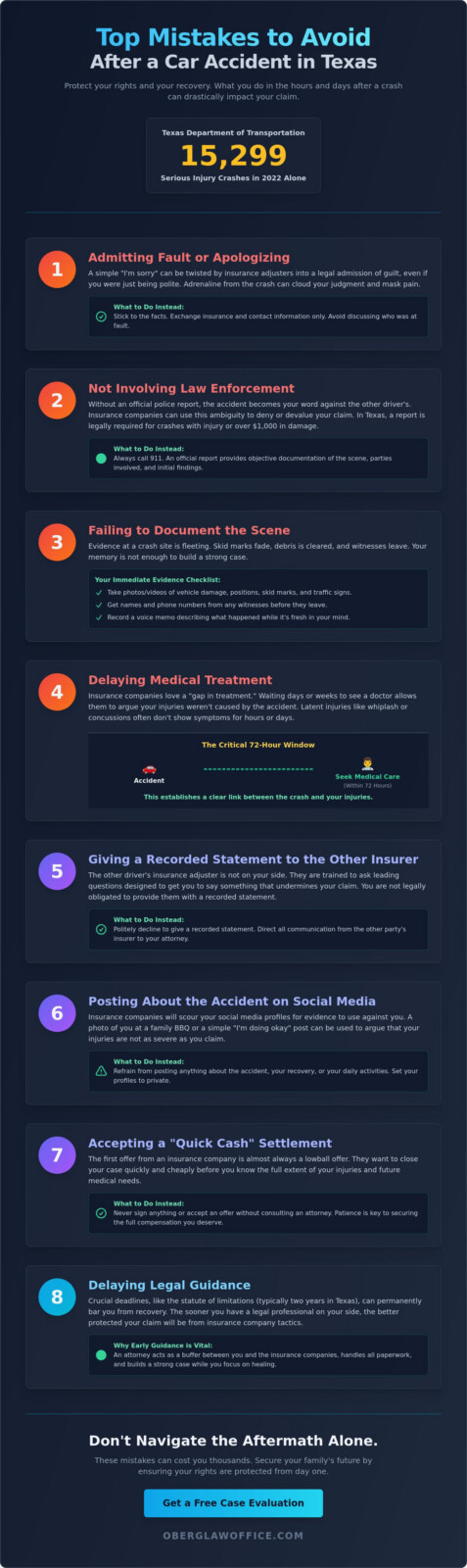
You might feel the urge to say “I’m sorry” just to de-escalate the tension. Don’t do it. Insurance adjusters are trained to twist a simple apology into a legal admission of liability. They don’t see your words as kindness; they see them as an admission that you caused the wreck. Your natural urge to be polite at the scene can be used as evidence of negligence later, potentially shifting the legal burden of the crash onto your shoulders. Stick to the facts when speaking to the other driver. Exchange insurance information and driver’s license numbers, but keep the conversation strictly professional. If they ask what happened, simply state that you’ll let the police report and the evidence speak for itself.
Failing to Document the “Fleeting” Evidence
Evidence at a crash site disappears faster than you think. Rain washes away oil slicks, city crews clear debris, and skid marks fade under Texas sun. Use your smartphone to capture everything immediately. Take photos of the vehicle positions, the weather conditions, and any nearby traffic signs. These visuals are critical mistakes to avoid after a car accident because they provide an objective record that doesn’t rely on memory.
- Gather Witness Data: Get names and phone numbers before witnesses drive away. Their neutral perspective is gold for your case.
- Record a Voice Memo: Speak into your phone while the details are fresh. Describe the direction of travel and what you saw right before the impact.
- Capture the Surroundings: Take wide shots of the intersection or road layout to show the context of the collision.
By taking these steps, you protect your right to a fair recovery before you even leave the scene. Our team at Oberg Law Office knows how to use this evidence to build a wall of protection around your family’s future.
The Critical Window: Medical and Physical Recovery Missteps
The “Gap in Treatment” is a phrase insurance adjusters love. It refers to any delay between your collision and your first medical visit. If you wait five days to see a professional, the insurance company will argue that you weren’t actually hurt or that a different event caused your pain. This gap is one of the most common mistakes to avoid after a car accident because it provides the adjuster with the ammunition they need to deny your claim before it even begins. Your health is the priority, but your medical record is the legal foundation of your recovery.
Delaying Your First Medical Evaluation
Your body often goes into shock after a crash. Adrenaline masks pain, making you feel fine when you aren’t. You must see a doctor within 72 hours, which is the standard window insurance companies use to evaluate the urgency of a claim. Latent injuries are medical conditions like whiplash or traumatic brain injuries that don’t show symptoms immediately but cause significant long-term damage. If you don’t have a medical record established within those first three days, proving the accident caused your injury becomes a difficult legal hurdle. We see this often in Mesquite, where neighbors try to “tough it out” only to find themselves in debilitating pain a week later.
Inconsistent Follow-Up and “Malingering” Accusations
Missing a physical therapy session might seem like a minor scheduling conflict to you. To an insurance company, it’s evidence. They use “no-shows” to label you as a malingerer, a term they use for someone who is faking or exaggerating pain for financial gain. Following your doctor’s orders to the letter is a legal necessity. If your physician prescribes therapy three times a week, you must attend every session. To help your case, keep a daily pain journal. Document how your injuries limit your life, such as being unable to lift your groceries or play with your kids. This personal record makes it much harder for an adjuster to dismiss your physical struggle.
Insurance companies also hunt for pre-existing conditions. They’ll dig through your medical history from 2018 to find an old sports injury and use it to blame your current back pain. You need a guide who knows how to prove the accident exacerbated your condition. If you’re feeling pressured by an adjuster to sign a medical release, speaking with a dedicated local attorney can help protect your private history from being weaponized against you. We ensure that your past health doesn’t dictate your future justice.
Guarding Your Privacy: Communication and Social Media Pitfalls
You might think your private life stays private, but insurance companies are skilled at finding what you try to keep hidden. One of the biggest mistakes to avoid after a car accident is sharing too much information with the wrong people. Whether it’s a casual conversation with an adjuster or a quick post on Facebook, your words can be twisted to undermine your claim. Silence isn’t just golden; it’s a vital part of your legal protection.
The Recorded Statement Trap
The other driver’s insurance adjuster will likely call you within 24 to 48 hours of the wreck. They often sound sympathetic, almost like a neighbor checking in on you, but their primary goal is to protect their company’s bottom line. They’ll ask for a recorded statement to “get the facts straight” or “speed up the process.” In Texas, you aren’t legally required to provide a recorded statement to the other party’s insurance carrier to start a claim.
Adjusters use specific trick questions to trap you. If they ask, “How are you doing today?” and you reflexively answer “I’m doing okay,” they’ll use that recording to argue your injuries aren’t serious. They want you to minimize your pain before you’ve even seen a specialist or understood the full extent of your medical needs. Politely decline any interview until you’ve secured legal counsel. At Oberg Law Office, we handle these communications for you so you don’t accidentally damage your case.
The Digital Footprint: Social Media in 2026
In 2026, insurance companies use sophisticated software to monitor your digital footprint. Even if your settings are set to private, adjusters can often gain access through mutual friends or public metadata. Industry data suggests that defense teams now search for social media evidence in over 75% of personal injury cases. A single photo of you smiling at a family dinner can be used to “disprove” a back injury or a claim for mental anguish. They won’t see the physical therapy you attended that morning or the pain medication you took just to sit at the table.
- Metadata and Check-ins: Digital tags can reveal your location and activity levels, contradicting your reports of being bedridden.
- The “Tagging” Risk: Friends might tag you in photos from years ago, but an adjuster may claim the photo is current to show you’re active.
- Third-Party Comments: Well-meaning comments from relatives saying “Glad to see you’re up and about!” can be used as evidence against you.
The safest strategy is to go completely dark on social media until your case is resolved. Don’t post, don’t comment, and ask your family not to mention you or the accident online. Your recovery is a personal matter that shouldn’t be scrutinized by someone looking for an excuse to deny your compensation. Only discuss the details of your health and the accident with your doctor and your attorney. This ensures your communications are protected by privilege and used only to support your path to justice.
Financial Traps: Settlement and Insurance Notification Errors
The days following a crash are often a blur of doctor visits and phone calls. During this stressful time, insurance companies frequently use your urgency against you. One of the most significant mistakes to avoid after a car accident is accepting an immediate “quick cash” offer. These checks usually arrive before you even know the full extent of your injuries. While a $2,000 settlement might cover your immediate deductible, it won’t help if you discover a herniated disc three weeks later. Insurance adjusters are trained to close files cheaply and quickly.
You must also prioritize notifying your own insurance provider. Many people worry that reporting an accident where they weren’t at fault will raise their rates, but failing to report it can void your coverage entirely. In Texas, specific policy language often requires notice within a “reasonable time,” which many courts interpret as 30 days or less. If the other driver is uninsured, your own policy is your only safety net. Don’t lose that protection by staying silent.
Keep your property damage claim separate from your medical claim. You can often settle the repairs for your vehicle quickly so you can get back on the road in Mesquite. However, ensure any document you sign specifically excludes “bodily injury.” Signing a general release form is a permanent decision. Once that ink is dry, you cannot ask for more money, even if your condition worsens.
The Danger of Settling Before You Are Healed
We always advise our neighbors to wait until they reach Maximum Medical Improvement (MMI). This is the point where a doctor determines your condition is as good as it’s going to get. If you settle before reaching MMI, you’re essentially gambling with your future. An immediate offer might cover your first ER bill; a comprehensive settlement accounts for the next twenty years of physical therapy or lost wages. Protecting your family means looking at the long-term horizon, not just the next bill.
Misunderstanding Policy Limits and Underinsured Coverage
Never assume the person who hit you has enough insurance. Texas law only requires a minimum of $30,000 in bodily injury liability per person. If you spend three days in a Dallas hospital, those costs can easily exceed $50,000. This is where Uninsured/Underinsured Motorist (UM/UIM) coverage becomes vital. It acts as a secondary layer of protection for you and your passengers. Understanding your own policy is a key step in identifying mistakes to avoid after a car accident. You should review their personal injury protection options to see how these coverages work together to secure your recovery.
If you’re feeling pressured by an insurance adjuster to sign away your rights, we can help you understand the true value of your claim. Speak with a dedicated advocate today for a free consultation with an attorney who treats you like family.
Securing Your Future: Why Delaying Legal Guidance Is a Mistake
Waiting to seek legal advice is one of the most costly mistakes to avoid after a car accident. In Texas, the statute of limitations generally gives you two years from the date of the crash to file a lawsuit. While two years sounds like a long window, the clock starts ticking immediately. If you miss this deadline by even a single day, the court will permanently bar your claim. You lose your right to seek justice, regardless of how clear the other driver’s fault was or how severe your injuries are.
Insurance adjusters often reach out within 24 to 48 hours of a collision. They might sound sympathetic, but their primary job is to save the insurance company money. They’re trained to lead you into statements that shift blame or downplay your pain. When you hire an attorney, you create an immediate buffer. We handle every phone call, email, and negotiation so you can focus on your physical therapy and family. Many people hesitate because they fear legal bills, but the “Contingency Fee” model removes that barrier. You don’t pay any hourly rates or upfront costs. Our firm only recovers a fee if we successfully secure a settlement or verdict for you.
Preserving Evidence Through Professional Investigation
Physical evidence at a crash site disappears faster than you might think. Rain washes away skid marks, and cities often repair damaged guardrails within days. Our team moves quickly to secure “Black Box” data, technically known as the Event Data Recorder (EDR). This device captures precise metrics like vehicle speed, brake application, and steering angles in the five seconds before impact. We also issue formal spoliation letters to trucking companies and local businesses. These legal notices mandate that they preserve surveillance footage and maintenance logs that could prove negligence. A car accident lawyer provides a level of investigative depth that individuals cannot match alone.
The Value of a Free Strategy Session
Your initial consultation is a roadmap for your recovery. During this session, we sit down to discuss the specific details of your crash and identify the unique challenges of your case. We don’t just look at your current medical bills; we look at the long-term impact on your quality of life. Calculating “Pain and Suffering” isn’t a simple math problem. It involves analyzing how your injuries prevent you from enjoying your hobbies or caring for your children. We act as your advocate to ensure the insurance company recognizes the full scope of your loss. You shouldn’t have to guess what your claim is worth while you’re still in pain.
Schedule your free case review with Oberg Law Office today. Let us take the legal burden off your shoulders so you can focus on getting back on your feet.
Take Control of Your Recovery and Your Future
The moments following a collision are overwhelming, but the choices you make today define your path to justice. You’ve learned how critical it is to seek medical care immediately and keep your recovery off social media to protect your claim. By understanding the common mistakes to avoid after a car accident, you’re already ahead of the insurance companies that hope you’ll settle for less than you deserve.
You don’t have to carry this burden alone. At the Oberg Law Office, we provide the steady guidance you need during this difficult time. With over 25 years of experience fighting for accident victims, we ensure you speak directly with your attorney, not just a paralegal. We operate on a contingency basis, which means there’s no fee unless we win your case. Let us handle the legal complexities while you focus on healing.
Contact Oberg Law Office for a Free Accident Strategy Session
You have the strength to move forward, and we’re here to make sure you have the legal support to do it right.
Frequently Asked Questions
Can I still recover compensation if I was partially at fault for the accident?
Yes, you can still recover compensation as long as you’re not more than 50% responsible for the crash. Texas follows a modified comparative negligence rule under Chapter 33 of the Civil Practice and Remedies Code. If a jury finds you 20% at fault, your final settlement is simply reduced by that 20%. We’ll work to ensure the insurance company doesn’t unfairly shift the blame onto you to lower your payout.
How long do I have to file a car accident claim before the deadline expires?
You generally have 2 years from the date of the collision to file a personal injury lawsuit in Texas. This strict deadline is established by Section 16.003 of the Texas Civil Practice and Remedies Code. Missing this date usually means you lose your right to seek justice forever. Waiting too long is one of the biggest mistakes to avoid after a car accident because evidence disappears and memories fade.
What happens if the other driver does not have insurance?
You can seek compensation through your own insurance policy if you have Uninsured Motorist (UM) coverage. The Texas Department of Insurance reports that roughly 8.3% of Texas drivers were uninsured as of 2021. If you’re hit by one of these drivers, your UM coverage steps in to pay for your medical bills and car repairs. We’ll review your policy to find every available source of recovery for your family.
Do I have to give a recorded statement to the other driver’s insurance company?
No, you’re not legally required to give a recorded statement to the other driver’s insurance adjuster. These adjusters often look for any reason to deny your claim or minimize your injuries. Anything you say can be used against you later in the process. It’s best to let your attorney handle all communications so you don’t accidentally say something that hurts your case or your future recovery.
What if I did not feel pain until a few days after the car crash?
It’s very common for injuries like whiplash or soft tissue damage to stay hidden for 48 to 72 hours while adrenaline masks the pain. Seeking medical attention immediately is vital even if you feel okay right away. Delaying treatment is one of the most common mistakes to avoid after a car accident because it gives insurance companies an excuse to claim your injuries aren’t related to the collision.
How much does it cost to hire a car accident attorney?
We work on a contingency fee basis, which means you pay nothing upfront and no hourly fees. You only pay us if we successfully recover money for you through a settlement or jury verdict. This model ensures that every Mesquite neighbor has access to high-quality legal protection regardless of their current financial situation. We take on all the financial risk so you can focus on your physical healing.
Will my car accident case have to go to court?
Most car accident cases settle out of court, with the Bureau of Justice Statistics noting that only about 3% of personal injury cases go to a full trial. We prepare every case as if it’s going to court to show the insurance company we’re serious. This aggressive preparation often forces them to offer a fair settlement sooner. If they refuse to be reasonable, we’re fully prepared to fight for you.
Can I change my lawyer if I already started a claim with someone else?
Yes, you have the right to change your attorney at any point if you feel your current representation isn’t meeting your needs. You deserve a lawyer who treats you like a person, not a case number. If you switch, your new firm handles the paperwork to pay your former lawyer for their time out of the final settlement. You won’t have to pay two separate fees to get better service.