
You might think that slipping on a wet floor in a Texas grocery store is a straightforward case of owner neglect, but the law often views that puddle through a much narrower lens. Proving negligence in a slip and fall case texas requires more than just showing you were hurt; it requires proving the owner knew the danger existed before you ever stepped foot on the property. It’s a high bar, and insurance companies use it every day to protect their bottom lines while your medical bills continue to pile up.
We understand how overwhelming it feels when adjusters claim a hazard was “open and obvious” or when a store manager refuses to hand over an incident report. You deserve a partner who sees the person behind the case number and understands the physical pain you are enduring. This guide provides the exact legal standards and evidence required to hold property owners accountable for their failures under Texas law. We will explore the critical “notice” requirement, explain how to secure vital surveillance footage, and help you determine if your claim is viable so you can move forward with confidence and clarity.
Key Takeaways
- Understand how Texas courts use the “reasonable person” standard to determine if a property owner’s failure to act led directly to your injuries.
- Identify your visitor status to see if you were an invitee or licensee, as this dictates the specific legal duty of care the owner owed you.
- Master the “notice” requirement, which is the most critical hurdle when proving negligence in a slip and fall case texas.
- Learn the four essential elements of a premises liability claim and why securing evidence like surveillance logs is vital before it is lost.
- Discover how a veteran legal advocate can help you navigate insurance company tactics and the strict two-year statute of limitations for Texas injury claims.
What Constitutes Negligence in a Texas Slip and Fall Case?
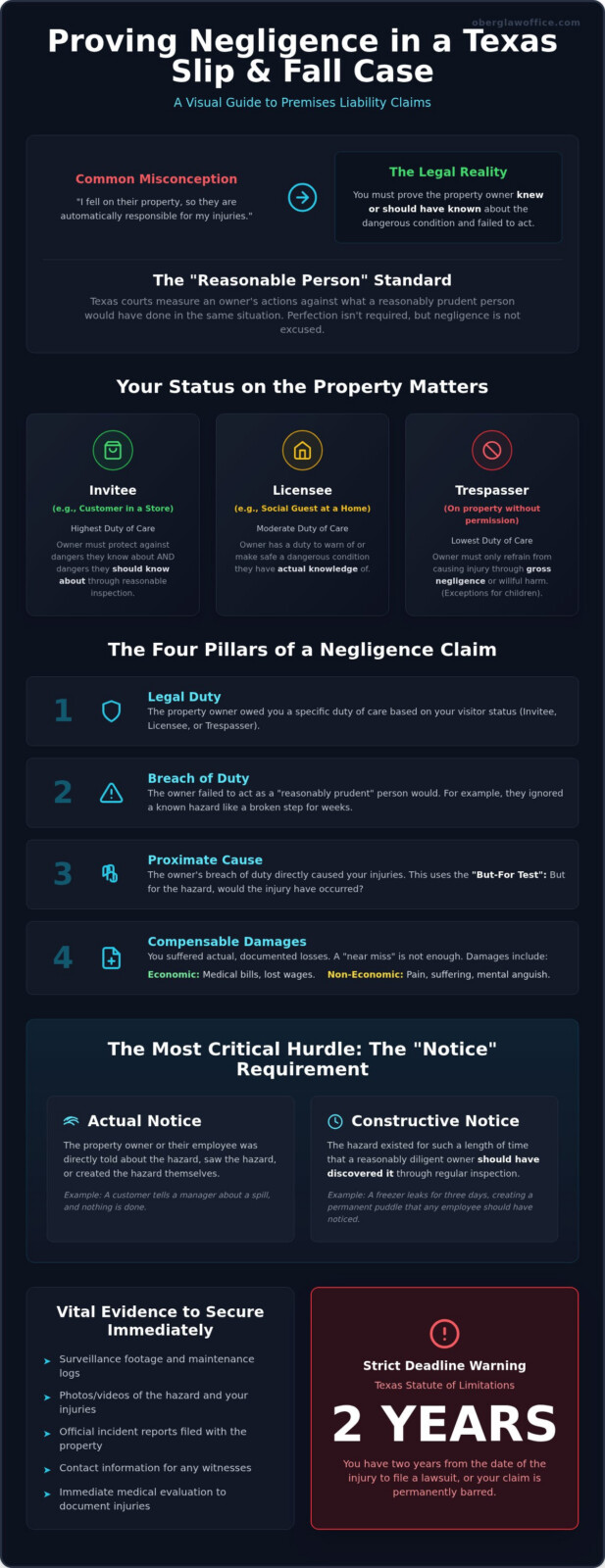
When you’re hurt after a tumble in a store or on a neighbor’s property, you might assume the owner is automatically responsible for your medical bills. In the eyes of the law, it isn’t that simple. To understand What Constitutes Negligence, we have to look at how a property owner managed their space. Negligence is essentially a failure to exercise the care that a reasonably prudent person would have used in the same situation.
Proving negligence in a slip and fall case texas involves showing that the property owner didn’t meet this “reasonable person” standard. Courts don’t expect perfection; they don’t require an owner to follow you around with a mop. However, they do expect owners to keep their premises safe for guests. If a store owner ignores a leaking freezer for three days, they’ve likely failed that standard. If a pipe bursts and creates a puddle ten seconds before you walk by, the court might find their actions were reasonable under the circumstances.
Simply falling doesn’t trigger a payout. You carry the burden of proof. You must show a “preponderance of the evidence,” which means your version of events is more likely than not to be true. It’s a technical hurdle that requires strong evidence like photos, witness statements, or maintenance logs to prove the owner was at fault.
Premises Liability vs. General Negligence
There’s a specific legal distinction between a condition on the property and a negligent activity. Premises liability is the legal framework for property-based injuries. Most slip and fall cases fall into this category because the injury stems from a static hazard, like a broken stair or a slick floor. General negligence usually involves a person’s ongoing actions, such as an employee running through a crowded aisle and knocking you down. If your injury happened because of a dangerous condition that stayed in place, premises liability rules will govern your claim.
The Role of Foreseeability in Texas Law
Foreseeability is the glue that holds a negligence claim together. A property owner is generally only liable if they could have predicted that a hazard would cause harm. If a handrail has been loose for a month, it’s foreseeable that someone will eventually lean on it and fall. However, extraordinary circumstances, like a sudden “freak” weather event that causes an immediate structural failure, might shield an owner from liability. The law balances your right to a safe environment with the reality that some accidents are truly unavoidable.
The Four Essential Elements of a Negligence Claim
Winning a premises liability claim requires checking four specific legal boxes. Proving negligence in a slip and fall case texas isn’t just about showing you were injured; it’s about building a bridge between the owner’s inaction and your current physical state. If even one of these pillars is missing, an insurance adjuster will likely deny your claim before it ever reaches a courtroom.
The first element is the existence of a legal duty. In Texas, property owners aren’t responsible for everyone equally. We must first establish that you had a legal right to be on the property and that the owner owed you a specific level of care. Second, we have to prove a breach of that duty. This happens when an owner fails to act as a “reasonably prudent” person would, such as leaving a broken step unrepaired for weeks. The Texas Civil Practice and Remedies Code serves as the foundation for these standards, outlining how liability is assigned in our state.
Establishing Proximate Cause
Proximate cause is often the most contested part of a claim. We use the “But-For” test to prove this element: but for the existence of the hazard, would your injury have occurred? If the answer is no, we have a strong case. However, insurance companies often point to “intervening causes” to shift blame. They might argue your own distraction or a pre-existing back condition caused the fall rather than the slick floor. We focus on connecting the dots clearly so the hazard remains the primary focus of the case.
Documenting Compensable Damages
You cannot sue for a “near miss” or a “scare.” To have a viable claim, you must have suffered actual compensable damages. These are split into two categories. Economic damages cover your tangible financial losses, like hospital bills, physical therapy costs, and the wages you lost while recovering. Non-economic damages address the human side of the accident, including your physical pain, mental anguish, and the loss of enjoyment of life.
Insurance companies look for any gap in your medical history to devalue these damages. This is why an immediate medical evaluation is vital. It creates a paper trail that links your injuries directly to the fall. If you’re struggling to organize your medical records or don’t know where to start, discussing your situation with an experienced advocate can help ensure no detail is overlooked. We’ll help you gather the proof needed to show the full extent of your financial and emotional burden.
Visitor Status: Invitee, Licensee, or Trespasser?
Your legal right to compensation depends heavily on why you were on the property in the first place. Texas law categorizes every visitor into one of three specific groups. Proving negligence in a slip and fall case texas requires identifying your status at the exact moment of the accident because it dictates the “duty of care” the owner owed you. While invitees get the most protection, trespassers receive the least. For those on a property without permission, the owner only has a minimal duty to avoid “willful or wanton” injury, meaning they can’t intentionally cause harm but don’t have to maintain the premises for your safety.
Social guests fall into the middle category, known as licensees. If you’re at a friend’s house for a barbecue, you’re there for your own benefit or a mutual social purpose. In these cases, the owner must warn you of dangerous conditions they actually know about, but they aren’t necessarily required to inspect the property for hazards they haven’t discovered yet. To better understand these distinctions, it helps to review the legal definitions of Visitor Status: Invitee, Licensee, or Trespasser. Knowing where you stand is the first step in holding a negligent party accountable for your medical bills and lost wages.
The Duty Owed to Business Invitees
As an invitee, you’re owed the highest standard of care under Texas law. This category includes retail customers, restaurant patrons, and even tenants in the common areas of an apartment complex. Business owners have a proactive obligation to inspect their property for hidden dangers. It’s not enough for a manager to claim they didn’t see the spill that caused your fall. They must show they had a reasonable inspection schedule in place to catch such hazards. If they fail to warn you of a known danger or neglect to fix a broken floor tile promptly, they’ve breached their legal duty to you.
When Your Legal Status Changes
Status isn’t always fixed for the duration of your visit. It can change in a heartbeat based on where you walk. If you’re a customer at a store but wander through a door marked “Employees Only” to find a shortcut, your status could drop from invitee to trespasser. The owner’s duty to protect you drops along with it. Similarly, timing plays a role in these cases. If you enter a public venue after it officially closes for the night, you may no longer be considered an invitee. Locked doors and clear signage serve as legal boundaries that protect owners from liability if a visitor chooses to ignore them.
The Notice Requirement: Actual vs. Constructive Notice
Proving negligence in a slip and fall case texas often hinges on a single question: did the owner know the hazard was there? This is known as the notice requirement. Actual notice is the most direct form. It happens when an employee literally saw the spill or when another customer reported the danger to a manager before you fell. If we can find a witness or an incident report confirming this, the owner’s liability becomes much clearer. We prioritize finding these records before they “disappear” from the store’s files.
Establishing constructive notice is the most common way of proving negligence in a slip and fall case texas when there’s no direct witness to the spill. This uses the Texas “time-rule” to argue that the hazard existed for such a long period that the owner should have discovered it through reasonable inspection. If a grape is smashed and dirty on a grocery store floor, it suggests it’s been there for quite a while. If the floor was just mopped but no yellow “wet floor” signs were placed, the owner created the dangerous condition themselves. This often removes the need to prove how long the hazard was there.
Evidence for Constructive Notice
We look for physical clues that tell a story about time. Melted ice in a puddle or footprints through a spill are powerful pieces of evidence that show a hazard was neglected. Surveillance footage is even better. We work quickly to secure video that shows exactly when a leak started or when a spill occurred. We also examine maintenance logs, often called “sweep sheets.” If a store claims they check the floors every hour but the log shows a three-hour gap, that’s a clear sign of neglect that supports your claim.
The ‘Open and Obvious’ Defense
Insurance adjusters almost always try to use the “open and obvious” defense to avoid paying your medical bills. They’ll argue that any reasonable person should have seen the hazard and avoided it. It’s a tactic designed to shift 100% of the blame onto you. We counter this by showing that the hazard was deceptive or that your attention was understandably diverted by store displays. You don’t have to fight these aggressive insurance tactics alone. If an adjuster is telling you the accident was your fault, contact Oberg Law Office to discuss how we can protect your rights and challenge their excuses.
Building Your Case with Oberg Law Office
You shouldn’t have to spend your recovery time arguing with a billion-dollar insurance company about a spill they knew existed. We’ve spent over 25 years acting as a shield for individuals who have been let down by negligent property owners. Proving negligence in a slip and fall case texas is a complex legal battle, but it’s one we’ve fought and won many times. When you choose our firm, you aren’t handed off to a junior clerk or an automated system. You work directly with senior legal professionals who are personally invested in your restoration and your family’s future.
Our process begins with a free strategy session where we listen to your story and determine the best path forward. Proving negligence in a slip and fall case texas isn’t something you have to do alone. We believe that everyone deserves access to high-quality legal help, which is why we use a contingency-based fee structure. You don’t pay us a dime unless we successfully recover money for you. This approach removes the financial barrier to justice and ensures that we are completely focused on tangible results rather than abstract legal theories.
The Importance of Early Investigation
Evidence in premises liability cases is notoriously fragile. Store managers often “misplace” internal incident reports, and digital surveillance footage is frequently recorded over within just a few days. We move quickly to secure this data and issue preservation letters before it’s lost forever. Our investigation goes beyond the surface to identify every liable party, including absentee landlords, third-party cleaning crews, and management companies. If you’re looking for a slip and fall lawyer mesquite victims can trust, we provide the aggressive advocacy needed to uncover the truth about how your accident happened.
Your Path to Recovery and Fairness
Your only job should be getting better. While you focus on physical therapy and healing, we handle the heavy lifting of legal filings, insurance adjuster calls, and medical billing negotiations. We pride ourselves on direct, neighborly communication; you’ll never be left wondering about the status of your case or what the next step looks like. As a mesquite personal injury lawyer with a deep commitment to our local community, we fight for a settlement that covers your past medical bills and your future care needs. We’re here to move you logically from a state of uncertainty to a feeling of empowerment and security.
Take Control of Your Recovery Journey
You shouldn’t have to carry the heavy burden of a property owner’s mistake while you’re trying to heal. Successfully proving negligence in a slip and fall case texas requires a deep understanding of the notice requirement and your specific legal status as a visitor. Whether you were a customer in a retail store or a social guest, the evidence you secure today determines the level of fairness you receive tomorrow. The path to restoration is often complex, but you don’t have to walk it without a knowledgeable guide by your side.
At Oberg Law Office, we’ve spent over 25 years acting as a steadfast protector for our neighbors. You’ll work directly with Attorney Gregg Oberg, ensuring you receive the personalized advocacy and direct communication you deserve. We operate on a contingency fee basis, which means you don’t pay a single dime unless we win your case. Schedule your free slip and fall strategy session with Oberg Law Office today. You have the legal right to seek justice, and we have the unwavering determination to help you find it.
Frequently Asked Questions
How long do I have to file a slip and fall claim in Texas?
In Texas, you generally have two years from the date of your accident to file a personal injury lawsuit under the Texas Civil Practice and Remedies Code § 16.003. This deadline is strict; if you miss it, you’ll likely lose your right to seek compensation forever. We recommend acting much sooner to ensure evidence like store video isn’t erased. Early action helps us build a stronger foundation for your recovery and peace of mind.
Can I still recover compensation if I was partially at fault for my fall?
Yes, you can still recover compensation even if you were partially responsible, provided your level of fault isn’t greater than 50%. This is known as modified comparative negligence. Your final settlement will be reduced by your percentage of fault. For example, if you’re found 20% responsible for not seeing a spill, you would receive 80% of the total damages. We work hard to minimize the blame insurance companies try to place on you.
What should I do immediately after slipping and falling at a store?
You should immediately report the incident to the property manager and insist on a written report. Take clear photos of the hazard that caused your fall, such as a leak or broken floor tile, before it’s cleaned. Collect names and phone numbers from any witnesses who saw what happened. Finally, seek a medical evaluation right away to document your injuries. These steps are vital for proving negligence in a slip and fall case texas.
Do I need to see a doctor even if I don’t feel immediate pain?
You should see a doctor immediately, even if you don’t feel severe pain right away. Adrenaline often masks the true extent of internal injuries or soft tissue damage that may appear days later. A medical professional provides a clear diagnosis and creates the necessary paper trail linking your injuries to the accident. Without this documentation, insurance adjusters will likely claim your injuries were pre-existing or happened somewhere else entirely.
How much is a typical slip and fall settlement worth in Texas?
Every settlement is unique because it’s based on your specific financial and physical losses. We calculate the value by totaling your medical bills, future treatment costs, and lost wages from time away from work. We also account for non-economic damages like your pain and mental anguish. While we don’t provide average numbers, our goal is always to secure a result that fully restores your financial security and honors your difficult experience.
What if the property owner claims they didn’t know about the hazard?
If an owner claims ignorance, we focus on establishing constructive notice. This means proving the hazard existed for such a long time that a reasonable owner should have discovered and fixed it. We look for clues like dirty footprints in a spill or melted ice to show the danger wasn’t new. Proving negligence in a slip and fall case texas often comes down to these small details that show the owner was neglectful.
Will my slip and fall case have to go to court?
Most cases are resolved through a settlement with the insurance company before a trial is necessary. Settlements are often faster and less stressful for you. However, we prepare every case as if it’s going to court from the very first day. This unwavering determination signals to the opposing party that we won’t accept a lowball offer. If the insurance company refuses to be fair, we are fully prepared to advocate for you before a judge.
How long does a slip and fall lawsuit usually take in Texas?
The timeline varies significantly based on the complexity of the evidence and the length of your medical treatment. Some cases resolve in a few months through negotiation, while others involving litigation can take a year or longer. We generally wait until you’ve reached maximum medical improvement before finalizing a settlement. This ensures we know the full cost of your care so you aren’t left paying for future medical bills out of your own pocket.