
Did you know that as of May 2026, nearly 95% of personal injury cases never step foot in a courtroom? You’re likely staring at a stack of medical bills right now, wondering if the insurance adjuster’s “final offer” is actually fair. It’s exhausting to feel like just another claim number when your physical recovery and your family’s stability are on the line. You deserve to know the truth about what your case is worth before you sign your rights away.
In this guide, we’ll explore real-world slip and fall settlement examples to show you how payouts are calculated in today’s legal environment. We’ll look at how recent shifts, like Florida’s January 1, 2026, move to modified comparative negligence, change the way victims receive compensation. You’ll learn why the average settlement sits around $30,000 while severe injury claims can reach $500,000 or more. This article breaks down the specific evidence you need to protect your rights and find a path toward recovery with a partner who stands by you every step of the way.
Key Takeaways
- Learn how premises liability laws define a property owner’s duty of care and why settling out of court is often the best path to recovery.
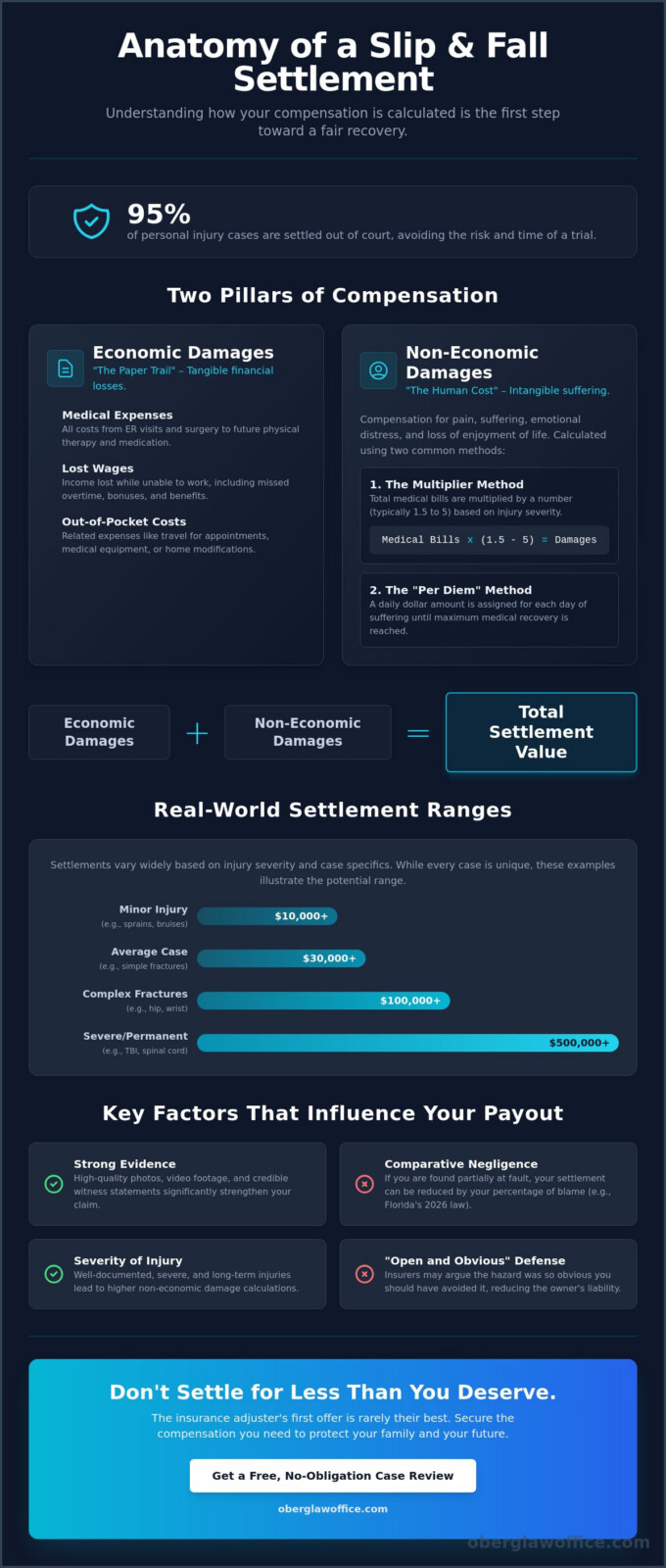
- Review real-world slip and fall settlement examples ranging from $10,000 for minor injuries to over $100,000 for complex bone fractures.
- Understand the difference between economic damages you can track with receipts and the non-economic compensation you deserve for pain and suffering.
- Discover how high-quality evidence like video footage and witness statements can overcome common “open and obvious” defenses used by insurance companies.
- See how working directly with an attorney ensures your case gets the personal attention it needs to secure a fair payout.
Understanding the Landscape of Slip and Fall Settlements
When you lose your footing on a wet floor or a broken sidewalk, your world stops for a moment. Suddenly, you’re dealing with physical pain, hospital visits, and the heavy stress of missing work. In the legal world, these incidents fall under the umbrella of “premises liability.” Premises liability is the legal obligation of property owners to maintain safe conditions. When a property owner fails this duty, they’re responsible for the harm that follows. While you might see slip and fall settlement examples online, it’s vital to remember that your story is unique. No two cases are exactly the same because no two injuries impact a person’s life in quite the same way.
The Role of Premises Liability in Your Claim
Your right to compensation often depends on why you were on the property in the first place. Texas law generally recognizes three types of visitors. Invitees are people there for business, like shoppers at a Mesquite grocery store. Licensees are social guests, while trespassers enter without permission. Property owners owe the highest level of “reasonable care” to invitees. This means they must regularly inspect the grounds and fix hazards. Proving they failed this duty is where the real work begins. You have to show the owner knew about the danger or should’ve known if they’d been paying attention. Understanding Slip and Fall Claims requires looking at this “burden of proof” as the foundation of your recovery. It isn’t just about the fall; it’s about the preventable mistake that caused it.
Why Most Cases Settle Out of Court
You might wonder why we don’t just go to court every time. The truth is that trials are unpredictable, expensive, and can drag on for years. A settlement is a private agreement that gives you control over the outcome. It provides immediate financial relief for those mounting medical bills without the risk of a jury’s “all or nothing” decision. As of May 2026, about 95% of personal injury claims are resolved through these negotiations. Insurance companies often try to offer a quick, lowball amount early in the process. Our job is to push back with evidence of your “fair recovery.” This recovery is a mix of economic damages, like lost wages and receipts, and non-economic damages for your physical pain and suffering.
We look at slip and fall settlement examples to set a baseline, but we fight for a result that reflects your specific losses. Whether it’s a minor sprain or a life-altering fracture, your recovery should cover the full impact on your family’s future. You aren’t just a file number; you’re a neighbor who deserves justice and a clear path forward.
How Slip and Fall Settlement Values Are Calculated
Calculating the value of your case isn’t about pulling a number out of thin air. It’s a structured process that balances your tangible losses with the intangible toll the accident has taken on your life. When looking at slip and fall settlement examples, you’ll see a wide range because every person’s “human cost” is different. Insurance adjusters usually start with your hard numbers, but they don’t always value your personal suffering correctly without a nudge. Our goal is to make sure the final number actually reflects the disruption to your family and your future.
Economic Damages: The Paper Trail
These are the “Special” damages that come with a receipt or a pay stub. They provide a clear, objective look at the financial hole the accident created. We gather every piece of evidence to build a wall of proof that the insurance company can’t ignore. This includes:
- Medical expenses: This covers everything from the initial ER visit to future surgeries or physical therapy sessions you’ll need.
- Lost wages: We track every hour you missed, including lost overtime and bonuses you would’ve earned if you weren’t sidelined.
- Out-of-pocket costs: Small things add up. We include gas for doctor visits, medications, and even modifications to your home if your injury requires them.
Non-Economic Damages: The Human Cost
Quantifying “General” damages is more complex. These represent the mental anguish and loss of enjoyment that follow a traumatic fall. In severe injury cases, non-economic damages often exceed medical bills because they represent a permanent change in your quality of life. To calculate this, adjusters often use the “Multiplier Method.” They multiply your total medical bills by a number, usually between 1.5 and 5, depending on the severity. Alternatively, the “Per Diem” method assigns a daily dollar value to your pain until you reach maximum recovery. Choosing a Slip and Fall Lawyer who understands these nuances is the best way to ensure you aren’t leaving money on the table.
You also have to account for “Comparative Negligence.” As of May 2026, many states have moved to stricter rules where your payout is reduced by your percentage of fault. For instance, if you’re found 20% responsible for not seeing a spill, a $100,000 settlement becomes $80,000. If you’re found more than 50% at fault, you might be barred from recovery entirely. If you’re worried about how these calculations might affect your family’s future, you can reach out for a personal review of your specific situation.
Real-World Slip and Fall Settlement Examples by Injury Type
Seeing headlines about multi-million dollar verdicts can be confusing when you’re just trying to pay your mortgage after a fall. While those massive numbers make the news, most people want to know what a typical recovery looks like for a neighbor in Mesquite. Looking at slip and fall settlement examples helps you set realistic expectations based on the severity of your injury. Your payout isn’t just a random number; it’s a reflection of your medical records, your lost paychecks, and the physical pain you endure every day.
As of May 2026, we see a clear trend where settlements scale with the level of medical intervention required. Soft tissue injuries, like grade 2 sprains or painful muscle strains, often result in payouts between $10,000 and $25,000. These cases move quickly because they usually don’t involve surgery. Bone fractures, however, push values much higher. A broken wrist or ankle that requires a cast and months of rehabilitation often sees settlements ranging from $30,000 to over $100,000, depending on how the break affects your ability to work.
Minor to Moderate Injury Examples
Small injuries still deserve justice. Consider a case where a shopper slips in a retail store puddle that wasn’t marked with a yellow sign. If that fall results in a sprained ankle and requires six weeks of physical therapy, a $15,000 settlement is a common outcome. This covers the initial ER visit, the therapy sessions, and a few weeks of missed shifts. Another example involves a torn ligament that doesn’t need surgery but keeps you from your hobbies for months. Even without a hospital stay, these “moderate” cases rely heavily on immediate medical documentation to prove the fall caused the damage.
Severe and Life-Altering Injury Examples
When an injury changes your life forever, the settlement must reflect that permanent shift. We often see hip fractures in elderly victims lead to recoveries of $150,000 or more because of the high risk of complications and the need for long-term assisted care. Spinal cord injuries are even more complex. A herniated disc that requires a fusion surgery can easily reach a mid-six-figure settlement to account for the surgical costs and the permanent loss of mobility. If you’re facing a recovery that involves home modifications or lifelong medical needs, our catastrophic injury lawyer mesquite resources explain how we calculate these significant long-term costs.
Traumatic Brain Injuries (TBI) also fall into this high-value category. Even a “mild” concussion can lead to months of cognitive fog and light sensitivity. Because your brain’s health impacts every part of your life, these slip and fall settlement examples often result in higher non-economic payouts for your mental anguish and lost quality of life.
Factors That Can Increase or Decrease Your Settlement Payout
You’ve seen the slip and fall settlement examples by injury type, but why do two people with the same broken wrist end up with different payouts? The final value often depends on how well you can counter the property owner’s defense tactics. Insurance companies aren’t in the business of being generous; they’re in the business of protecting their bottom line. They’ll look for any reason to chip away at your compensation, from questioning your shoes to digging through your medical history from five years ago.
Property owners frequently rely on the “open and obvious” defense. They’ll argue that the hazard was so plain to see that any reasonable person would’ve avoided it. If they can convince an adjuster or a jury that you were distracted, your payout could drop significantly under comparative negligence rules. Another major factor is the insurance policy limit. Every business has a “ceiling” on their coverage. If your damages exceed that limit, we have to look for other ways to ensure your family gets the full support you need.
Strengthening Your Case with Evidence
The “Golden Hour” is the sixty minutes immediately following your accident. Evidence in these cases is fragile and can disappear as soon as a janitor grabs a mop. If you’re physically able, take clear photos of the hazard from multiple angles. You also need to notify the property manager so they can create an official incident report. Be polite but firm; tell them what happened, but never sign a waiver or a statement that says you’re “fine” before you’ve seen a doctor. In complex cases, we often bring in safety experts who can testify about floor friction or lighting levels to prove the owner was truly negligent.
Common Pitfalls to Avoid
One of the biggest mistakes you can make is giving a recorded statement to an insurance adjuster without a lawyer present. They’re trained to ask “trap” questions that can make you sound like you’re admitting fault. You should also be very careful with social media. As of May 2026, insurance companies use sophisticated software to monitor your public profiles. A single photo of you smiling at a birthday party can be used to claim your “loss of enjoyment of life” isn’t as severe as you say. Finally, don’t delay your medical treatment. If you wait two weeks to see a doctor, the insurance company will claim there’s a “gap” in your timeline and argue your injury happened somewhere else.
Protecting the value of your claim requires a proactive strategy from day one. If you’re worried about how an insurance company is handling your case, you can contact our team today for a straightforward evaluation of your rights.
Navigating Your Claim with the Oberg Law Office
After a traumatic accident, you don’t just need a lawyer. You need a steadfast protector who understands that your recovery is about more than just money. It’s about your family’s future and your peace of mind. While looking at slip and fall settlement examples can give you a ballpark idea of what to expect, the right advocate makes the difference between a lowball offer and a settlement that truly covers your needs. At the Oberg Law Office, we combine compassionate support for our neighbors with an unwavering determination to hold negligent parties accountable.
Personalized Legal Protection
Many large firms operate as “settlement mills.” They take on hundreds of cases at once, and you might go months without ever speaking to an actual attorney. We’ve seen how these high-volume factories prioritize quick payouts over the actual needs of the client. Gregg Oberg brings over 25 years of experience to every case, ensuring you receive the personal attention you deserve. You’ll work directly with your attorney rather than being passed off to a paralegal or an assistant. This boutique approach allows us to build stronger cases by focusing on the specific details that a larger firm might overlook. For more information on how we handle local cases, you can read our guide for a personal injury lawyer mesquite tx.
Your Path to Recovery
The legal process shouldn’t add to your stress. We’ve designed our practice to be accessible and low-pressure. Our “no fee unless we win” model is a signature promise of our commitment to you. It means we share the risk of your case; if we don’t secure a settlement or a verdict, you don’t owe us a dime. This allows you to focus on your physical therapy and healing while we handle the aggressive negotiations with insurance giants. We use slip and fall settlement examples from our decades of practice to show adjusters exactly why your case warrants maximum compensation.
Your journey toward justice begins with a single, simple step. We offer a free initial strategy session where we’ll sit down, listen to your story, and outline a clear plan for your recovery. We’ll answer your questions about medical bills and legal jargon without the cold, detached formality of other offices. You don’t have to face the insurance companies alone. Schedule your free slip and fall strategy session today and let us help you move from a state of uncertainty to a feeling of empowerment.
Securing Your Future After a Fall
Understanding the value of your claim is the first step toward getting your life back on track. You’ve seen how slip and fall settlement examples range from $10,000 for minor sprains to over $500,000 for life-altering injuries. Your specific path to justice depends on the strength of your evidence and your advocate’s determination. With the 2026 shifts in comparative negligence laws, you can’t afford to let insurance companies dictate what your recovery is worth. You deserve a partner who sees the person behind the medical records and fights to protect your family’s stability.
Attorney Gregg Oberg brings over 25 years of legal experience to your side. You’ll have direct communication with your attorney from the very start rather than being passed to a paralegal. Because we believe in shared risk, we offer a no fee unless we win guarantee. This ensures you have access to high-quality legal protection without any upfront costs. Don’t let mounting bills or legal jargon overwhelm you. You can Get a Free Case Evaluation from Oberg Law Office today to discuss your rights. We’re ready to be your steadfast protector and guide you toward the recovery you deserve.
Frequently Asked Questions
What is the average settlement for a slip and fall in 2026?
As of May 2026, the average settlement for a slip and fall case is approximately $30,000. Most payouts typically fall within a range of $10,000 to $50,000. However, these numbers can change significantly based on the severity of your injuries and the impact on your ability to work. For instance, catastrophic injury claims involving long term care often result in much higher recoveries exceeding $500,000.
Can I still get a settlement if I was partially at fault for my fall?
Yes, you can still recover compensation as long as your fault doesn’t exceed a specific limit. Many states, including Florida and Louisiana as of January 1, 2026, use a modified comparative negligence standard. This means you can collect a settlement if you’re 50% or less at fault, but your total payout is reduced by your percentage of responsibility. If you’re found 51% or more at fault, you’re barred from recovery.
How long does it take to receive a slip and fall settlement check?
Most cases take between six and eighteen months to reach a final resolution. This timeline depends on your physical recovery and how long it takes to reach maximum medical improvement. We wait until your medical status is clear so we don’t settle for less than you need. Once both parties sign the agreement, the insurance company usually sends the check within 30 days.
Should I accept the first settlement offer from the insurance company?
You should almost never accept the first offer because it’s usually a lowball amount designed to save the insurance company money. Adjusters often push for a quick signature before you know the full extent of your future medical costs. Looking at slip and fall settlement examples shows that victims who decline the first offer and negotiate with professional help often secure much higher compensation for their families.
What happens if the property owner claims the hazard was “open and obvious”?
When an owner uses the “open and obvious” defense, they’re trying to prove that you should’ve seen the danger and avoided it. This is a common tactic to shift the blame onto the victim. We fight this by gathering evidence that shows the hazard was a violation of safety codes or that you were distracted by a business’s own displays. Proving the owner’s knowledge of the hazard is critical to overcoming this defense.
Do I need to go to court to get a slip and fall settlement?
You likely won’t have to go to trial. Data from May 2026 indicates that 90% to 95% of personal injury cases are settled out of court through private negotiations. While we prepare every case as if it might go to a jury, the goal is often to reach a fair agreement that provides your family with immediate financial relief. A settlement gives you more control over the final outcome than a trial.
What if I fell on government property or a public sidewalk?
Claims against government entities have much shorter deadlines and stricter procedural rules than private claims. You may only have 90 days to file a formal notice of claim, depending on the local municipality. These cases require a deep understanding of sovereign immunity laws. Because the window to act is so small, it’s vital to start the legal process immediately to protect your right to seek justice.
How much does a slip and fall lawyer cost?
You don’t pay any upfront costs because we work on a contingency fee basis. Our firm only receives a fee if we successfully win a settlement or a verdict for you. This “no fee unless we win” model ensures that everyone in our community has access to experienced legal protection. It removes the financial risk for you, allowing you to focus entirely on your physical and emotional recovery.