
Imagine sitting at your kitchen table with a stack of mounting bills in one hand and a doctor’s note in the other, wondering how you’ll bridge the gap between your recovery and your rent. It’s a heavy burden to carry when you should be focusing on your health. Knowing exactly how to document lost wages for a claim is the difference between struggling to stay afloat and receiving the full compensation you’ve earned. With insurance companies increasingly using automated systems to scan for any reason to lower your payout, your evidence needs to be airtight.
We understand the anxiety of watching your bank account dwindle while you’re physically unable to return to work. It feels incredibly unfair that you have to prove your worth to a claims adjuster who doesn’t know your personal story or your dedication to your job. This guide will show you exactly how to build a professional paper trail that links your medical necessity to your financial reality. You’ll find a clear checklist of required documents, specialized tips for calculating irregular income, and the steps needed to present a claim that the insurance company cannot ignore.
Key Takeaways
- Understand that your claim covers more than just base pay, including missed overtime, bonuses, and commissions you would have earned.
- Learn how to document lost wages for a claim by building a solid paper trail of paystubs and tax returns that establishes your pre-accident income.
- See why a doctor’s work excuse and functional capacity evaluations are essential to prove the direct link between your injury and your missed time.
- Find out how gig workers and the self-employed can use 1099s and Schedule C forms to provide the same level of proof as salaried employees.
- Identify common insurance traps, such as the sick leave misconception, to ensure your employer’s benefits don’t lower the settlement you deserve.
What Are Lost Wages in a Personal Injury Claim?
When you’re recovering from an accident, the physical pain is often matched by the stress of a shrinking bank account. Lost wages are the actual dollars and cents you would have earned if the injury hadn’t happened. This category of compensation is designed to restore your financial security by replacing the income that vanished the moment you were forced to stop working. Whether your case involves car accident representation or slip and fall representation, recovering these funds is a vital part of your path to wholeness.
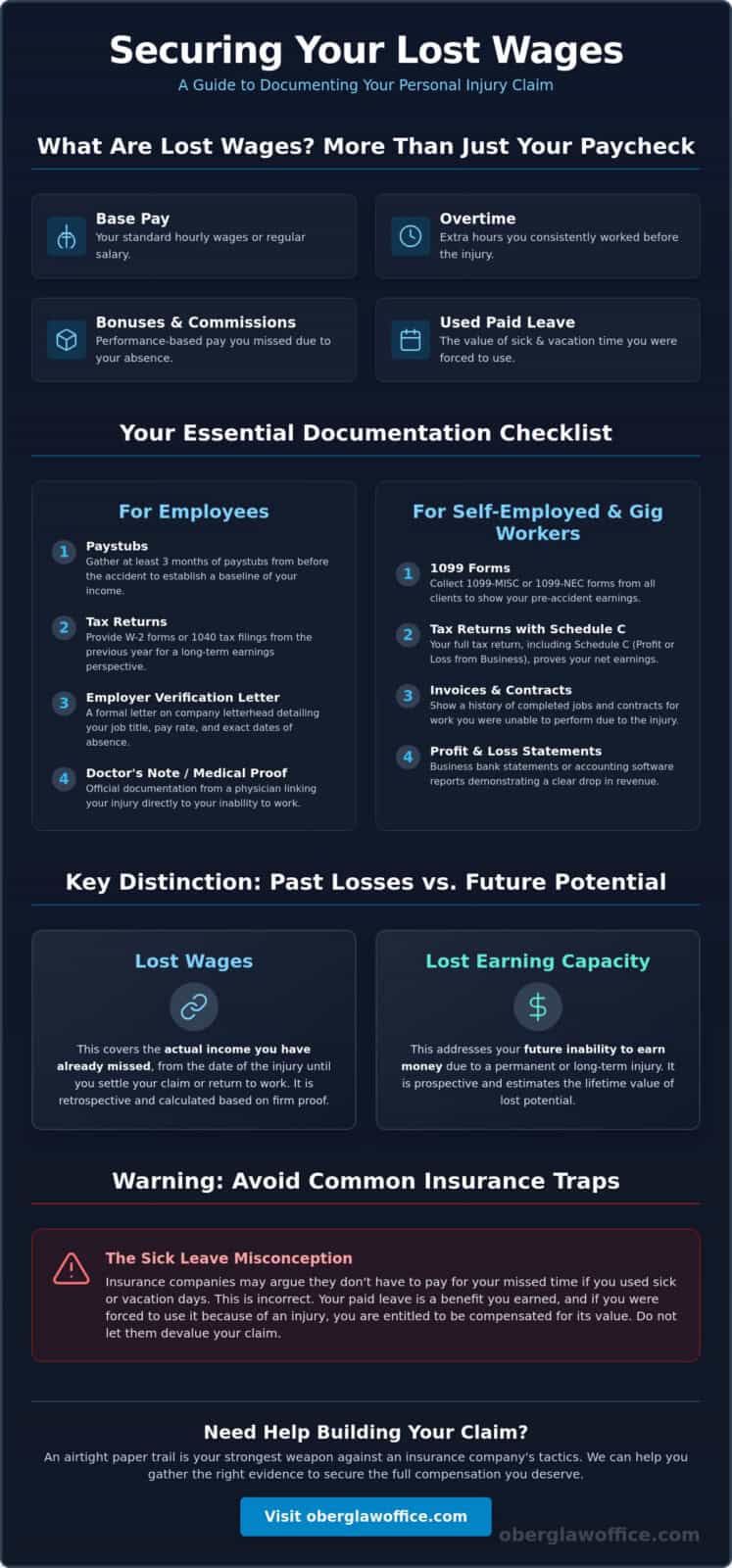
Knowing exactly how to document lost wages for a claim is essential because insurance companies won’t simply take your word for it. They treat lost income as a specific type of economic damage, which means it must be capable of exact calculation. This isn’t just about your base salary; it’s about every financial benefit your job provides. A comprehensive personal injury claim should account for several types of missed income, including:
- Base Pay: Your standard hourly wages or your regular monthly salary.
- Overtime: The extra hours you consistently worked before the accident but can no longer handle.
- Bonuses and Commissions: Performance-based pay that you missed out on due to your absence.
- Sick and Vacation Time: The value of the paid leave you were forced to use while recovering.
It doesn’t matter if you were hurt in a motorcycle accident or a bicycle accident; the law recognizes that your time has value. If another person’s negligence took you away from your livelihood, they are responsible for making it right.
Lost Wages vs. Lost Earning Capacity
While lost wages focus on the money you have already missed out on, lost earning capacity looks toward the future. Lost wages are retrospective; they cover the period from the date of your injury until you return to work or reach a settlement. In contrast, lost earning capacity addresses how your injuries will limit your ability to earn a living in the years to come. In cases involving catastrophic injury representation, both elements are critical. If a permanent disability prevents you from returning to your high-paying career, we must calculate the lifetime value of that lost potential to ensure your family remains protected.
Why Documentation Is Non-Negotiable
Insurance adjusters require verifiable proof before they’ll even consider issuing a payout for missed work. You carry the burden of proof, which means the responsibility to gather every paystub and medical note sits squarely on your shoulders. They often use sophisticated AI tools to look for gaps in your story, so your records must be flawless. Proper documentation serves as a shield that prevents insurance companies from dismissing your financial losses as merely speculative or unproven. Without a clear paper trail, even the most legitimate loss can be reduced or denied entirely.
The Essential Checklist: Core Employment Records
Organizing your financial life while recovering from an injury is a daunting task. It’s often the last thing you want to do when you’re focused on physical therapy and doctor appointments. However, gathering these records is your strongest defense against an insurance company that wants to minimize your loss. To successfully prove a lost wages claim, you must provide a clear “before and after” snapshot of your earnings. This starts with your most recent paystubs. We recommend gathering at least three months of stubs from the period immediately preceding your accident to establish a consistent baseline of your typical take-home pay.
While paystubs show your recent activity, income tax returns provide the long-term perspective adjusters look for. Your W-2 forms or 1040 tax filings from the previous year act as an undisputed annual baseline. These documents are particularly helpful if your income varies slightly from month to month. If you are worried about the complexity of your financial history, remember that you don’t have to face the insurance company’s scrutiny alone. Understanding how to document lost wages for a claim becomes much simpler when you have a dedicated advocate reviewing your files for accuracy.
The Employer Letter: What It Must Include
A simple note from your boss isn’t enough to satisfy a skeptical claims adjuster. You need a formal Wage Verification Form or a letter on company letterhead signed by a supervisor or HR representative. This document must state your exact job title and the specific dates you were absent from work. It should clearly outline your rate of pay at the time of the incident, whether you are salaried or hourly. Most importantly, it needs to document your typical overtime history. If you consistently worked five hours of overtime every week before your injury, that lost opportunity is a reimbursable expense.
Handling Irregular Income and Bonuses
Proving lost income is more challenging if you rely on performance-based pay. If your injury caused you to miss a quarterly bonus or a major sales commission, you must use historical data to show that these earnings were “expected” rather than speculative. We look at your production numbers from the same period in previous years to establish a pattern. For commission-based roles, we document how your physical inability to attend meetings or close deals directly resulted in a lower paycheck. This level of detail makes it much harder for an insurer to claim your financial dip was just a coincidence.
Don’t forget to account for lost “perks” that don’t appear on a standard paycheck. If your absence caused you to miss out on 401k matching contributions or required you to pay more for health insurance premiums, these are real economic losses. We can help you calculate these often-overlooked damages to ensure your settlement is truly fair. If you’re feeling overwhelmed by the paperwork, reaching out for professional legal guidance can provide the clarity and peace of mind you need during this difficult time.
Proving Medical Necessity: The Link Between Injury and Work
The insurance company doesn’t care how you feel; they care what a licensed medical professional says. If you stay home because you’re in pain but don’t have a doctor’s note to back it up, the insurer will likely deny those days as voluntary time off. This is why a formal work excuse is the most powerful tool in your arsenal. It bridges the gap between your physical suffering and your financial loss. Without this clinical link, your missed income is often dismissed as self-diagnosed and non-reimbursable.
Understanding how to document lost wages for a claim requires a deep dive into your medical files to ensure they speak the language of your job description. If your role requires heavy lifting, long periods of standing, or precise manual dexterity, your doctor’s reports must reflect why those specific tasks are currently impossible. This level of detail is a core part of documenting your lost wages with enough authority to silence a skeptical adjuster. We look for specific clinical findings that correlate directly with your inability to perform your daily work duties.
Functional Capacity Evaluations (FCE) provide objective data that subjective pain reports cannot. These tests measure your actual physical limits, such as your strength, range of motion, and stamina. If your job involves lifting 50-pound crates and the FCE shows you can’t lift more than 10 pounds without risking further injury, the link is undeniable. This evidence stops an insurance company from claiming your recovery is taking too long or that you are simply avoiding your responsibilities.
The Danger of “Light Duty” Restrictions
If your doctor clears you for light duty, but your employer has no such positions available, you are caught in a difficult spot. In these cases, you are still entitled to lost wages because your injury is the sole reason you aren’t earning. We document this as a constructive loss by obtaining a written statement from your employer confirming they cannot accommodate your medical restrictions. You must follow doctor’s orders exactly to protect the claim. Returning to work before you are cleared or ignoring restrictions can give the insurer an excuse to stop your benefits entirely.
Documenting Ongoing Medical Appointments
Recovery isn’t just about the weeks you spent in a hospital bed. It’s also about the two hours you miss every Tuesday for physical therapy or the half-day lost to a specialist consultation. These fragmented hours add up quickly over several months. We recommend keeping a meticulous time log of every minute missed due to medical necessity. Working with an experienced personal injury lawyer ensures these smaller, repetitive losses are calculated accurately and included in your final demand. Your time has value, and every hour spent in a waiting room is an hour you should have been paid for.
Documenting Lost Income for the Self-Employed and Gig Workers
If you work for yourself, you are your own HR department. This makes the question of how to document lost wages for a claim slightly more complex, but certainly not impossible. Since you don’t have a traditional supervisor to sign a wage verification form, your evidence must come from your financial history and business records. We help you assemble a professional package that proves your value to the insurance company. You deserve to be compensated for the business you built, even if your paycheck doesn’t come from a standard employer.
Your IRS Tax Returns, specifically Schedule C from your 1040, serve as the primary evidence of your historical earnings. Insurance adjusters typically require two to three years of these returns to establish a reliable income baseline. We also utilize 1099 forms to prove income from various clients or digital platforms. To show the immediate impact of the accident, we look at your Profit and Loss (P&L) statements. A sharp dip in revenue following your injury provides a clear, visual representation of your loss that is difficult for insurers to dispute.
Don’t overlook lost contractual opportunities. If you had to cancel a bid, turn down a freelance project, or walk away from a signed contract because of your injury, that income is recoverable. Understanding how to document lost wages for a claim as a freelancer involves gathering every piece of evidence that shows your business was thriving before the accident. We use email chains, formal bids, and cancellation notices to turn these missed opportunities into tangible damages. Documenting these specific losses ensures you aren’t just reimbursed for the work you did, but also for the work you were prevented from doing.
Gig Economy Documentation (Uber, Lyft, DoorDash)
Working in the gig economy requires a specialized approach. We use your app-based earnings reports to calculate your average weekly take prior to the accident. It’s vital to distinguish between active hours and online hours to prove your actual availability to work. Because gig work fluctuates, we compare year-over-year data for the same month. This accounts for seasonality, ensuring a slow month in the broader industry doesn’t unfairly lower your personal settlement.
The Role of Expert Witnesses
High-value business losses often require more than just basic spreadsheets. We may bring in a forensic accountant to untangle complex revenue streams and calculate the true cost of your absence. If your injuries are life-altering, a vocational expert can testify about how you can no longer work in your specific field. This level of expertise is why catastrophic injury lawyer involvement is vital for protecting your long-term business interests. If you are struggling to prove your income as a business owner, contact us for a personal review of your financial records to ensure nothing is missed.
Common Pitfalls and Insurance Tactics to Avoid
Insurance companies are businesses focused on their bottom line, not your recovery. They often use sophisticated tactics to minimize the amount they pay out for missed work. One of the most frequent traps is the “sick leave” objection. An adjuster might tell you that because your employer paid you using sick time or vacation days, you didn’t actually lose any income. This is a misleading argument designed to save them money. You’ve lost a valuable benefit that you earned, and you’re entitled to have those days “bought back” through your settlement.
Consistency is your best defense when learning how to document lost wages for a claim. In the digital age, insurance companies increasingly use AI to monitor your social media activity. If you claim you’re unable to work due to a severe back injury but post a photo of yourself at a neighborhood barbecue or a child’s sporting event, the insurer will use it to challenge your credibility. Even an innocent moment can be twisted to look like you’re exaggerating your physical limits. It’s best to stay off social media entirely until your case is resolved to ensure your public profile doesn’t contradict your medical records.
Timing is another critical factor. You must be mindful of the statute of limitations, which is the legal deadline for filing your lawsuit. If you wait too long to organize your evidence or file your claim, you could lose your right to recover anything at all. Similarly, be extremely cautious about signing early releases. Insurance adjusters often push for a quick settlement before the full extent of your wage loss is known. Once you sign that paper, you cannot go back and ask for more money if your recovery takes longer than expected.
The Collateral Source Rule Explained
The law provides a specific protection called the Collateral Source Rule to prevent insurers from acting unfairly. This rule states that benefits you receive from other sources, such as your private disability insurance or employer-provided leave, cannot be used to reduce the defendant’s liability. Your used vacation days have a specific dollar value that must be reimbursed as part of your economic damages. You are entitled to the full value of your time, regardless of how you were paid during your recovery period.
How a Lawyer Maximizes Your Recovery
Navigating these tactics alone is exhausting. Studies show that plaintiffs who hire a lawyer receive an average of $77,600 in compensation, compared to just $17,600 for those who represent themselves. We step in to negotiate with adjusters who claim you “could have” worked or that your time off wasn’t medically necessary. Our team ensures that every missed bonus, lost promotion, and future earning capacity is factored into your final demand. With contingency-based representation, you pay nothing unless we win, allowing you to focus on your health while we handle the heavy lifting of your claim.
Take Control of Your Financial Recovery Today
Recovering from an injury is hard enough without the added stress of financial uncertainty. You’ve worked hard for your income, and you shouldn’t have to sacrifice your stability because of someone else’s mistake. By gathering your paystubs and securing a detailed medical work excuse, you’ve already taken the first steps toward protecting your future. Understanding how to document lost wages for a claim is about more than just paperwork; it’s about ensuring the insurance company sees the real human impact of your accident. Your livelihood is worth defending, and a clear paper trail is your strongest shield.
You don’t have to navigate this complex process alone. With over 25 years of legal experience, Attorney Gregg Oberg provides the personalized attention your case deserves. We are committed to standing by your side as a steadfast protector against aggressive insurance tactics. Since we operate on a performance-based structure, there are no fees unless we recover money for you. Schedule your free initial strategy session with Oberg Law Office today and let us help you secure the full compensation you’ve earned. Your path to restoration starts with a single conversation, and we’re ready to help you move forward with confidence.
Frequently Asked Questions
Can I claim lost wages if I am a salaried employee?
Yes, salaried employees are absolutely entitled to recover lost income after an accident. We calculate your loss by determining your daily or hourly rate based on your annual contract. Even if your paycheck stayed the same because you used leave, you’ve lost the value of those benefit days. We work with your HR department to get a letter confirming the exact time you were away from your desk and the specific value of your salary package.
What if I was paid for sick leave or vacation time after the accident?
You can still recover the value of that time even if you used paid leave to cover your absence. Using your hard-earned vacation or sick days to recover from an injury is a real financial loss. The law doesn’t allow the insurance company to benefit from your employer’s generosity or your personal benefits. We ensure the value of every hour of leave you exhausted is included in your final settlement demand so those days are effectively bought back.
How do I prove lost wages if I work for cash or tips?
Proving cash or tip-based income requires a consistent trail of documentation to be successful. We look at your previous tax returns, bank deposit records, and any personal tip logs you maintained before the injury. If you reported your tips to your employer, those records become vital evidence. Our goal is to establish a believable average of your weekly earnings before the accident interrupted your ability to serve your customers and earn your livelihood.
Can I recover lost wages for time spent at doctors’ appointments?
Yes, any time missed for necessary medical treatment is a valid part of your personal injury claim. This includes physical therapy, specialist consultations, and follow-up exams. These small gaps in your workday add up quickly over several months of recovery. Keeping a detailed log of every appointment helps us show exactly how many hours of work you missed while attending to your health and rehabilitation. Every hour of your time has a specific dollar value.
What if I was unemployed at the time of the accident but had a job offer?
You can recover lost income if you had a firm job offer with a set start date and salary. We use the formal offer letter and a statement from the prospective employer to prove what you would have earned. If the injury prevented you from starting that new role, the insurance company is responsible for the wages you lost. It is about documenting the certainty of that missed financial opportunity rather than just a general desire to find work.
How long does it take to get reimbursed for lost wages in a claim?
Lost wages are typically reimbursed as part of your final settlement rather than in weekly installments from the insurance company. On average, personal injury claims take about 11 months to resolve. We know the wait is difficult when household bills are piling up. That is why we work to build an undeniable case early on, moving you from a state of uncertainty toward a fair and timely resolution that covers all your missed paychecks.
Do I need a lawyer to help me document my lost income?
While you aren’t legally required to have a lawyer, professional help often results in significantly higher compensation for your losses. Knowing how to document lost wages for a claim involves navigating complex insurance tactics and specific legal rules. We handle the stressful communication with adjusters and verify every calculation for you. This partnership allows you to focus entirely on your physical recovery while we work to secure your complete financial restoration.
Is there a limit on how much lost income I can recover?
There is generally no legal cap on the amount of lost income you can recover, but insurance policy limits may restrict the available funds. If your total losses exceed the at-fault party’s coverage, we explore other avenues like underinsured motorist coverage. We calculate your total economic loss, including future earning capacity, to ensure the demand reflects the true reality of your situation. No detail is too small when we are protecting your family’s financial security.