
The insurance adjuster who calls you after a crash might sound like a helpful neighbor, but their primary goal is to settle your claim for as little as possible. It’s a frustrating reality that many Texans face while they’re still in pain and trying to make sense of a life-altering event. You likely feel the pressure to sign papers just to stop the phone from ringing, yet you worry that one wrong word could cost you the compensation you deserve.
You’re right to be cautious because dealing with insurance adjusters after an accident in Texas requires a strategic approach to protect your future. This guide provides the expert legal insights you need to master these complex negotiations and stand your ground against large institutions. We will walk through the specific 2026 Texas legal frameworks, common adjuster tactics to avoid, and how to determine the true value of your medical bills and lost wages. By the end of this article, you’ll have the clarity and confidence to move from a state of uncertainty to a position of strength.
Key Takeaways
- Learn why insurance adjusters prioritize company profits over your recovery and how to set firm boundaries from the very first phone call.
- Discover how the Texas Insurance Code protects you with mandatory claim deadlines and fair investigation requirements that insurers must follow.
- Master the art of dealing with insurance adjusters after an accident texas by sticking to objective facts and avoiding common verbal traps that can devalue your claim.
- Identify and counter standard industry tactics like low-ball settlement offers and attempts to shift blame through comparative negligence.
- Find out how direct communication with a senior attorney can transform your negotiation leverage and ensure your medical bills and lost wages are fully covered.
The Adjuster’s Role: Why Their Interests Diverge from Your Recovery
An insurance adjuster is a professional negotiator hired to evaluate claims and minimize the financial exposure of the insurance company. While they may present themselves as a neutral party helping you move forward, their primary duty is to the corporation that signs their paycheck. This creates an inherent conflict of interest. Every dollar they save their employer is a dollar that stays out of your pocket. Understanding this dynamic is the first step in successfully dealing with insurance adjusters after an accident texas victims often face.
It’s also vital to recognize who you’re speaking with during this process. A first-party adjuster works for your own insurance company, while a third-party adjuster represents the other driver. Even if you’re talking to your own provider, remember that they are still a business focused on profit margins. Establishing clear professional boundaries from the very first phone call ensures you don’t accidentally compromise your right to a full recovery. You aren’t required to be their friend; you’re there to protect your legal rights.
The “Friendly Adjuster” Trap
Adjusters are often trained in rapport-building skills designed to put you at ease. They might ask how your family is doing or suggest they “just want to get your side of the story” to help speed things up. This friendliness isn’t just politeness; it’s a strategic tool. If you casually mention you’re “doing okay” or were “out running errands,” they can use those statements later to argue your injuries aren’t severe. Maintain a professional, fact-based tone. Don’t discuss your health, your daily activities, or your emotional state in casual conversation.
The Goal of Early Settlement Offers
You might receive a settlement offer within days of the accident. While a quick check feels like a relief when medical bills are piling up, these offers rarely account for the long-term costs of care or future lost wages. Insurance companies know that once you sign a release, your case is officially over. A full and final release is a legal document that permanently waives your right to seek any additional compensation for the accident, even if your injuries worsen later. Dealing with insurance adjusters after an accident texas requires the patience to wait until the full extent of your damages is known. Don’t let the pressure of a quick check lead to a lifetime of unpaid medical debt.
Texas Insurance Laws: Understanding Your Rights and Claim Timelines
Victims often feel like they’re at the mercy of a giant corporation, but the Texas Insurance Code actually acts as your primary shield against unfair practices. When you’re dealing with insurance adjusters after an accident texas law provides specific protections to ensure your claim is handled with professional decency. If a company violates these rules, they may be acting in “bad faith.” This occurs when an insurer fails to attempt a fair settlement when liability is reasonably clear. You also have the legal right to a written explanation if they deny your claim or only offer a partial payment. This document is vital because it forces the adjuster to commit their reasoning to paper.
Statutory Deadlines for Claims in Texas
Specific clocks are set by state statute to ensure your life isn’t put on hold indefinitely while an insurer sits on your file. Successfully dealing with insurance adjusters after an accident texas involves holding them to these strict 2026 requirements:
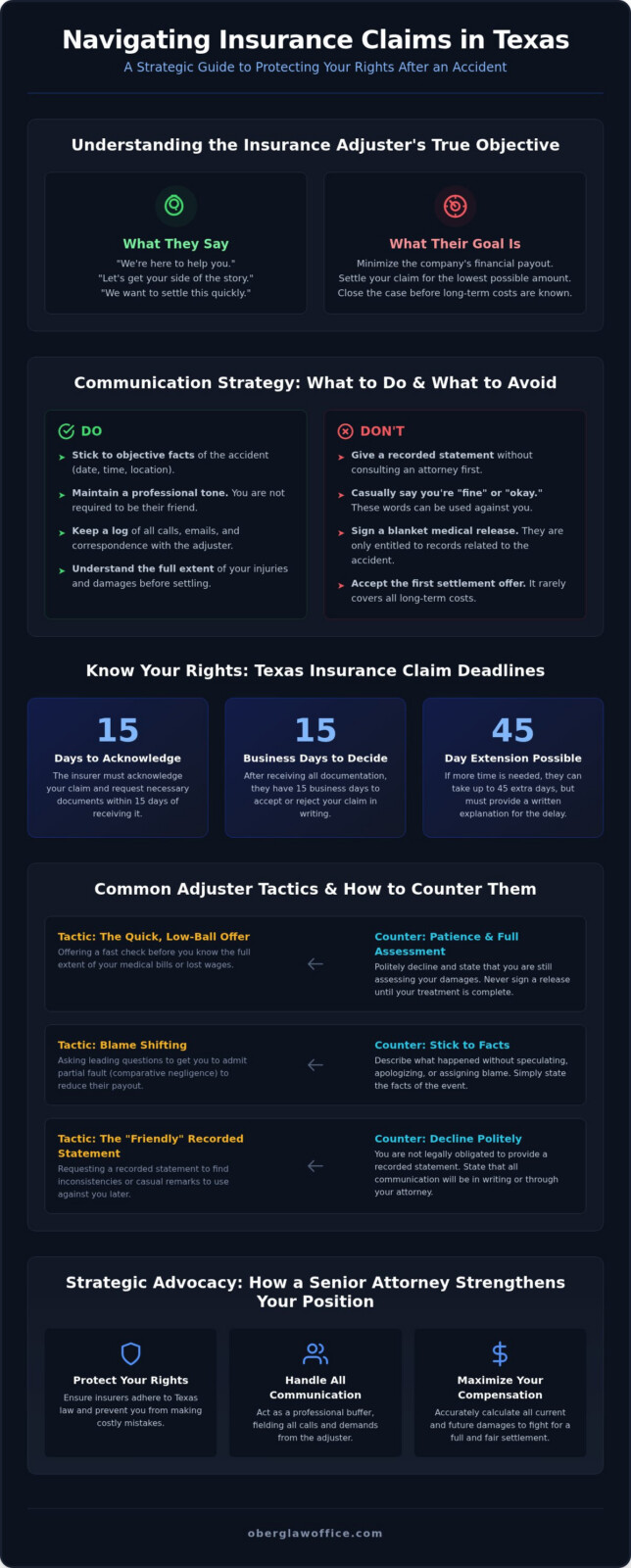
- 15 Days to Acknowledge: Once you file a claim, the company has 15 days to acknowledge it and request all necessary items or forms.
- 15 Business Days to Decide: After they receive all requested documentation, they generally have 15 business days to accept or reject your claim in writing.
- The 45-Day Extension: If they need more time to investigate, they can request an extension of up to 45 days, but they must explain the reason for the delay.
Your Rights During the Investigation
You don’t have to accept the insurance company’s word as final during the evaluation process. You have the right to obtain your own independent estimate for property damage rather than relying solely on their preferred body shops. Regarding your health, protect your medical privacy. Adjusters often ask for a blanket medical release, but they’re only legally entitled to records related to the specific injuries from the accident. They might also perform a “social media sweep” to find photos that contradict your claims. It’s often helpful to have a professional review your case to ensure you aren’t providing more information than the law requires. Your privacy is a right, not a luxury.
Communication Best Practices: Protecting Your Case During Initial Interviews
The first phone call from an insurance company often arrives when you’re still processing the shock of the crash. It’s a high-pressure moment where one casual comment can change the trajectory of your recovery. Successfully dealing with insurance adjusters after an accident texas requires a disciplined approach to every conversation. You should treat these interviews as formal legal encounters rather than casual chats with a neighbor. Your goal is to provide the bare essentials: the date, the time, the location, and the names of the parties involved. Anything beyond these objective facts creates an opening for the insurance company to devalue your claim.
Speculation is one of the most dangerous traps you can fall into. Phrases like “I think,” “maybe,” or “I’m pretty sure” signal to the adjuster that your memory is unreliable. If you don’t know an answer with absolute certainty, “I don’t know” or “I’m not prepared to discuss that yet” are perfectly valid responses. This is especially true when it comes to your health. You should never discuss your injuries or how you’re feeling until you’ve completed a full medical evaluation and have a clear treatment plan from a professional. Adrenaline can mask pain for days; don’t let an adjuster record you saying you’re “fine” before the real symptoms even appear.
The Recorded Statement Dilemma
You aren’t legally required to give a recorded statement to the other driver’s insurance company in Texas. While they may imply that it’s a necessary step to “process your claim faster,” they’re actually looking for “gotcha” moments. They might ask leading questions about your speed or your pre-existing medical history to imply that you’re at fault or that your current pain isn’t related to the crash. Having a legal protector present or simply declining the recording until you’ve consulted with a professional ensures that your words aren’t twisted against you later in the process.
Managing Digital and Social Presence
Adjusters are professional investigators who will likely monitor your public social media profiles. Even a simple, well-intentioned photo of you at a family dinner or a local park can be used as evidence to dispute your physical pain or emotional distress. They’ll argue that if you’re well enough to smile for a camera, you aren’t as injured as you claim. While your legal case is pending, it’s best to set your accounts to private and avoid posting any updates about your life or the accident. Your digital footprint is part of your evidence; keep it secure so it can’t be used to undermine your right to fairness.
Common Adjuster Tactics and How to Counter Them Effectively
Insurance adjusters often rely on a specific playbook of tactics to protect their company’s bottom line. When you’re dealing with insurance adjusters after an accident texas victims should be prepared with a strategic counter-move for every common play. For instance, if you receive a “low-ball” first offer, don’t just reject it. Demand a line-item breakdown of how they calculated your damages. This forces them to justify their numbers rather than pulling an arbitrary amount from thin air. If they try to delay the process, remind them of the Texas Insurance Code mandates. Silence is often a tool used to wait until your bills become overwhelming; don’t let it work.
Another frequent tactic involves requesting a “blanket” medical release. This gives them access to your entire health history, allowing them to claim your current pain is actually a pre-existing condition. You should only provide records directly related to the accident. If the adjuster continues to push for invasive access or refuses to be fair, it’s time to schedule a free strategy session to gain professional clarity on your next steps. Standing your ground early prevents the insurance company from controlling the narrative of your recovery.
Combatting Comparative Fault Arguments
Texas follows a “proportionate responsibility” rule. This means your total recovery is reduced by your percentage of fault. If you’re found to be more than 50% responsible, you cannot recover any damages at all. Adjusters try to find even 1% of fault on your part to chip away at their liability. They might claim you were distracted or speeding without any evidence. To counter this, you must present objective police reports and expert analysis that solidify the other party’s 100% liability. We use every piece of evidence to ensure you aren’t unfairly blamed for a crash you didn’t cause.
The Value of an Independent Evaluation
The insurance company might encourage you to use their “preferred” repair shops or medical providers. While this sounds convenient, these vendors often have financial relationships with the insurer, creating a potential bias toward cost-cutting. You have the right to choose your own repair facility. Seeking an independent evaluation ensures that the full extent of your vehicle damage and physical injuries is documented by someone who isn’t worried about the insurance company’s profit margins. Independent accident reconstruction experts can also provide the technical proof needed when an adjuster refuses to acknowledge the facts of the crash. Dealing with insurance adjusters after an accident texas is a battle of evidence; make sure yours is unbiased and accurate.
Strategic Advocacy: How a Senior Attorney Secures the Justice You Deserve
Dealing with insurance adjusters after an accident texas can feel like an uphill battle when you’re doing it alone. Large insurance companies have teams of professionals working to minimize your claim. When you partner with Oberg Law Office, you’re leveling the playing field. Gregg Oberg brings over 25 years of experience in Texas personal injury law to your side. Unlike volume-based firms where you might only speak with a support staff member, we ensure you have direct communication with a senior attorney. This personal touch changes everything. It signals to the insurance company that you have a formidable protector who won’t be intimidated by their tactics.
Being trial-ready is a significant advantage. Insurance adjusters are more likely to offer a fair settlement when they know the attorney on the other side is prepared to go to court. We handle all the logistics, from gathering evidence to managing deadlines. This removes the heavy burden from your shoulders. You can focus on your medical treatment and physical healing while we handle the aggressive negotiations. Our goal is to restore your sense of security and ensure you aren’t forced to accept anything less than what is fair.
The Partnership Approach to Legal Recovery
Our partnership approach moves you from the role of a victim to a protected client. We look beyond the immediate bills to calculate the true, long-term cost of your recovery. This is especially vital for catastrophic injuries that require ongoing care or specialized equipment. You can find more details in our personal injury recovery guidance regarding how we build a comprehensive case for your future. We treat your case with the individual attention it deserves, focusing on tangible results rather than abstract legal theories.
Your Path Forward: The Free Strategy Session
Your path forward begins with a free strategy session. During this initial consultation, Gregg Oberg will personally review the facts of your case and provide clarity on your legal rights. We operate on a contingency fee basis. This means our fee is a percentage of the recovery we secure for you; if we don’t win, you don’t pay. This shared risk ensures we’re just as invested in your success as you are. For specific vehicle claim insights, please see our car accident legal representation guide. Mastering the process of dealing with insurance adjusters after an accident texas starts with having the right advocate in your corner.
Take Control of Your Recovery and Your Future
Mastering the process of dealing with insurance adjusters after an accident texas requires both patience and a firm understanding of your legal rights. The insurance company operates on profit margins; your recovery depends on setting clear boundaries and holding them to the strict timelines mandated by the Texas Insurance Code. By refusing to settle for a quick low-ball offer and protecting your medical privacy, you ensure that your final settlement covers the true, long-term costs of your injuries. You don’t have to face these large institutions alone.
With over 25 years of Texas legal experience, Gregg Oberg provides direct advocacy to ensure your voice is heard. Our firm works on a contingency basis, meaning there are no fees unless we secure a recovery for you. Request Your Free Legal Strategy Session Today to gain the clarity you need. We’re here to help you move from a state of uncertainty to a position of strength and restoration. You deserve a partner who is personally invested in your success.
Frequently Asked Questions
Do I have to talk to the other driver’s insurance adjuster?
You aren’t legally required to provide a statement to the other driver’s insurance company. While they may call you quickly to “get your side of the story,” their goal is often to find ways to reduce their liability. It’s usually safer to refer the adjuster to your legal representative to ensure your words aren’t twisted. Dealing with insurance adjusters after an accident texas is much easier when you have a professional handling the communication for you.
Should I sign the medical authorization form the adjuster sent me?
You should be extremely cautious about signing a blanket medical authorization form. These forms often give the insurance company access to your entire medical history, not just records related to the accident. They use this information to claim your current injuries are actually pre-existing conditions. Instead of signing a broad release, provide only the specific medical bills and records related to your crash injuries to protect your privacy and your claim’s value.
What happens if the insurance adjuster says the accident was my fault?
If an adjuster claims you’re at fault, they’re likely applying Texas “proportionate responsibility” rules to reduce or deny your payout. Don’t take their word as final. You can challenge their assessment by presenting objective evidence like police reports, witness statements, and photos from the scene. Professional advocacy is vital here to prove the other party’s liability and ensure you aren’t unfairly blamed for a crash that wasn’t your fault.
How long do I have to file a claim after an accident in Texas?
In Texas, the statute of limitations for personal injury lawsuits is typically two years from the date of the accident. However, your insurance policy likely requires you to report the crash promptly or within a specific number of days. Waiting too long to start the process can give the insurer an excuse to deny coverage. It’s best to initiate the claim as soon as possible while the evidence is fresh and witnesses are available.
Can I change my mind after accepting a settlement offer?
Once you sign a settlement agreement and a “full and final release,” you generally cannot change your mind or ask for more money later. This is true even if you discover new injuries or your medical bills end up being higher than expected. This finality is why you should never rush into a settlement before you’ve reached maximum medical improvement and fully understand the total financial impact of the accident on your life.
What if the adjuster is ignoring my calls or emails?
If an adjuster is ignoring you, they may be using a delay tactic to wait until you’re financially desperate enough to accept a low offer. You have rights under the Texas Insurance Code, which mandates specific timelines for acknowledging and investigating claims. Dealing with insurance adjusters after an accident texas requires persistence. Sending a formal written inquiry or having an attorney intervene often forces the insurance company to prioritize your file and follow the law.
Is the first offer from the insurance company usually fair?
The first offer from an insurance company is rarely fair. It’s often a “low-ball” amount designed to see if you’ll settle quickly for less than your claim is worth. These early offers usually fail to account for future medical care, lost earning capacity, or the full extent of your pain and suffering. You have the right to reject the first offer and counter with a demand that reflects the true value of your damages.
How much does it cost to have a lawyer handle the insurance adjuster for me?
At Oberg Law Office, we work on a contingency fee basis. This means there are no upfront costs or hourly fees for you to pay. Our fee is a percentage of the final recovery we secure on your behalf. If we don’t win your case, you don’t owe us any legal fees. This structure ensures that high-quality legal representation is accessible to everyone, regardless of their current financial situation after a serious accident.