Imagine you’re driving home through Mesquite on a rainy Tuesday evening when a shadow suddenly looms in your rearview mirror. You feel your sedan tremble as one of the massive big rigs thunders past, leaving you gripped by a familiar sense of anxiety. It’s a feeling shared by the 2.5 million motorists who traverse Texas highways every day, many of whom wonder if that 80,000-pound machine is actually following federal safety standards. You deserve to feel secure on the road, yet the sheer size of these vehicles often makes the pavement feel like a place where you’re the underdog.
We understand that the legal landscape following a truck encounter can leave you feeling overwhelmed and unheard. This guide is here to change that. You’ll discover everything you need to know about big rigs, from their complex mechanics and 2026 federal regulations to the exact steps for protecting your rights after a collision. We’re going to break down the latest safety requirements and provide a clear roadmap for your legal recovery. By the time you finish reading, you’ll have the knowledge you need to stand firm against insurance companies and focus on your family’s healing.
Key Takeaways
- Understand the technical differences between various commercial vehicles to help you navigate the aftermath of an accident with confidence.
- Learn how 2026 federal safety standards and rest mandates work to keep tired drivers off our roads and protect your safety.
- Identify the leading causes of accidents involving big rigs, including mechanical failures and driver errors, to better understand who may be at fault.
- Discover the critical steps you must take in the first 24 hours after a collision to preserve evidence and secure your right to justice.
- Find out why having a compassionate advocate is essential for standing up to powerful trucking “Goliaths” and securing the compensation you deserve.
What is a Big Rig? Defining the Giants of the Highway
You see them every day while driving along I-635 or the US-80 through Mesquite. They are the massive vehicles that haul everything from our groceries to our building materials. A big rig is technically defined as the combination of a heavy-duty tractor unit and one or more semi-trailers. These Giants of the Highway serve as the primary artery of American commerce. You might hear people use terms like 18-wheeler, semi-truck, or tractor-trailer interchangeably. While “semi” refers to the trailer itself, which has no front axle and relies on the tractor for support, “big rig” has become the neighborly shorthand for the entire massive assembly.
The scale of this industry is staggering. By 2026, data from the American Trucking Associations suggests that over 4.3 million Class 8 trucks will be operating across U.S. highways. This means you are sharing the road with more heavy freight than ever before. Understanding the sheer size of big rigs is the first step in staying safe. A standard tractor-trailer can reach lengths of 70 to 80 feet, creating a presence on the road that demands your full attention and respect.
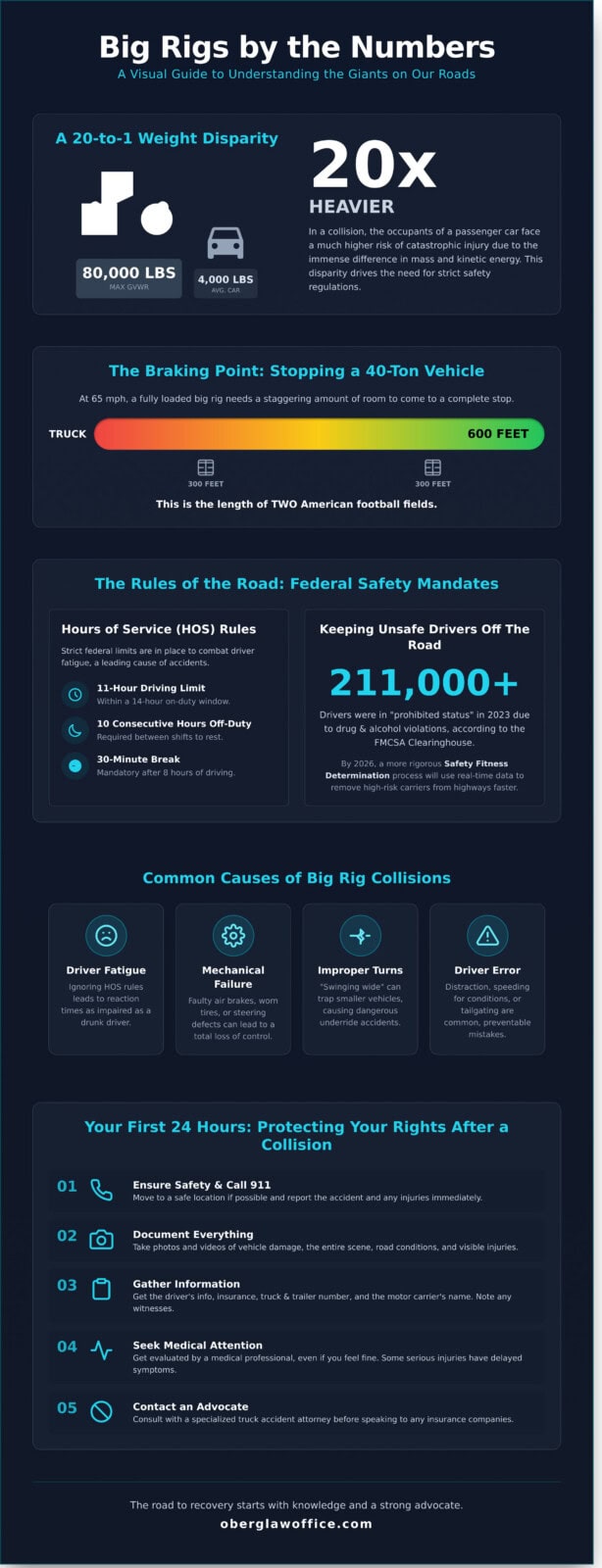
A fully loaded truck can weigh up to 80,000 pounds under federal Gross Vehicle Weight Rating (GVWR) limits. To put that in perspective, your typical passenger car weighs about 4,000 pounds. This 20-to-1 weight ratio means that in any collision, the smaller vehicle and its occupants face a much higher risk of catastrophic injury. We see the aftermath of these weight imbalances often, and it drives our commitment to protecting families in our community.
The Anatomy of a Tractor-Trailer
The tractor unit is the powerhouse of the operation. It houses a massive diesel engine and multiple axles designed to distribute weight. The “fifth wheel” is the horseshoe-shaped coupling that links the tractor to the trailer. Different trailers serve different needs; you will see dry vans for general freight, reefers for refrigerated goods, and flatbeds for oversized equipment. Unlike your car’s hydraulic brakes, these trucks use air brakes. This system is reliable but has a built-in “brake lag” that adds precious feet to every stop.
Why Weight Matters: The Physics of a Collision
Physics doesn’t take a day off on the Texas highways. When a 40-ton truck travels at 65 mph, its kinetic energy is immense. Stopping a vehicle of this size isn’t immediate. A loaded truck needs roughly 600 feet to come to a complete stop, which is the length of two football fields. Big rigs also require a massive turning radii. Drivers must often “swing wide” to the left to make a right-hand turn. If you are caught in that gap, it can lead to a dangerous underride accident where a car slides beneath the trailer.
Federal Regulations: The Rules Big Rigs Must Follow
When you share the road with 80,000-pound vehicles, you deserve to know that the driver behind the wheel is qualified, sober, and well-rested. The Federal Motor Carrier Safety Administration regulations serve as the primary shield protecting Texas families from preventable tragedies. By 2026, the FMCSA will implement a more rigorous Safety Fitness Determination process, which will use real-time data to identify and remove high-risk carriers from our highways more quickly. These rules aren’t just suggestions; they are legal requirements designed to keep big rigs from becoming hazards to everyone else on the road.
Fatigue is a silent killer in the trucking industry. To combat this, Hours of Service (HOS) rules establish strict limits on how long a person can operate a commercial vehicle. Currently, drivers are limited to an 11-hour driving shift within a 14-hour window after being off duty for 10 consecutive hours. They must also take a mandatory 30-minute break after 8 cumulative hours of driving. These rest periods are essential because an exhausted driver has the same diminished reaction time as someone under the influence of alcohol. When companies push their drivers to ignore these limits, they prioritize their delivery schedules over your life.
Operating a commercial vehicle requires specialized skills that go far beyond a standard driver’s license. Operators must earn a Commercial Driver’s License (CDL) and obtain specific endorsements for complex tasks, such as hauling hazardous materials or pulling double trailers. Safety also depends on sobriety. Under Part 382 of the federal code, carriers must conduct pre-employment, random, and post-accident drug and alcohol testing. In 2023, the FMCSA Drug and Alcohol Clearinghouse reported that over 211,000 drivers were in prohibited status due to violations. This system ensures that those who struggle with substance abuse are identified and removed from the driver’s seat until they complete a supervised return-to-duty process.
Electronic Logging Devices (ELDs) and Data Privacy
Since 2017, almost all commercial drivers have been required to use Electronic Logging Devices to track their movements. By 2026, the industry will transition toward “Smart” ELDs that offer better GPS accuracy and enhanced crash-survivability for data. These devices record exactly when a truck is moving, making it nearly impossible for drivers to falsify their logs. If you are hurt in a collision, we can use this digital footprint to prove HOS violations in court. This data provides the concrete evidence needed to hold negligent companies accountable for their choices.
Maintenance and Inspection Standards
Safety starts before the engine even turns over. Federal law requires drivers to perform daily pre-trip and post-trip inspections to verify that brakes, tires, and lights are functioning. Carriers must also conduct a formal annual inspection for every vehicle in their fleet. If a truck fails to meet the “Out of Service” criteria, such as having 20 percent of its brakes out of adjustment, it is legally prohibited from being on the road. When a carrier skips these vital checks to save money, they put every driver in Mesquite at risk. If you suspect a mechanical failure caused your accident, our team can help you review the carrier’s maintenance logs to uncover the truth about the vehicle’s condition.
The Most Common Causes of Big Rig Accidents
When you or a loved one suffers an injury in a collision, the physical pain is often compounded by a sense of deep injustice. We understand that your life can change in a single second on a Texas highway. Research from the Large Truck Crash Causation Study indicates that driver error is the catalyst in 87% of commercial vehicle accidents. These errors aren’t just simple mistakes; they often represent a failure to adhere to the Federal Motor Carrier Safety Regulations designed to protect everyone on the road. Whether it’s a failure to yield or a lapse in judgment at a busy Mesquite intersection, the consequences of negligence are devastating for local families.
Mechanical failure also accounts for a significant portion of these tragedies. Data shows that brake system failures contribute to 29% of all commercial vehicle crashes. In the intense Texas heat, where road surface temperatures can climb above 140 degrees in July, tire blowouts become a recurring hazard for big rigs. When a tire disintegrates at 65 miles per hour, the driver often loses the ability to steer, turning a massive vehicle into an uncontrollable projectile. Our firm looks closely at maintenance logs to see if a trucking company skipped essential inspections just to save a few dollars.
Improper loading is a hidden danger that many drivers don’t consider until it’s too late. If a 40,000-pound cargo load isn’t balanced correctly, the entire physics of the vehicle changes. A sudden shift in weight during a curve can cause a rollover or a jackknife, where the trailer swings out at a 90-degree angle. This frequently happens during the unpredictable weather patterns we see in North Texas, where high winds and flash flooding make maneuvering big rigs a life-or-death challenge.
Blind Spots and the ‘No-Zone’
You must recognize that a tractor-trailer has four massive blind spots where your car becomes invisible to the trucker. These “No-Zones” exist directly in front of the cab, directly behind the trailer, and along both sides of the vehicle. A particularly dangerous situation is the “Squeeze Play,” which occurs when a truck swings left to make a wide right turn. If a driver doesn’t see you in their side mirror, they may trap your vehicle against the curb. While 2024 models often feature side-view cameras and collision-avoidance sensors, many older trucks on our roads still rely on basic mirrors and human sight, leaving you vulnerable to a driver’s blind spot.
The Role of Distracted and Fatigued Driving
Trucking companies sometimes place an unfair amount of pressure on their employees to meet impossible deadlines. This environment encourages drivers to ignore Hours of Service (HOS) rules, leading to extreme exhaustion. The isolation of the cab and the monotony of 11-hour shifts can dull a driver’s reflexes just as much as alcohol or drugs. Micro-sleep is a brief, involuntary moment of sleep lasting up to 15 seconds that serves as a primary cause of lane-departure accidents. When a driver loses focus for even a few seconds, they lose the ability to protect you and your family from a catastrophic impact. We are here to hold these companies accountable and ensure you receive the compensation you deserve for your recovery.
What to Do After a Collision with a Big Rig
A collision with a big rig is a life-altering event. Your priority is immediate safety. Move your vehicle out of the flow of traffic if possible and call 911. In Texas, a formal police report is a cornerstone of your recovery process. It provides an unbiased account of the scene before vehicles are moved or weather conditions change. You need to seek medical attention immediately, even if you feel fine. Adrenaline often masks internal injuries that may not surface for 48 hours.
The first 24 hours after a wreck are a race against time. While you focus on healing, the trucking company is already working to limit your recovery. Most major carriers employ “Rapid Response” teams. These investigators often arrive at the crash site within 120 minutes to take photos, interview witnesses, and look for ways to shift blame onto you. They aren’t there to help; they’re there to protect the company’s bottom line.
Identifying every party responsible is the next step in seeking justice. Liability in these cases is rarely simple. You might have a claim against the driver for fatigue, but the motor carrier could also be liable for violating the 11-hour driving limit set by the FMCSA. If a mechanical failure caused the crash, the maintenance provider or the manufacturer of a defective part might be at fault. We look at every angle to ensure your family is protected.
Securing the ‘Black Box’ and ECM Data
Modern big rigs are equipped with an Electronic Control Module, or ECM. This “black box” records vital data including speed, hard braking events, and steering patterns at the moment of impact. This data is fragile. It can be overwritten in as little as 7 to 10 days of continued truck operation. We immediately issue a “Letter of Spoliation” to the trucking company. This legal notice mandates they preserve all electronic evidence. Accident reconstruction experts then use this data to prove exactly how the driver’s negligence caused the crash.
Navigating Insurance Company Tactics
Commercial liability policies are vastly different from standard car insurance. These policies often carry limits of $1,000,000 or more, which makes the insurance adjusters incredibly aggressive. They will likely call you within 72 hours asking for a recorded statement. Don’t give one. They are trained to lead you into admissions that damage your case. An early “lowball” settlement offer is another common tactic. These initial offers typically cover less than 30% of the long-term costs associated with serious injuries like spinal damage or traumatic brain injuries. You deserve a partner who understands these high-stakes negotiations.
If you have been injured, you don’t have to face the trucking companies alone. Our team provides the compassionate guidance you need to start your recovery journey today and secure the justice your family deserves.
Why Specialized Legal Representation is Non-Negotiable
When you’re involved in a collision with big rigs, the legal aftermath is rarely a straight line. These accidents are complex puzzles. You aren’t just dealing with a single driver; you’re facing a web of liability that includes the trucking company, the vehicle manufacturer, and even third-party maintenance contractors. Data from the Federal Motor Carrier Safety Administration (FMCSA) in 2021 indicated that thousands of large truck crashes involve equipment failure or improper loading. Identifying every negligent party requires a deep dive into electronic logging devices, black box data, and rigorous maintenance records.
Trucking corporations operate like a Goliath. They deploy rapid-response teams to accident scenes within hours to protect their interests. You need a protector who moves just as fast. At the Oberg Law Office, we don’t let these companies hide behind layers of corporate bureaucracy. We understand how to peel back those layers to find the truth. Whether it’s a violation of federal hours-of-service regulations or a failure to perform a 6-month safety inspection, we find the evidence that proves your case.
You deserve more than being passed off to a paralegal or an automated system. In many large firms, clients are treated like a file number on a desk. We do things differently. You’ll speak directly with your attorney because your story matters to us. This personal connection ensures that every detail of your physical and emotional recovery is factored into your claim. We build a partnership based on trust and transparency, ensuring you’re never left wondering about the status of your pursuit for justice.
Seeking justice shouldn’t add to your financial burden. We operate on a contingency fee model, which means you pay zero upfront costs for our services. Our interests are perfectly aligned with yours. If we don’t secure a settlement or verdict for you, we don’t get paid. This approach removes the barriers to high-quality legal help, allowing you to focus entirely on your healing while we handle the heavy lifting against the insurance companies.
The Oberg Advantage in Mesquite and Beyond
Gregg Oberg brings over 25 years of experience to the table, specifically navigating the intricate web of Texas truck laws. Since 1996, our firm has served the Mesquite community with a commitment to treating every client like family. We’ve successfully held negligent carriers accountable in cases involving driver fatigue and distracted driving. We know the local courts, the local roads, and the local people. This deep-rooted community connection allows us to provide a level of advocacy that distant, national firms simply can’t match.
Taking the First Step Toward Recovery
Your journey toward compensation starts with a free initial strategy session. During this meeting, we’ll review the 2024 accident report, discuss your medical needs, and outline a clear path forward. We don’t use high-pressure tactics; we provide the information you need to make an empowered decision. Our “No Fee Unless We Win” promise is our guarantee to every accident victim who walks through our doors. You have rights, and we’re here to ensure they’re protected. Contact the Oberg Law Office today for your free consultation and let us start fighting for the recovery you deserve.
Take Control of Your Path to Justice
Understanding the strict federal safety regulations and knowing how to document a collision scene are your first steps toward a successful recovery. These massive big rigs present unique dangers on our Texas highways, and the legal process following an accident in 2026 shouldn’t be a burden you carry alone. You deserve a steadfast protector who treats you like a neighbor while fighting for every dollar of compensation you’re owed. Our team stands ready to challenge aggressive insurance companies that try to minimize your pain.
Gregg Oberg offers over 25 years of Texas legal experience to help you navigate this difficult time with confidence. You’ll speak directly with your attorney throughout the process, not a paralegal or an automated system. Because we believe in accessibility for every family, you’ll pay no fees unless we win your case. We’re here to handle the complex paperwork and negotiations so you can focus on healing. Your recovery is our priority, and we’re committed to securing the results you need for the road ahead.
Protect your future; schedule a free strategy session with Gregg Oberg now.
You have the strength to move forward, and we’re here to provide the guidance you deserve.
Frequently Asked Questions
What is the difference between a big rig and an 18-wheeler?
Most people use these terms interchangeably, but a big rig typically refers to the entire heavy-duty tractor and trailer combination. An 18-wheeler specifically describes the total number of tires found on a standard Class 8 commercial vehicle. These massive machines carry up to 80,000 pounds of cargo across Texas highways. Whether you call it a semi or one of many big rigs, the impact of a collision is devastating for your family. We focus on getting you justice when these giants cause harm.
How much is a typical settlement for a big rig accident in Texas?
Settlement amounts vary based on your medical bills and lost wages, but they often range from $100,000 to over $1,000,000 for severe injuries. According to the American Transportation Research Institute, average truck litigation awards rose by 33% over the last decade. We look at your 100% recovery needs to ensure the insurance company doesn’t shortchange your future. Every case is unique, so we calculate the specific costs of your long-term care to secure a fair result.
Can I sue the trucking company if the driver was an independent contractor?
You can still hold the trucking company liable even if the driver is an independent contractor. Federal Motor Carrier Safety Regulation 49 CFR § 376.12 often treats the carrier as the employer regardless of the driver’s tax status. This prevents companies from dodging responsibility for your injuries through clever paperwork. We investigate the specific contract details to ensure every negligent party pays for the damage they caused to your life. You won’t be passed to a paralegal while we fight this battle.
What are the Hours of Service rules for truck drivers in 2026?
In 2026, truck drivers must follow the FMCSA 11-hour driving limit within a strict 14-hour workday. They’re required to take a 30-minute break after 8 hours of consecutive driving time to prevent fatigue. These rules are vital since exhaustion causes 13% of all commercial crashes. If a driver ignored these limits and hit you, their electronic logging device provides the 100% proof we need to win your case. We’ll help you hold them accountable for their choices.
What evidence is needed to prove a truck driver was at fault?
Proving fault requires securing the truck’s Electronic Control Module data and the driver’s last 6 months of logs. We also gather 911 dispatch recordings and scene photos of the 50-foot skid marks left behind. This evidence proves the driver was speeding or distracted before the impact. Our team acts fast to send a spoliation letter so the trucking company doesn’t lose this vital information. We’re here to guide you through this complex process with total transparency.
How long do I have to file a lawsuit after a truck accident in Mesquite?
Texas Civil Practice and Remedies Code Section 16.003 gives you exactly two years from the crash date to file your lawsuit. If you miss this 24-month deadline, you lose your right to seek compensation forever. We recommend starting your claim within the first 30 days while evidence in Mesquite is still fresh. Don’t wait until the clock runs out on your family’s chance for a full financial recovery. We’ll handle the deadlines so you can focus on healing.
What if the truck accident was caused by a mechanical failure?
If a mechanical failure caused your crash, the trucking company is likely responsible for violating 49 CFR Part 396. This federal law requires carriers to perform systematic inspections and repairs on every vehicle in their fleet. Brake failures account for 29% of truck accidents according to the Large Truck Crash Causation Study. We hold companies accountable when they put profits over safety by skipping routine maintenance on their big rigs. Your safety should always come before their bottom line.
Why is a truck accident case more complex than a standard car accident?
Truck accidents are more complex because they involve federal laws and multiple layers of insurance. While a car has a $30,000 minimum policy, commercial trucks must carry at least $750,000 in liability coverage. You often face a team of corporate lawyers representing the driver, the carrier, and the cargo owner all at once. We level the playing field by providing the aggressive advocacy you need to stand up against these billion-dollar corporations. You don’t pay us anything unless we win your case.