
Why should your savings account take the hit for a mistake you didn’t make? When you’re sitting in the aftermath of a crash, the weight of rising medical debt can feel just as heavy as the physical pain. It’s frustrating to feel pressured by adjusters who want you to settle before you even know the full extent of your injuries. You’re likely wondering, what is a third-party car accident claim, and how does it actually help you get back on your feet?
You’ve probably realized that your own insurance policy has limits that might not cover everything you’ve lost. It’s only fair that the person who caused the damage is the one who pays for the restoration of your life. We’re here to help you understand your legal rights and provide a clear roadmap for recovering your financial losses. This comprehensive guide explains how third-party claims differ from your own insurance and how you can confidently manage the process to secure the full compensation you deserve. We’ll explore the specific steps to take so you can stop worrying about the jargon and start focusing on your recovery.
Key Takeaways
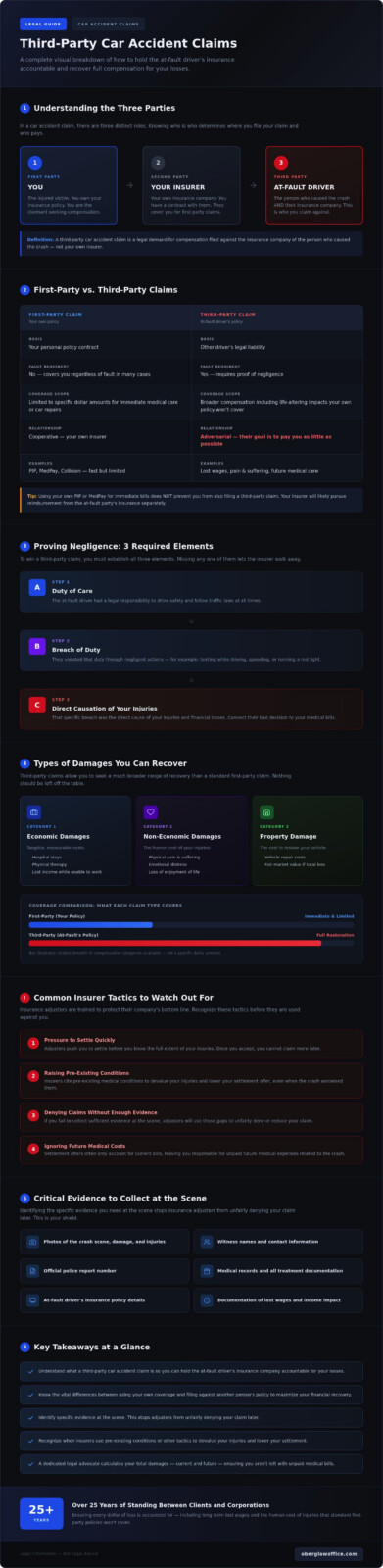
- Understand exactly what is a third-party car accident claim so you can hold the at-fault driver’s insurance company accountable for your losses.
- Learn the vital differences between using your own coverage and filing against another person’s policy to maximize your financial recovery.
- Identify the specific evidence you’ll need at the scene. This stops insurance adjusters from unfairly denying your claim later.
- Recognize the common tactics insurers use to devalue your injuries, such as bringing up pre-existing conditions to lower your settlement.
- See how a dedicated legal guide calculates your total damages. This ensures you aren’t left with unpaid future medical bills.
Defining the Third-Party Car Accident Claim
When you’re hit by another driver, your world stops; theirs should be the one to pay for the restart. Simply put, what is a third-party car accident claim? It’s a legal demand for compensation filed against the insurance company of the person who caused the crash. Understanding what is a third-party car accident claim helps you see that you aren’t just asking for a handout; you’re asserting your right to be made whole. In the legal world, you’re the “first party” because you own your policy. Your insurance company is the “second party” because you have a contract with them. The person who hit you and their insurer are the “third party.” You’re reaching outside your own circle to hold the responsible person accountable. This process is built on the foundation of vehicle insurance and liability coverage, which ensures that those who cause harm have the financial means to fix it.
Relying solely on your own insurance can leave you short. Personal Injury Protection (PIP) or MedPay might cover immediate doctor visits, but they rarely address the deep, life-altering impacts of a major wreck. A third-party claim becomes necessary when you need full financial restoration. We’ve spent over 25 years standing between our clients and the corporations that try to ignore them, ensuring every dollar of loss is accounted for. This claim is your primary tool for recovering costs that your own policy won’t touch, such as long-term lost wages and the human cost of your injuries.
The Legal Basis for Third-Party Liability
To win a third-party claim, you must prove the other driver was negligent. This isn’t just a fancy word; it’s a specific legal standard. First, we establish they had a “duty of care” to drive safely. Second, we show they breached that duty through actions like texting, speeding, or running a red light. Finally, we must prove that this specific breach was the direct cause of your injuries. It’s about connecting the dots between their bad decision and your medical bills. Without clear evidence of this link, insurance companies will try to walk away from their responsibilities.
Types of Damages Covered in a Third-Party Claim
These claims allow you to seek a much broader range of recovery than a standard first-party claim. We look at the total impact on your life to ensure nothing is missed:
- Economic Damages: These are the tangible costs, such as hospital stays, physical therapy, and the income you lose when you can’t work.
- Non-Economic Damages: This covers the human cost. It includes your physical pain, emotional distress, and the loss of enjoyment in your daily life.
- Property Damage: This ensures your vehicle is repaired or that you receive the fair market value if it’s a total loss.
Our role is to act as your steadfast protector, making sure the insurance company sees the person behind the paperwork. We calculate these damages comprehensively, accounting for your current needs and the medical care you’ll require in the years to come.
First-Party vs. Third-Party Claims: Understanding the Difference
Understanding the nuances of insurance can be overwhelming when you’re trying to heal from a crash. A first-party claim is a request you make to your own insurance provider. You’ve paid premiums for years; this is simply your contract in action. In contrast, when you ask what is a third-party car accident claim, you’re looking at a situation where the other driver’s insurance is on the hook. This relationship is adversarial by nature. Their goal is to pay you as little as possible to protect their bottom line, while your goal is to secure the funds needed for your physical and financial restoration.
- First-Party: Based on your personal policy contract; covers you regardless of fault in many cases.
- Third-Party: Based on the other driver’s legal liability; requires proof of negligence.
- First-Party: Usually limited to specific dollar amounts for immediate medical care or car repairs.
- Third-Party: Offers a path to broader compensation for life-altering impacts that your own policy won’t cover.
When to Use Your Own Insurance First
Sometimes, you need help immediately and can’t wait for a long investigation. If you have Personal Injury Protection (PIP) or Medical Payments (MedPay) coverage, these benefits can cover your initial hospital bills right away. Similarly, using your collision coverage often gets your car back on the road faster than waiting for the other side to admit fault. You won’t be “double-charged” for this help. Your insurer will likely pursue a process called subrogation to get their money back from the at-fault party. This legal mechanism allows your insurance to step into your shoes, seeking reimbursement so you aren’t left paying a deductible for a crash you didn’t cause. Following state auto insurance liability claim guidelines ensures you’re using these tools correctly while protecting your future legal options.
The Advantages of Pursuing a Third-Party Claim
While your own insurance provides a vital safety net, it rarely provides a complete recovery. When you look into what is a third-party car accident claim, you should recognize that this is your primary avenue for securing the full value of your case. Pursuing a third-party claim allows you to seek damages that aren’t available in most first-party policies, such as compensation for your pain, suffering, and emotional trauma. These non-economic damages are often the most significant part of a settlement, reflecting how the injury has changed your ability to enjoy your hobbies or care for your family. Because this claim is filed against the negligent driver’s policy, it generally doesn’t affect your own claims history. Most importantly, it holds the person who caused the wreck personally and financially accountable. If you’re feeling pressured by adjusters or confused by the jargon, a personalized strategy session can help clarify your best path forward. We believe you shouldn’t have to carry the financial burden of someone else’s mistake.
The Step-by-Step Process of Filing a Third-Party Claim
The road to recovery starts at the scene, even if it feels chaotic. When you ask what is a third-party car accident claim, you’re really asking for a roadmap to justice. The first step is notification. You must inform the at-fault driver’s insurance company that an incident occurred. They’ll open an investigation, but don’t be fooled; their investigators are looking for ways to shift blame away from their client. This is especially true in complex wrecks involving multi-vehicle pileups or commercial trucks, where multiple policies might be at play. Understanding exactly what is a third-party car accident claim and how it moves through the system ensures you don’t miss critical deadlines while the insurer “investigates.”
Once the investigation concludes, the process moves into negotiation. This is where you present a demand letter that outlines your total losses. It isn’t just about today’s bills; it’s about every way the crash has impacted your future. Following the official guidelines for third-party car accident claims helps you stay grounded when the insurance company tries to rush you into a premature settlement.
Critical Evidence for a Strong Claim
Your case is only as strong as the facts you can prove. The official accident report is the cornerstone of establishing fault, as it provides an objective account of the scene from a law enforcement perspective. Beyond the report, your immediate medical documentation is your strongest asset. It creates a paper trail that links your injuries directly to the crash. If you have dashcam footage or notice nearby surveillance cameras at a gas station or intersection, secure that data immediately. In commercial accidents, black box data from a truck can reveal speeding or braking patterns that an adjuster might try to downplay.
Dealing with the Insurance Adjuster
Adjusters often call early, sounding friendly and helpful. They might ask for a recorded statement to “speed things up.” Don’t give one without legal advice. Anything you say can be twisted to lower your settlement. They often use a “low-ball” initial offer tactic, hoping you’re desperate enough to take a quick check. Remember, once you sign a settlement, you can’t go back for more if your medical needs grow. Protecting your privacy is vital. You aren’t required to give them access to your entire medical history; only records relevant to the crash. We act as a steadfast protector during these interactions, ensuring the insurer treats you with the respect you deserve.
Common Challenges and Why Insurance Companies Deny Claims
Filing a claim should be straightforward, but insurance companies often create hurdles to protect their own profits. When you’re learning what is a third-party car accident claim, you’ll quickly find that adjusters aren’t looking for ways to pay you. They’re looking for reasons to say no. One of the most common issues is disputed liability. This happens when the other driver changes their story after leaving the scene, claiming you were the one who ran the light or merged improperly. Without strong evidence, it becomes your word against theirs, and the insurer will almost always side with their policyholder.
Another favorite tactic involves your medical history. Insurers will comb through years of records to find a pre-existing condition, like an old sports injury or a minor back ache from years ago. They’ll use this to claim your current pain isn’t from the crash, but from a condition you already had. Similarly, if you wait more than a few days to see a doctor or skip follow-up appointments, they’ll argue you weren’t actually hurt. Finally, policy limits can be a brick wall. If the at-fault driver only carries the state minimum and your bills exceed that amount, securing the rest of the money requires a sophisticated legal strategy to find other sources of recovery.
Comparative Negligence and Your Recovery
Most states follow some form of comparative negligence. This means if you’re found even 10% or 20% at fault for the accident, your total settlement will be reduced by that same percentage. Insurance adjusters love to assign a small portion of blame to you just to save money. We fight back against these unfair shared-fault allegations by using witness statements and physical evidence to prove the other party was responsible for the harm they caused. Don’t let an adjuster convince you that you’re to blame without seeing the proof first.
The Danger of Early Settlement Offers
If an insurance company sends you a check within days of the crash, be careful. That check usually comes with a “Release of All Claims” form. Once you sign it and cash that check, your case is closed forever. You can’t go back and ask for more money later, even if you discover you need surgery or can’t return to work. It’s vital to wait until you reach Maximum Medical Improvement (MMI). This is the point where your doctors know exactly what your future medical needs will look like. If you’re facing a denial or a low-ball offer, reaching out for a free strategy session can help you understand the true value of your claim before you sign your rights away.
Maximizing Your Recovery: How a Personal Injury Attorney Protects You
You don’t have to face billion-dollar insurance corporations alone. These companies have teams of adjusters and lawyers dedicated to one goal: paying you as little as possible. When you understand what is a third-party car accident claim, you see that it’s a legal battle for your future restoration. An experienced personal injury attorney acts as your shield, ensuring that your rights aren’t trampled by high-pressure tactics. We bring a level of professional authority that forces insurers to take your case seriously from day one.
A common mistake is settling for what you owe today without considering what you’ll need tomorrow. We provide a comprehensive damage calculation that accounts for future surgeries, ongoing physical therapy, and lost earning capacity. The power of litigation is often the strongest tool in our arsenal. When an insurance company knows we’re prepared to take a case to trial, their settlement offers often increase significantly. They’d rather pay a fair amount now than risk a much larger verdict in front of a jury. This leverage is essential for securing the full value of what is a third-party car accident claim in a system that often favors the insurer.
The Oberg Law Office Approach to Advocacy
At our firm, you aren’t just a case number passed down to support staff. You’ll have direct communication with Gregg Oberg throughout your journey, benefiting from over 25 years of experience in car and truck accident law. We offer a free strategy session to evaluate the strength of your third-party claim without any risk to you. Our mindset is that of a steadfast protector; we’re focused entirely on your long-term recovery and financial security. We treat our clients like neighbors, providing the compassionate advocacy you need during a difficult time.
Taking the Burden Off Your Shoulders
The emotional aftermath of a crash is heavy enough without the weight of legal paperwork and constant phone calls. We handle all communication with adjusters so you can focus on your physical healing. If the other driver’s insurer denies liability, we find expert witnesses to reconstruct the accident and prove exactly what happened. Because we work on a contingency-fee basis, you don’t pay us anything unless we win your case. This shared-risk model ensures everyone has access to high-quality legal help regardless of their current financial situation. For more details on navigating this process, check out our car accident legal guide. We’re here to turn your uncertainty into empowerment.
Take the First Step Toward Your Restoration
You now have a clear understanding of what is a third-party car accident claim and how it serves as your primary tool for financial recovery. We’ve explored how these claims hold negligent drivers accountable and why the insurance company’s initial offer is rarely their best one. By gathering strong evidence and refusing to settle for less than your future medical needs require, you’re already ahead of the curve. You’ve moved from a state of uncertainty to a position of empowerment.
You don’t have to carry this weight alone. With over 25 years of legal experience, our firm acts as a steadfast protector for those facing the aftermath of a crash. You’ll have direct access to your attorney throughout the process, and we operate on a contingency basis; there are no fees unless we win your case. Schedule your free car accident strategy session today to discuss your rights and build a roadmap for your recovery. You deserve a partner who is as invested in your future as you are.
Frequently Asked Questions
Can I file a third-party claim if I was partially at fault for the accident?
Yes, in most states you can still recover damages through a third-party claim if you were partially at fault. Most jurisdictions follow comparative negligence rules. This means your total compensation is reduced by your specific percentage of fault. For example, if you’re 20% responsible for the crash, you receive 80% of the calculated damages. However, some states bar recovery if your fault exceeds 50%. It’s a complex area where professional legal guidance is vital.
How long do I have to file a third-party car accident claim in 2026?
The deadline to file depends on the statute of limitations in the state where the accident occurred. While many states allow two to three years from the date of the crash, some have much shorter windows. It’s crucial to act quickly because evidence can disappear and memories fade. Missing this legal deadline permanently bars you from seeking compensation. We recommend starting the process immediately to ensure your rights regarding what is a third-party car accident claim are preserved.
What happens if the at-fault driver doesn’t have enough insurance to pay my bills?
If the other driver’s policy limits are too low, you may need to turn to your own Underinsured Motorist coverage. This benefit kicks in to cover the gap between the at-fault driver’s limits and your actual damages. We also investigate whether other parties, such as a vehicle manufacturer or an employer in commercial cases, share liability. Our goal is to find every available source of funding to ensure your financial security and complete restoration.
Do I have to talk to the other driver’s insurance adjuster if they call me?
No, you aren’t legally required to speak with the at-fault driver’s insurance adjuster or provide a recorded statement. Doing so can be risky. Adjusters often look for ways to twist your words to devalue your claim. You can simply inform them that you’re seeking legal advice and that all future communication should go through your representative. This protection keeps you from making accidental admissions that could hurt your case or lower your settlement.
Will my insurance rates go up if I file a third-party claim against someone else?
Generally, filing a third-party claim against another driver’s policy shouldn’t cause your own insurance rates to increase. Since you’re seeking money from the at-fault party’s insurer rather than your own, your claims history with your provider remains clean. Insurance companies typically raise premiums when they deem you a high-risk driver based on accidents where you were at fault. Holding the responsible party accountable is a matter of fairness that shouldn’t penalize your wallet.
What is the average settlement for a third-party car accident claim?
There is no true average settlement because every case depends on unique factors like medical costs, lost wages, and the severity of injuries. A minor fender bender will settle for much less than a wreck involving catastrophic injuries. When we evaluate what is a third-party car accident claim for a client, we look at the total impact on their life. This includes current bills and projected future needs to ensure the settlement is actually fair.
Do I need a lawyer to file a third-party claim, or can I do it myself?
You can file a claim yourself, but having an experienced attorney often results in significantly higher settlements. Insurance companies are billion-dollar entities that use sophisticated tactics to minimize payouts. We provide the professional authority needed to level the playing field. Since we work on a contingency-fee basis, you get high-quality legal help without any upfront costs. We handle the complex paperwork and aggressive negotiations so you can focus on your physical healing.
How long does it typically take to receive a settlement from a third-party claim?
The timeline varies based on the complexity of the accident and the length of your medical treatment. Simple cases might settle in a few months; however, complex disputes involving disputed liability can take a year or longer. It’s vital not to rush into a settlement before you reach maximum medical improvement. We work diligently to move your case forward while ensuring the insurance company doesn’t use delays to pressure you into a low offer.