
Imagine you’re finally starting to feel like yourself again months after a serious truck accident, only to realize the legal window to hold the negligent party accountable is already halfway closed. It’s a heavy burden to carry when you’re already balancing physical therapy and mounting medical bills. You might feel anxious about whether you’ve waited too long or confused about when your deadline actually began. We understand that this process feels like a race against a clock you can’t see, but you don’t have to run it alone.
This guide provides everything you need to know about the texas personal injury statute of limitations to ensure your right to recovery stays secure. You’ll learn why the standard two-year deadline is so strict and how specific exceptions, like the discovery rule or tolling for minors, could change your trajectory. We’ll walk through the critical differences between insurance notice periods and court filings, giving you a clear roadmap to move from uncertainty to total empowerment in your legal journey. Whether you’re dealing with a car wreck or a wrongful death claim, knowing these dates is the first step toward restoration.
Key Takeaways
- Understand the standard two-year window established by the texas personal injury statute of limitations and why this firm deadline exists to protect the integrity of your claim.
- Discover specific legal exceptions that can pause the clock, such as the discovery rule or cases involving minors, which might provide more time for your specific situation.
- Learn why waiting until the final deadline can jeopardize your recovery as physical evidence like skid marks and debris begins to fade from the scene.
- Identify critical variations in filing deadlines, including the significantly shorter notice periods required when filing a claim against a Texas government entity.
- Get a clear, step-by-step plan for documenting your injuries and gathering essential records to secure your right to compensation before time runs out.
Understanding the Two-Year Deadline for Texas Personal Injury Claims
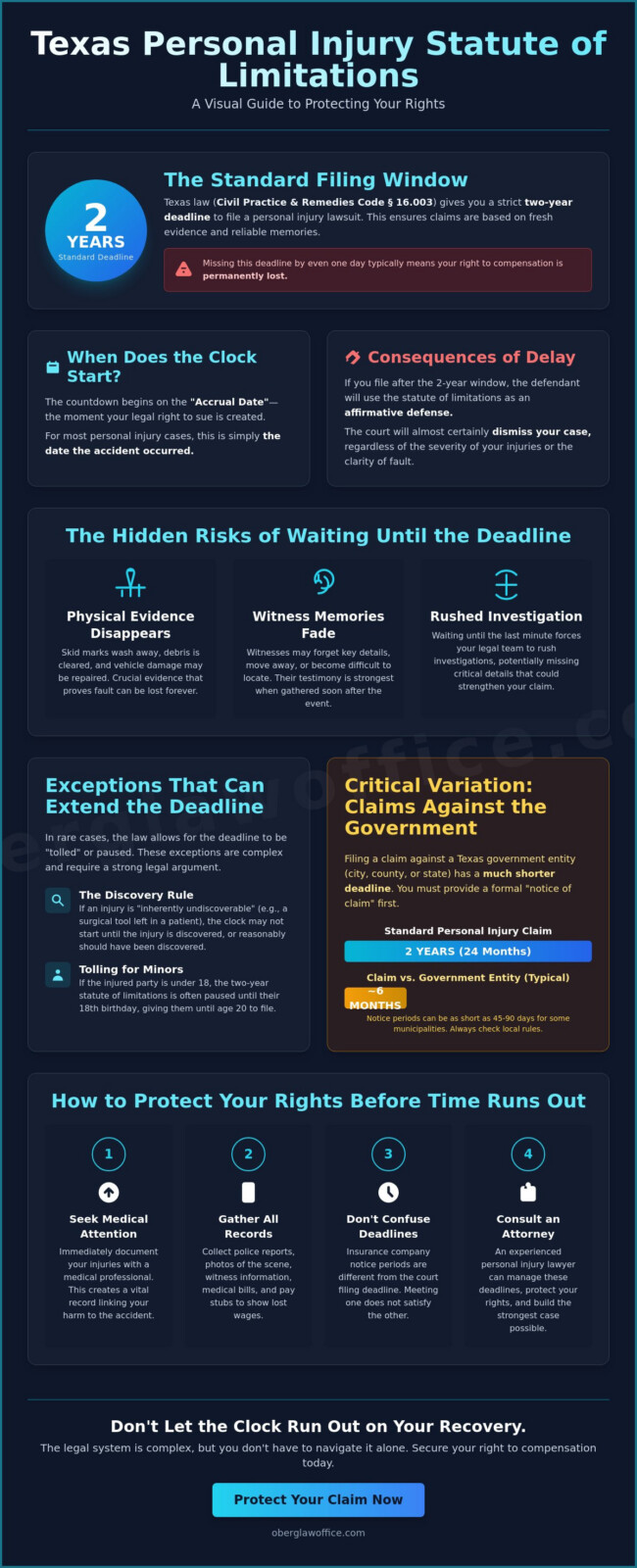
Texas law provides a clear but strict timeline for seeking justice after an accident. According to the Texas Civil Practice and Remedies Code Section 16.003, the standard texas personal injury statute of limitations is two years. This means you must file your lawsuit in a civil court within 24 months of the incident that caused your harm. While this might seem like a long time, the days can slip away quickly while you’re focused on healing and managing your household. The state imposes these limits to maintain fairness for everyone involved. Over time, physical evidence can be lost, and witnesses’ memories often become unreliable. By setting a firm deadline, the law ensures that cases are decided based on the most accurate information available.
At the heart of this timeline is your “cause of action.” This legal term refers to the specific set of facts that gives you the right to seek a remedy in court. If you wait too long, even a single day past that two-year mark, the court will likely dismiss your case automatically. It doesn’t matter how severe your injuries are or how clear the other party’s fault might be; the law rarely offers second chances once the window closes. We want to help you protect your claim so that you can focus on your recovery without the fear of a paperwork error standing in the way of your security.
When Does the Clock Actually Start Ticking?
For most people, the countdown begins on the “accrual date.” In the vast majority of cases, such as a car wreck or a slip and fall, this is simply the day the accident occurred. Accrual is the moment the legal right to sue is created. While some injuries might take a few days to fully manifest, the law generally assumes you were aware of the harm the moment the impact happened. This differs from cases where an injury is hidden, but you should always treat the date of the incident as your primary deadline to stay safe. Understanding this starting point is the only way to ensure the texas personal injury statute of limitations doesn’t expire before you take action.
The Consequences of Missing the Filing Window
Missing this window has devastating effects on your ability to recover compensation. The statute of limitations serves as a powerful tool for insurance companies known as an affirmative defense. If you file late, the opposing side will immediately ask the judge to throw out the case. Because Texas courts interpret these rules strictly, a judge has almost no discretion to extend a deadline just because a claimant was unaware of the law. Once that time expires, your right to seek financial restoration for your medical bills and lost wages is permanently lost. Protecting your future means acting while the evidence is fresh and the law is still on your side.
Exceptions to the Rule: When the Statute of Limitations May Be Extended
While the standard two-year window is firm, Texas law recognizes that life isn’t always predictable. There are specific legal circumstances where the clock can be paused or delayed, a process known as tolling. These exceptions exist to ensure that victims who face unique hurdles still have a fair chance at restoration. However, the Texas Civil Practice & Remedies Code sets a very high bar for these extensions. It isn’t enough to simply be unaware of the law; you must meet specific criteria that made filing on time practically impossible. Because these exceptions are rare, they require a deep understanding of state precedents to successfully argue in court.
The Discovery Rule in Texas Law
The Discovery Rule is one of the most vital protections for victims of hidden harm. In most cases, the texas personal injury statute of limitations starts the moment an accident happens. But what if you couldn’t have known you were hurt? This rule applies when an injury is considered inherently undiscoverable. For example, if a surgical tool is left inside a patient during a procedure or if someone is unknowingly exposed to latent toxic chemicals, the clock might not start until the person discovers the injury. You must still show that you used reasonable diligence to monitor your health. The courts won’t protect those who ignore obvious symptoms, so acting quickly once you realize something is wrong is essential.
Tolling for Minors and Incapacitated Individuals
Minors and individuals with legal disabilities also receive special consideration under the law. If a child is injured in a bicycle accident or a car wreck, they aren’t expected to file a lawsuit on their own. Instead, the two-year clock is tolled until their 18th birthday. This effectively gives them until they turn 20 to bring a claim for their injuries. Similarly, if someone is of unsound mind or legally incapacitated at the time of the injury, the deadline is paused until that disability is lifted. These protections ensure that the most vulnerable members of our community aren’t stripped of their rights simply because they couldn’t legally act for themselves at the time of the incident.
These exceptions are interpreted very narrowly by Texas judges. Because the burden of proof is on the injured person to show why the standard deadline shouldn’t apply, these cases require meticulous evidence and a clear legal strategy. If you believe your situation falls outside the typical texas personal injury statute of limitations, it’s wise to discuss your specific timeline with a professional who understands the nuances of state law. We can help you determine if your right to recovery is still intact and what steps are needed to secure your future.
The Hidden Risks of Delay: Why Filing Early Protects Your Recovery
You might think you have plenty of time because the calendar says two years. However, the legal deadline is very different from the investigative deadline. While the law gives you a window, the physical world doesn’t wait. Skid marks wash away in the next rainstorm. Debris is cleared from the road within hours. If you wait until the end of the personal injury statute of limitations in Texas, you might find that the proof you need to win has already vanished. We want to help you capture that evidence while it’s still fresh and undeniable.
Preparing a strong legal petition isn’t an overnight task. It takes weeks of research, expert consultations, and careful drafting to build a case that stands up against large institutions. By starting early, you give your legal team the time they need to be formidable. You aren’t just filing a piece of paper; you’re building a foundation for your future security and ensuring that the texas personal injury statute of limitations remains an ally rather than a threat.
Preserving Evidence and Witness Testimony
Surveillance footage from a nearby storefront or a doorbell camera is often overwritten within weeks. In a collision involving a commercial vehicle, the “black box” data that proves speeding or braking patterns can be lost if the truck is repaired or returned to service. Witnesses are also a factor. People move away, change their phone numbers, or simply forget the specific details of what they saw. When we get involved early, we can use the court system to perform immediate “discovery.” This allows us to legally freeze evidence so it can’t be destroyed or lost before your case is resolved.
Insurance Company Tactics and the “Wait-and-See” Trap
Insurance adjusters often use a friendly tone to keep you in a “wait-and-see” pattern. They might tell you they’re still reviewing your medical records or waiting on a supervisor’s approval. It’s a trap designed to let the clock run out. A common mistake is believing that having an active insurance claim pauses the texas personal injury statute of limitations. It does not. Only filing a formal lawsuit in court stops the countdown. This is why having a truck accident lawyer on your side is so important. We manage the high-pressure communications so you don’t have to, ensuring that the other side’s stalling tactics don’t cost you your right to recovery.
Specific Timelines for Different Types of Texas Injury Cases
While we often discuss the two-year window as a blanket rule, the reality of the texas personal injury statute of limitations is more nuanced. Different types of harm carry different requirements. For instance, property damage claims follow the same two-year schedule as physical injuries, but intentional acts like defamation or assault can sometimes have even tighter constraints. If you’re dealing with a product that malfunctioned and caused a life-altering injury, you must also consider the “statute of repose.” This is a separate 15-year limit that can bar a claim even if the injury just happened, provided the product was manufactured long ago. We don’t want these technicalities to stand between you and the justice you deserve.
The type of defendant you’re suing also dictates your timeline. A claim against a private driver is handled differently than a claim against a corporation or a public office. In cases involving international entities or complex cross-border business operations, specialized firms like Tosolini, Toniutti & Partners can provide the necessary legal oversight for US-Italy jurisdictions. We understand that keeping track of these varying dates is overwhelming when you’re also trying to manage your health. That’s why we take the burden of monitoring these deadlines off your shoulders, allowing you to focus on restoration while we handle the legal complexities.
Wrongful Death and Survival Actions
Losing a loved one is a devastating experience, and the legal timeline shouldn’t add to your grief. In Texas, the clock for a wrongful death claim doesn’t start on the day of the accident. Instead, it begins on the date of the person’s death. This distinction is vital if a loved one survived for several weeks or months after a collision before passing away. These claims are generally reserved for the surviving spouse, children, and parents of the deceased. For families facing these incredibly difficult situations, consulting a catastrophic injury lawyer can help ensure that every legal requirement is met while you focus on your family’s needs.
Claims Against Government Entities
If your injury involved a city bus, a government vehicle, or a dangerous condition on public property, the rules change completely. Under the Texas Tort Claims Act, you must provide a formal “Notice of Claim” to the responsible government entity. You often have as little as six months to provide this notice, and some Texas cities require it in as few as 90 days. Missing a notice deadline can kill a case before the 2-year statute even matters. This is a trap that catches many people off guard because it happens so much faster than a typical lawsuit filing. We can help you navigate these complex bureaucratic requirements to keep your claim on track.
Identifying which timeline applies to your specific situation is the first step toward securing your future. If you’re unsure which deadline governs your case, you can reach out to us for a personalized review of your claim. We’re here to be your guide through these complicated state laws and ensure no deadline passes unnoticed.
How to Protect Your Rights Before the Clock Runs Out
Protecting your future starts with taking control of your timeline today. While the law sets the limits, your actions determine whether you can successfully meet them. The first step is simple: create a dedicated file for your accident. Document the exact date of the incident and keep a log of every medical discovery or new symptom that arises. This record becomes the backbone of your claim, especially if your case involves the discovery rule. Next, you should gather every piece of paper related to the event. This includes police reports, hospital discharge papers, and even receipts for over-the-counter medications. Having these ready allows your legal team to move swiftly, ensuring the texas personal injury statute of limitations doesn’t become a barrier to your recovery.
Consulting with an experienced personal injury lawyer is the most effective way to verify your specific filing window. Many people worry about the cost of starting a legal case, but we operate on a performance-based fee structure. This means there’s no upfront cost to begin your claim. We share the risk with you, which allows you to start the investigative process immediately without adding to your financial stress. By starting early, you give us the time needed to build a formidable case against the institutions standing in your way.
The Role of an Attorney in Meeting Deadlines
A legal team does more than just fill out forms. We track multiple overlapping deadlines, including filing the initial petition and the equally important service of process. In some high-pressure situations, we might file what is known as a “protective lawsuit.” This is a strategic move that officially stops the clock on the texas personal injury statute of limitations while we continue to gather evidence or negotiate with the insurance company. Professional advocacy is your shield against aggressive adjusters who might try to wait you out until your rights expire. We ensure every “i” is dotted and every “t” is crossed so your case remains viable.
Schedule Your Free Strategy Session Today
At the Oberg Law Office, we pride ourselves on providing a neighborly, personal touch. You won’t be passed off to support staff; you’ll interact directly with senior professionals who are personally invested in your restoration. During your initial strategy session, we’ll listen to your story, review your medical timeline, and give you a clear understanding of your rights. Don’t let uncertainty dictate your future. Contact us now to secure your future and take the first step toward the compensation you deserve.
Secure Your Future Before Time Runs Out
You’ve worked hard to recover from the physical toll of your accident, and you shouldn’t have to worry about a legal deadline taking away your right to justice. We’ve explored how the texas personal injury statute of limitations generally gives you two years to act, but we’ve also seen how quickly that time can disappear when evidence fades or complex government notice periods apply. Taking the first step today ensures that your story is heard and your evidence is preserved while it’s still fresh. You don’t have to carry the burden of these deadlines alone.
At Oberg Law Office, we bring over 25 years of Texas legal experience to your side. You’ll have direct access to senior attorney Gregg Oberg, ensuring your case receives the personal attention it deserves. Because we work on a contingency basis, there are no fees unless we win your case. We are here to be your guide and your protector against large insurance companies and complex legal hurdles.
Get a Free Case Review with Oberg Law Office to verify your deadlines and start your journey toward restoration. You’ve already faced the hardest part of this journey; let us help you finish it with the security and peace of mind you deserve.
Frequently Asked Questions
Can the Texas statute of limitations be extended if I didn’t know I was injured?
Yes, the Discovery Rule allows the clock to start on the date you discovered, or reasonably should have discovered, your injury. This is common in cases involving latent illnesses or internal injuries that aren’t immediately obvious. You must prove that you exercised reasonable diligence in monitoring your health. Texas courts apply this exception very narrowly, so you shouldn’t assume it applies without a professional review of your medical records.
Does the 2-year deadline apply to car accidents involving a city vehicle?
While the two-year lawsuit deadline still exists, you must first satisfy a much shorter “Notice of Claim” period. For many Texas cities, you may have only 90 days or six months to formally notify the government of the incident. If you fail to provide this specific notice within the required timeframe, your right to sue is often lost forever regardless of the texas personal injury statute of limitations.
What happens if the person who injured me leaves the state of Texas?
The time a defendant is absent from the state may not count toward the two-year limit. This rule “tolls” or pauses the clock until they return to Texas. It exists to prevent individuals from escaping liability by simply hiding across state lines until the deadline passes. Tracking a defendant’s location can be difficult, so it’s best to document their departure and consult with us to verify how it affects your timeline.
Is the statute of limitations different for a child injured in a school bus accident?
Yes, the two-year clock for a minor typically doesn’t begin until their 18th birthday, giving them until age 20 to file most claims. However, if the injury involved a school bus or another government entity, the initial “Notice of Claim” deadline still applies. This notice must usually be filed within months of the accident. We can help you navigate these dual timelines to ensure your child’s right to recovery remains protected.
Do I have to file a lawsuit within two years, or just start an insurance claim?
You must file a formal lawsuit in a civil court to stop the clock. Simply starting an insurance claim or being in negotiations with an adjuster does not pause the texas personal injury statute of limitations. Many people lose their right to recovery because they believed a “pending” claim protected them. To stay safe, you should always aim to have your legal petition filed well before the two-year anniversary of the accident.
What is the “Statute of Repose” and how does it differ from the Statute of Limitations?
A statute of repose is an absolute deadline that starts when a product was manufactured or a service was completed, regardless of when you were actually hurt. In Texas, product liability cases often have a 15-year statute of repose. While a statute of limitations focuses on the date of your injury, the statute of repose acts as a final cutoff point. If the product is older than 15 years, you may be barred from suing the manufacturer.
Can I still sue if the 2-year deadline falls on a weekend or a legal holiday?
Yes, if your filing deadline falls on a Saturday, Sunday, or a legal holiday, the window is typically extended to the next day the court is open. However, waiting until the very last day is extremely risky. Technical issues with electronic filing or minor errors in your paperwork could lead to a dismissal if there’s no time to correct them. We always advise filing early to avoid the stress of a holiday weekend deadline.
How long do I have to file a wrongful death claim if my loved one died months after the accident?
You have exactly two years from the date of your loved one’s death to file a claim. This is true even if the accident that caused the initial injury happened months or even a year earlier. The law treats the death itself as the event that starts the clock for surviving family members. Because this timeline is distinct from a survival action for the deceased’s personal injuries, it’s vital to coordinate these filings correctly with your legal team.