
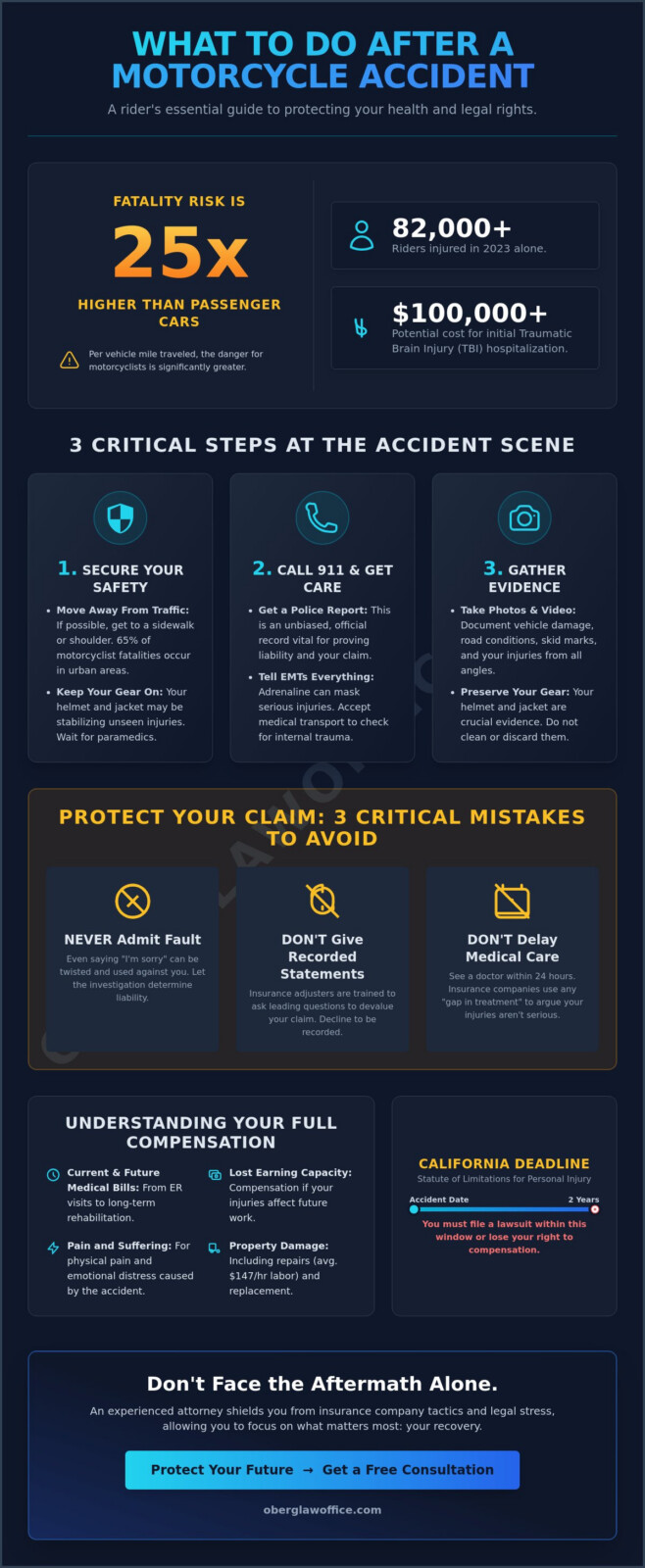
Did you know that per vehicle mile traveled, the fatality rate for motorcyclists is nearly 25 times higher than for those in passenger cars? In 2023 alone, over 82,000 riders were injured, often facing medical bills for traumatic brain injuries that can exceed $100,000 for initial hospitalization. You understand that the freedom of the road comes with risks, but you shouldn’t have to face the aftermath of a crash alone. If you’re currently dealing with physical trauma and aggressive calls from insurance adjusters, you’re likely worried about how to pay your bills. Knowing exactly what to do after a motorcycle accident is the most important step you can take to protect your family’s future.
It’s natural to feel overwhelmed by the legal process while you’re trying to heal. We promise to show you how to navigate complex 2026 regulations, including California’s two year statute of limitations and the synthetic sound requirements for electric motorcycles. This guide walks you through the critical actions needed to secure fair financial compensation and ensure a professional handles the stress for you. You’ll discover how to document the scene, why you must seek immediate medical care, and how to protect your claim from being reduced by comparative negligence rules.
Key Takeaways
- Secure your immediate safety by moving away from traffic and keeping your protective gear on until medical responders arrive.
- Protect your right to recovery by documenting the scene with high-resolution photos and video of road conditions and vehicle damage.
- Discover exactly what to do after a motorcycle accident to avoid damaging your claim, including why you should never apologize or give recorded statements to adjusters.
- Understand the full range of legal compensation available to you, from current medical bills to future lost earning capacity.
- Learn how personalized advocacy can shield you from the stress of legal battles, allowing you to focus entirely on your physical recovery.
Prioritizing Your Physical Safety and Immediate Medical Needs
The moments after a crash feel like a blur. Your heart is pounding and your mind is racing with a thousand questions. Your first priority is simple: get to safety. If you can move, get yourself and your bike away from active traffic lanes immediately. Secondary accidents are a constant threat on busy roads, especially in high-traffic urban areas where 65% of motorcyclist fatalities occurred in 2023. Find a sidewalk, shoulder, or parking lot where you’re visible but out of the direct path of other vehicles.
Keep your protective gear on until help arrives. It’s tempting to rip off your helmet or gloves the moment you stop moving, but your gear might be stabilizing a neck injury or protecting a wound you haven’t noticed yet. Wait for the paramedics to assist you. When you’re thinking about what to do after a motorcycle accident, remember that your health comes before your bike. Understanding the basics of motorcycle safety helps you realize that even a low-speed slide can cause complex internal damage that isn’t immediately obvious.
The Critical Role of First Responders
Police officers do more than just direct traffic; they create the foundation of your future legal recovery. A formal police report provides an unbiased account of the scene, which is vital for proving liability. This document records the date, time, and specific location, along with witness contact information that might otherwise disappear. When EMTs arrive, tell them everything. Don’t play tough or downplay your pain. Adrenaline is a powerful hormone that masks severe internal trauma and spinal injuries, making you feel “fine” when you’re actually in danger. Accepting medical transport ensures you get the diagnostic scans, like CT scans or MRIs, needed to catch “hidden” injuries before they become life-threatening.
Seeking Follow-Up Care Within 24 Hours
The first 24 hours are critical for your health and your legal rights. Insurance adjusters look for any “gap in treatment” to deny or devalue your claim. They love to argue that if you didn’t go to the ER or a clinic immediately, your injuries must not be serious. Visit a doctor even if you only feel a little sore. Symptoms like whiplash, concussions, or internal bruising often peak two or three days after the impact. A consistent medical record starting from the day of the crash proves the timeline of your recovery. It acts as a professional shield, preventing the insurance company from claiming your injuries aren’t worth the full compensation you deserve.
Gathering the Evidence That Protects Your Right to Recovery
Evidence is the bridge between a denied claim and the justice you deserve. While you’re still at the scene, if your injuries allow it, start gathering facts immediately. This is a vital part of what to do after a motorcycle accident because memories fade and road conditions change within hours. Use your phone to take high-resolution photos of your bike, the other vehicles involved, and the surrounding road surface. Don’t just take one or two pictures; capture the scene from every angle to ensure no detail is missed.
Video evidence is often even more powerful than still images. Record a 360 degree view of the intersection or stretch of road where the impact occurred. Make sure to capture working traffic signals, posted speed limits, and any skid marks left behind. These details tell a story that words alone cannot. While you’re documenting the physical scene, don’t forget your gear. Your helmet and riding jacket are physical proof of the impact’s force. Keep them in the same condition they were in after the crash. Don’t clean them or throw them away. Following NHTSA safety guidelines emphasizes the importance of gear for protection, but in a legal sense, that gear becomes Exhibit A for your injuries.
With motorcycle repair labor rates averaging $147 per hour as of January 2026, plus the rising cost of specialized parts, your property damage claim can escalate quickly. This makes detailed photography of your bike’s damage essential for your financial recovery. If you feel overwhelmed by these technical details, reaching out to a motorcycle accident attorney can help ensure your evidence is preserved correctly from the start.
Documenting the Accident Scene Through Photos
Focus on capturing vehicle positioning before any tow trucks arrive. Close up shots of property damage are important, but wide shots showing the debris field provide necessary context for how the collision occurred. This visual record is your best defense against “he-said, she-said” disputes from the other driver’s insurance company. High resolution images make it difficult for negligent parties to change their story later in the process.
Identifying Witnesses and Exchanging Information
Gathering names and phone numbers from bystanders is crucial for your case. Witnesses often leave once they see help has arrived, so try to reach them quickly. When you speak to other drivers, get their full name, driver’s license number, insurance policy details, and the Vehicle Identification Number (VIN) of their car. Keep these interactions brief and professional. Avoid discussing who was at fault or apologizing for anything. Even a simple “I’m sorry” can be twisted by an aggressive insurance adjuster to mean you were responsible for the crash.
Navigating the Insurance Minefield: What Not to Say or Do
Dealing with insurance companies is often more stressful than the crash itself. While you are focusing on healing, adjusters are focusing on their bottom line. They might sound friendly on the phone, but their primary goal is to minimize the amount they pay you. This makes your communication choices a critical part of what to do after a motorcycle accident. A single misplaced word can be used to shift blame onto you or suggest your injuries aren’t as severe as you claim.
One of the most common mistakes is apologizing at the scene. It’s a natural reflex to say “I’m sorry” after a collision, even if you did nothing wrong. However, in the eyes of an insurance company, an apology is an admission of fault. Similarly, avoid the urge to share details about your accident or recovery on social media. A photo of you at a family dinner could be twisted by an adjuster to argue that your “pain and suffering” is non-existent. Silence is your best protection during the early stages of your claim.
Avoiding the Trap of Recorded Statements
An insurance adjuster will likely call you within 48 hours to ask for a “recorded statement to get your side of the story.” You are not legally required to provide this. These adjusters are trained to ask leading questions that can trick you into making “innocent” remarks that devalue your claim. For example, answering “I’m okay” to a casual “How are you?” can be used as evidence that you weren’t truly injured. You have every right to politely decline and state that all communication should go through your attorney. Silence is your strongest asset while the details of the crash are still being investigated.
The Danger of Early Settlement Offers
If an insurance company offers you a check shortly after the accident, be extremely cautious. These “lowball” offers are designed to close your case before you understand the full scope of your medical needs. Reviewing motorcycle crash statistics shows that even with proper safety equipment, the physical toll of an accident is often permanent and requires long-term care. You should never accept a settlement until you reach maximum medical improvement. Maximum medical improvement is defined as the point at which a patient’s condition has stabilized and no further functional improvement is expected, even with additional treatment. Only then can you accurately calculate the true cost of future physical therapy, lost wages, and specialized medical equipment.
Understanding the Full Scope of Your Legal Compensation
Motorcycle accidents often result in injuries that are far more severe than those sustained in typical car crashes. While a fender bender in a sedan might cause minor bruising, a rider faces the risk of life-altering trauma. When you are determining what to do after a motorcycle accident, you must look beyond your immediate bills. A comprehensive claim accounts for the total impact the crash has on your health, your wallet, and your family’s stability. In 2026, the average settlement for these cases often ranges from $66,000 to $185,000, but catastrophic cases involving spinal cord injuries can see initial emergency costs alone exceeding $600,000.
Your recovery should include compensation for every dollar you’ve lost and every dollar you’ll need to spend in the future. This starts with economic damages, which are the tangible costs you can prove with receipts and invoices. You’re entitled to reimbursement for your hospital stays, surgeries, and ongoing physical therapy. Don’t forget your property damage. With motorcycle repair labor rates now averaging $147 per hour, fixing a high-performance bike is expensive. You should also seek compensation for your protective gear, including your helmet and leathers, which were sacrificed to save your life. If you’re feeling the weight of these mounting costs, it’s time to contact a motorcycle accident attorney for a dedicated review of your case.
Beyond Medical Bills: The Impact on Your Life
Justice involves more than just paying back the hospital. It’s about recognizing the emotional and physical toll the crash took on your quality of life. Non-economic damages cover your pain, suffering, and emotional distress. If your injuries were severe, a catastrophic injury lawyer mesquite can help you secure funds for the long-term care required for traumatic brain injuries or permanent disability. We recommend keeping a daily recovery journal to document your pain levels and the activities you can no longer enjoy, such as your favorite hobbies or playing with your children. This personal record serves as powerful evidence of your loss of enjoyment of life.
Calculating Diminished Earning Capacity
A serious crash can threaten your ability to provide for your family. If your injuries prevent you from returning to your previous job or working full-time, you’re facing a loss of future income. We work with vocational experts to prove exactly how much your lifetime earning potential has been reduced. This ensures that your settlement doesn’t just cover the weeks you missed work immediately after the crash, but also protects your financial future for years to come. Your family deserves the peace of mind that comes from knowing their home and lifestyle are secure despite the negligence of another driver.
How Oberg Law Office Fights for Your Future
Deciding what to do after a motorcycle accident shouldn’t feel like a second job while you’re trying to heal. You’ve already seen how complex the evidence and insurance rules have become in 2026. From documenting specialized repair costs to fighting comparative negligence claims, the legal landscape is difficult to manage alone. Our firm steps in to carry that weight for you. We provide the professional authority needed to challenge aggressive adjusters and the compassionate advocacy you need to feel supported during your recovery.
We’re kind to our clients, but we’re formidable against insurance companies. They have teams of experts working to protect their profits; you deserve a steadfast protector working for your justice. We don’t just fill out forms. We build a strategic partnership with you, ensuring every medical bill, lost wage, and emotional hurdle is accounted for in your final claim. You’re not just a case number here. You’re a neighbor who deserves the best possible outcome for your family.
The Advantage of a Neighborly, Personalized Firm
Choosing a boutique firm means you won’t be passed off to a paralegal or an intake specialist. You’ll speak directly with Gregg Oberg. This personal touch allows us to dive deeper into the details of your case, providing a level of attention that large, corporate firms can’t match. Our motorcycle accident lawyer mesquite services are designed specifically for the unique needs of riders. This localized experience builds trust within our community and ensures you have an experienced guide through every phase of the legal journey.
The Contingency Fee Promise: Justice for Everyone
We believe that high-quality legal representation should be accessible to everyone, regardless of their current financial situation. This is why we operate on a “No Fee Unless We Win” contingency model. We remove the financial barriers that often prevent people from seeking justice after a catastrophic injury. Our interests are perfectly aligned with your successful recovery because we only get paid if we secure a settlement or jury award for you. It’s a signature promise of shared risk and absolute dedication to your future. You can focus on your physical therapy and your family while we handle the stress of the legal battle.
Take the Next Step Toward Your Full Recovery
The road to healing after a crash is rarely a straight line. By now, you understand that what to do after a motorcycle accident involves more than just fixing your bike. It requires immediate medical attention, meticulous evidence gathering, and the strategic silence necessary to outmaneuver aggressive insurance adjusters. You’ve fought through the initial shock; now it’s time to ensure your family’s financial future is secure.
You don’t have to navigate these 2026 legal complexities alone. With over 25 years of experience in Texas law, the Oberg Law Office provides the formidable advocacy you need. You’ll speak directly with Attorney Gregg Oberg, ensuring your case gets the personal attention it deserves. We operate with zero upfront costs; we only win when you do. Schedule your free strategy session with Oberg Law Office today. We’re ready to stand as your protector and guide while you focus on getting back on your feet.
Frequently Asked Questions
Should I call the police for a minor motorcycle accident?
Yes, you should call the police regardless of how minor the collision appears. A formal report is a neutral record of facts that protects you if injuries or bike damage appear later. In many jurisdictions, reporting is mandatory if property damage exceeds $1,000. Having this document ensures the other driver cannot change their story when they talk to their insurance company. It’s the best way to preserve the truth of the scene.
What if I was not wearing a helmet at the time of the crash?
You can still pursue a claim, but your compensation might be reduced under comparative negligence rules. Since California requires all riders to wear DOT-compliant helmets, failing to do so could be used to argue you contributed to your own head injuries. However, this shouldn’t stop you from seeking justice for other damages, like broken limbs or bike repairs caused by the other driver’s negligence. We’ll fight to ensure you’re treated fairly.
How long do I have to file a motorcycle accident claim in 2026?
For most personal injury cases in 2026, you have exactly two years from the date of the crash to file a lawsuit. If you’re only claiming property damage for your motorcycle, the limit is three years. It’s critical to act quickly because claims against government agencies have a much shorter window of only six months. Missing these deadlines means you lose your legal right to recover any compensation for your losses.
Can I still recover damages if I was partially at fault for the accident?
Yes, you can still recover damages even if you shared some responsibility for the crash. California uses a pure comparative negligence system, meaning your final settlement is simply reduced by your percentage of fault. If a jury decides you were 25% responsible, you can still collect the remaining 75% of your total damages. Knowing exactly what to do after a motorcycle accident helps you minimize these fault assignments through strong evidence and clear documentation.
What should I do if the other driver fled the scene?
Call the police immediately to report a hit and run. Try to write down any details you remember, such as the car’s color, make, or partial license plate number. Check nearby businesses for security camera footage that might’ve captured the impact. In these cases, your own Uninsured Motorist coverage often becomes the primary source for your medical bills and repair costs. We can help you navigate these tricky claims with your own insurer.
Why shouldn’t I talk to the other driver’s insurance company?
You shouldn’t speak to them because their priority is protecting their company’s profits, not your recovery. Insurance adjusters are experts at twisting casual comments into admissions of fault or evidence that your injuries aren’t serious. Politely tell them that your attorney will handle all communications. This ensures you don’t accidentally say something that devalues your claim before you even know the full extent of your long-term medical needs.
How much is my motorcycle accident case worth?
Your case value depends on your medical expenses, lost wages, and the clarity of the other driver’s liability. While average settlements often fall between $66,000 and $185,000, every situation is unique. A rider facing a permanent spinal injury will require a significantly higher award than someone with minor road rash. We analyze your specific 2026 medical records and vocational impact to determine the fair amount you deserve for your pain and suffering.
What if the driver who hit me is uninsured?
If the at-fault driver has no insurance, you’ll likely turn to your own Uninsured Motorist (UM) policy. This coverage is designed to step into the shoes of the negligent driver’s missing insurance to pay for your damages. If you don’t have this coverage, recovering funds becomes much more difficult. We can help you explore all possible avenues, including looking for other liable parties or investigating the driver’s personal assets to secure the justice you deserve.