Imagine standing in your Mesquite driveway, looking at a pile of twisted metal that used to be your $49,275 SUV, only to realize the insurance check won’t even cover your 7.02% interest loan. It’s a gut-wrenching moment. You’ve lost your ride to work, and now a lender is calling your phone demanding immediate payment for a vehicle that’s sitting in a scrap yard. You’re likely asking what happens if my car is totaled and I still owe money when the payout is thousands of dollars short of the balance.
We understand how overwhelming it feels to be “upside down” on a loan while you’re trying to recover from an accident. You shouldn’t have to face aggressive creditors alone while you’re still healing. We’ll show you exactly how to handle the lender and protect your credit score. This guide explains how Texas’s 100% total loss threshold impacts your claim and how professional advocacy can help bridge the financial gap left behind by the insurance company. You deserve a path forward that doesn’t leave your family’s future in the wreck.
Key Takeaways
- Understand why your lender expects full payment even after a total loss and how to approach them without triggering a loan default.
- Discover exactly what happens if my car is totaled and I still owe money when the insurance check doesn’t cover your high-interest loan balance.
- Check your existing loan paperwork for hidden Gap coverage that could save you thousands in out-of-pocket expenses.
- Maintain your credit health by following the correct steps for making payments while your insurance claim remains pending.
- Learn how professional advocacy can help you negotiate with insurance adjusters to ensure you aren’t stuck paying for a vehicle you can no longer drive.
Understanding Total Loss and the “Upside Down” Loan Reality
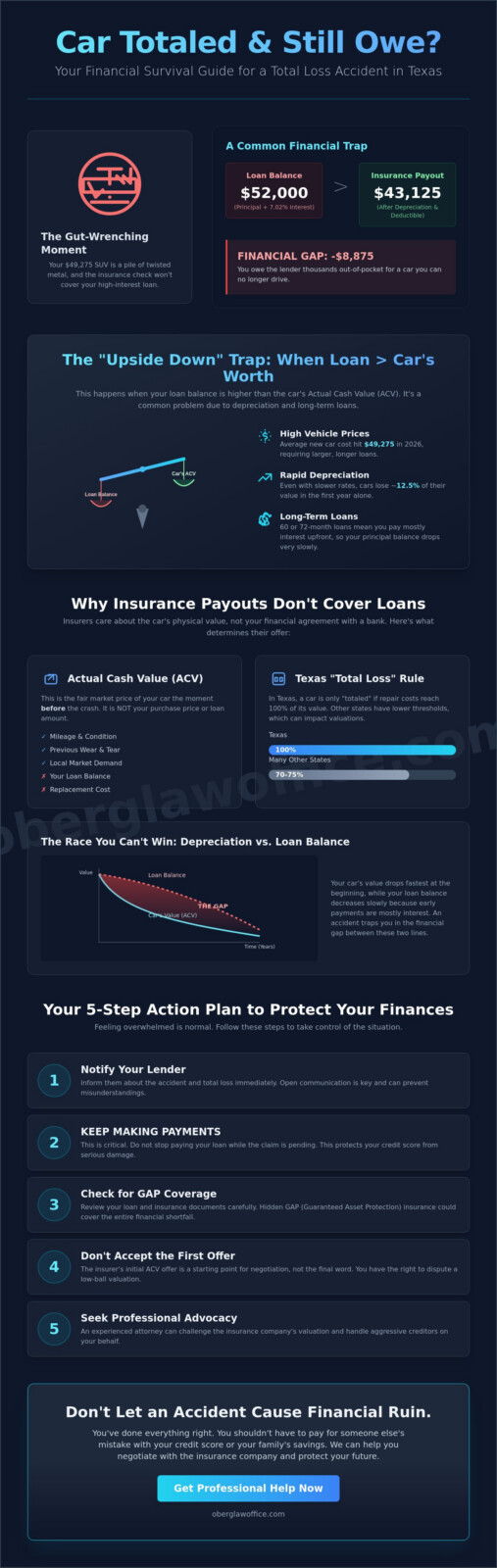
It’s a heavy burden to carry. You are dealing with the physical pain of an accident in Mesquite, and then you receive a letter from your insurance company stating your car is a total loss. In Texas, a vehicle is typically considered totaled when the cost of repairs reaches 100% of its value. While other states might write off a car at 70% or 75%, our local regulations require the damage to be extensive. This process of Understanding Total Loss is often the first step in a difficult financial battle. The most stressful part for many of our neighbors is realizing what happens if my car is totaled and I still owe money to a lender who expects a check regardless of the car’s condition. They don’t pause your interest just because you’re in a hospital bed.
Being “upside down” or having negative equity is a common reality in 2026. With the average price of a new car reaching $49,275 in March 2026, many buyers take out long-term loans with interest rates averaging 7.02%. Even though cars are depreciating slightly slower now, at about 12.5% in the first year, it’s still easy for your loan balance to outpace the actual value of the vehicle. When a crash happens, that gap between what you owe and what the car is worth becomes a financial trap. Your lender won’t simply forgive the remaining thousands of dollars; they’ll likely demand the full balance immediately after the insurance payout is processed.
We see this happen to hardworking families every day. You’ve done everything right, you’ve made your payments on time, and yet a single negligent driver can leave you with a debt for a car you can no longer drive. It feels like an injustice because it is. The insurance company’s goal is to pay the absolute minimum, leaving you to figure out how to cover the rest. We believe you shouldn’t have to pay for someone else’s mistake with your credit score or your family’s savings.
The Definition of Actual Cash Value (ACV)
Actual Cash Value is the fair market price your car would have sold for the second before the accident occurred. It isn’t based on what you paid or what a new model costs today. Adjusters look at your specific mileage, any previous wear and tear, and the current demand in the Texas market to arrive at this number. Because the average MSRP for 2026 models increased by $691 for base trims, the cost to replace your car is almost certainly higher than the ACV check you’ll receive.
Why Your Loan Balance Doesn’t Matter to the Insurer
Insurance companies view your car as an asset, not a debt. Their contract is designed to replace the value of the physical metal and plastic, not the financial contract you signed with a bank. This creates a legal distinction between market value and contractual debt that often leaves drivers wondering what happens if my car is totaled and I still owe money to an aggressive lender. Depreciation works against you the moment you leave the dealership, and since insurance only covers the depreciated value, the financial shortfall is legally considered your personal responsibility unless you have specific protections in place.
Why Insurance Payouts Often Fall Short of Your Loan Balance
It feels like a betrayal when you’ve been a responsible driver and suddenly find yourself in a financial hole because of someone else’s mistake. The insurance company sends a check, but it barely scratches the surface of what you still owe the bank. This gap exists because of a harsh mathematical reality. When you’re wondering what happens if my car is totaled and I still owe money, the answer often lies in the disconnect between your loan balance and the car’s market value. We believe you shouldn’t be penalized for a situation you didn’t cause, yet the system is often rigged in favor of the insurer’s bottom line.
In May 2026, many drivers are locked into 60-month or 72-month loans with interest rates averaging 7.02% for new vehicles. Because of these long terms, you spend the first few years mostly paying off interest rather than the principal balance. Meanwhile, even though depreciation has slowed to about 12.5% in the first year compared to pre-pandemic rates, your car’s value is still dropping faster than your debt. When you add a $500 or $1,000 deductible into the mix, the final check sent to your lender is even smaller. If you’re struggling to make sense of a low-ball offer, speaking with a car accident attorney can help you understand your options for recovery.
The Role of Depreciation in Total Loss Claims
Insurance adjusters use software to find “comparable” vehicles sold in Mesquite or the surrounding North Texas area. These formulas often fail to account for the specific care you took of your car. They might apply “wear and tear” deductions for minor stains or small scratches that wouldn’t actually lower the selling price in a real-world market. This “comparable vehicle” trap is a common tactic used to save the insurance company money at your expense, leaving you with a larger loan balance to cover out of pocket.
Challenging a Low Valuation
You don’t have to accept the first number they throw at you. If the adjuster says your car is worth $25,390, which was the average used car price in March 2026, but you find three local listings for the same model at $28,000, that’s evidence you can use. Keep receipts for recent upgrades like a new set of tires or a recent major service. If the gap remains too wide, you have the right to request a certified appraisal. This forces the insurer to look at the actual condition of your vehicle rather than a generic spreadsheet.
Options for Covering the Remaining Debt: Gap Insurance and Beyond
Finding out you owe thousands of dollars on a car you can no longer drive is a heavy weight to carry. You shouldn’t have to shoulder this burden alone, especially if the accident wasn’t your fault. When you’re trying to figure out what happens if my car is totaled and I still owe money, the first place to look is your original financing paperwork. Many drivers in Mesquite purchase protection at the dealership without even realizing it. These safeguards are designed for this exact moment of crisis, providing a financial bridge when the insurance payout doesn’t reach the finish line.
Beyond your own insurance policy, there are legal paths to hold the negligent party responsible for the full scope of your financial loss. If another driver’s carelessness caused the wreck, their liability insurance should be on the hook for the damage they caused. We focus on ensuring that our neighbors aren’t left paying for someone else’s mistake. You have rights that go beyond a standard insurance settlement, and we’re here to help you exercise them.
How Gap Insurance Works
Gap insurance is specifically designed to pay the difference between your car’s actual cash value and the remaining balance on your loan. If you purchased this through your insurer, it typically costs between $20 and $100 per year. If you bought it at the dealership, you likely paid a lump sum between $400 and $700 that was rolled into your loan. It’s a lifesaver, but be aware of exclusions. Most Gap policies won’t cover overdue payments, late fees, or excessively high interest rates that were added to your principal balance.
Recovering the Difference through Legal Action
You aren’t limited to just what your insurance company offers. If you were injured in the crash, a comprehensive personal injury legal recovery can include compensation for the financial “gap” created by the total loss. We look at the total impact the accident had on your life, including the debt you’re now facing for a vehicle that’s in the scrap yard. By including property damage disputes within a larger injury claim, we can often secure the funds needed to clear your debt and help you get back on the road. We believe in fighting for every dollar you need to move forward with your life.
Steps to Take Immediately After Your Financed Vehicle is Totaled
The dust has settled on a Mesquite road, but the clock is ticking on your financial obligations. It’s easy to let your car loan slip to the back of your mind while you’re focused on healing, but your lender won’t forget about the balance. To protect yourself, you must be proactive. One of the most common questions we hear is what happens if my car is totaled and I still owe money regarding my credit score. The answer is simple: if you stop paying, your credit will suffer. Even if the car is sitting in a salvage yard, the contract you signed remains legally binding until the lien is officially satisfied.
You should notify your lender within 48 hours of the accident. This isn’t just about being polite; it’s about managing the “Letter of Guarantee” process. This document is a promise from your insurance company to the bank, stating they will pay the actual cash value directly to the lienholder. Until that check clears, you are still the responsible party. If the accident has caused significant financial hardship, ask your lender about a “deferment” or “forbearance” period. Many banks allow you to skip a payment while the claim is processed, but you must get this agreement in writing to avoid a “default” status on your credit report.
Communicating with Your Lender
Never assume the insurance company is talking to your bank. You’re the bridge between these two massive corporations. When you call your lender, have your account number and the insurance claim number ready. Ask specifically if they have a dedicated “total loss department.” These specialists understand the timeline of a total loss claim and are often more helpful than a standard customer service representative. If you feel overwhelmed by these calls, reaching out to an experienced car accident lawyer can take that weight off your shoulders.
Building Your Valuation Case
The insurance company will offer you the lowest possible amount based on their generic data. You need to fight back with your own evidence to ensure the payout is as close to your loan balance as possible.
- Create a folder with receipts for any major work done in the last 12 months, such as new tires or a recent brake replacement.
- Use high-quality photos of the interior to prove the car was “clean” and well-maintained before the crash.
- Research the retail price of your exact trim level using March 2026 market data, where the average used car price was $25,390.
Don’t sign any final release forms until you’re certain the payout is fair. If the insurer is being stubborn, contact our office today for a free consultation to ensure your rights are protected.
How Legal Representation Can Protect You from Financial Ruin
Insurance companies often move with startling speed after a crash. They want to send you a check for the Actual Cash Value and close your file before you realize the payout doesn’t cover your 7.02% interest loan. This rush isn’t for your benefit. It’s a tactic to minimize their financial exposure. When you’re left wondering what happens if my car is totaled and I still owe money to a lender who doesn’t care about your accident, you need more than just a claims adjuster. You need a protector who understands that your financial recovery is just as vital as your physical healing. Understanding what happens if my car is totaled and I still owe money is the first step toward reclaiming your peace of mind.
We’ve seen how a single low-ball offer can derail a family’s budget for years. An attorney does more than just file paperwork. We dig into the data to prove your car’s true worth and push back against the standard formulas that ignore your vehicle’s excellent condition. By handling the aggressive calls from adjusters and the complex negotiations with lienholders, we give you the space to focus on getting back on your feet. You don’t have to face the burden of a debt for a car that’s already gone alone.
Negotiating with Aggressive Insurance Adjusters
Adjusters are trained to make you feel like their first offer is the only offer. They might use the average used car price of $25,390 to justify a settlement that leaves you thousands of dollars in debt, even if your car was in pristine condition. We don’t accept those generic numbers. Legal advocacy levels the playing field against billion-dollar insurers by using local market evidence and Texas law to demand a fair valuation. We make sure they see the person behind the policy, not just a number on a spreadsheet.
The Oberg Law Office Difference
When you call our office, you won’t be passed around to different departments or left waiting for a paralegal to return your call. You will speak directly with an attorney who is personally invested in your case. We operate on a contingency-based model, which means we share the risk with you. You pay nothing unless we win your case. This neighborly approach ensures that every Mesquite family has access to high-quality legal protection, regardless of their current bank balance. Contact us today for a free strategy session to discuss your totaled vehicle and your path to financial justice.
Take Control of Your Financial Recovery
You don’t have to let a single accident define your financial future in Mesquite. By gathering your own valuation evidence and communicating clearly with your lender, you can prevent a total loss from becoming a total disaster. We’ve explored what happens if my car is totaled and I still owe money, and the most important lesson is that you have options. Whether it’s finding hidden Gap coverage in your contract or holding a negligent driver accountable for your debt, you aren’t alone in this fight.
At the Oberg Law Office, we bring over 25 years of experience to every case. You won’t be passed to a paralegal; you’ll speak directly with Attorney Gregg Oberg to build a plan for your recovery. We take on the burden of negotiating with billion-dollar insurers so you can focus on your family. Best of all, we offer a no fee unless we win promise, so there’s no financial risk to getting the help you deserve. Contact Oberg Law Office for a Free Strategy Session today and let us start protecting your future. You’ve been through enough; let us help you find the way forward.
Frequently Asked Questions
Do I still have to pay my car loan if the car is totaled?
Yes, you are legally required to continue making payments on your car loan even after a total loss. Your finance agreement is a binding contract with the bank that exists regardless of the vehicle’s condition. If you stop payments, the lender can report you for delinquency, which will damage your credit score. We always advise our neighbors to keep paying until the insurance company and the bank have officially settled the balance.
What happens if the insurance check is less than what I owe?
You are personally responsible for paying the remaining balance if the insurance payout is lower than your loan amount. This financial shortfall is what happens if my car is totaled and I still owe money when you have negative equity. You must either pay the difference in a lump sum or work out a payment plan with your lender. Many drivers in 2026 find themselves in this spot due to the $49,275 average price of new vehicles.
Can I sue the at-fault driver for the difference in my car loan?
Yes, you can pursue the at-fault driver for all your financial losses, including property damage that exceeds the car’s market value. While insurance companies only pay the actual cash value, a legal claim can seek to make you whole. We look at the total impact of the crash on your life. If someone else’s negligence left you with a debt for a destroyed car, we believe they should be the ones to pay for it.
What is the fastest way to get a settlement for a totaled car?
The fastest way to secure a settlement is to provide the adjuster with a complete evidence package immediately. This package should include high-resolution photos of the car’s interior, maintenance receipts from the last 12 months, and local listings for similar models. In March 2026, used car prices averaged $25,390, so having your own data ready prevents the insurer from dragging out the valuation process. Clear communication helps move the “Letter of Guarantee” forward.
Will my credit score go down if my car is totaled and I owe money?
Your credit score will only drop if you miss your scheduled monthly payments while waiting for the insurance settlement. The bank doesn’t pause your interest or your due dates just because the car was totaled. We recommend asking your lender for a temporary deferment in writing if you’re facing financial hardship. This protects your credit while we fight to get you a fair payout from the insurance company.
Can I keep my totaled car and still get a payout?
Yes, you can choose to keep your totaled vehicle through a process called “owner retention.” The insurance company will pay you the actual cash value minus the car’s salvage value and your deductible. You’ll then receive a salvage title, which means the car cannot be driven until it passes a safety inspection and is re-titled. This is often a complex path if you still owe money, as your lender must also approve the arrangement.
Does Gap insurance cover my deductible?
Most Gap insurance policies don’t cover your out-of-pocket deductible. While Gap coverage is designed to pay the difference between the car’s value and your loan balance, it usually excludes the first $500 or $1,000 of the loss. However, some specific “Gap Plus” policies or dealership add-ons might include deductible reimbursement. You should check the “Exclusions” section of your contract to see if your $20 to $100 annual premium covers this cost.
How long does an insurance company have to pay out for a totaled car?
In Texas, insurance companies have 15 business days to accept or reject your claim once they receive all required documentation. After they accept the claim, they must issue the payment within 5 business days. If they’re taking longer than this to settle your total loss, they may be in violation of the Texas Insurance Code. We can help you hold them to these deadlines to ensure you get your check without unnecessary delays.