Imagine you’re driving through Mesquite on a Tuesday afternoon when a delivery van suddenly swerves into your lane. You’re left with a totaled car and a stack of medical bills, only to find out the driver carries the bare minimum Texas insurance policy of $30,000. It’s a gut-wrenching moment when you realize their personal assets won’t even cover your first surgery. However, you don’t have to face this burden alone. By understanding vicarious liability texas laws, you can often hold the driver’s employer or the vehicle owner responsible for your losses.
You likely feel overwhelmed by legal terms like “respondeat superior” and the prospect of fighting a massive corporation’s insurance company. We agree that the legal system should protect the victim, not a company’s bottom line. You shouldn’t have to worry about whether a negligent driver has enough assets to pay for your recovery. In this article, you’ll learn how to identify every available insurance policy to ensure your settlement covers every cent of your medical bills. We’ll walk you through the specific steps to prove an employer’s responsibility and clear the path toward the justice your family deserves.
Key Takeaways
- Discover how indirect legal responsibility allows you to hold a business accountable for your injuries, even if they weren’t physically at the scene.
- Learn the specific three-prong test used to prove an employer is liable for their staff’s actions, ensuring you aren’t left paying for a company’s mistakes.
- Understand how the doctrine of vicarious liability texas extends beyond the workplace to hold vehicle owners responsible for lending their cars to unfit drivers.
- Identify the common tactics insurance companies use to distance themselves from a negligent party and learn how to overcome these hurdles to protect your claim.
- Explore how shifting the focus to corporate insurance policies can increase your settlement leverage and provide the financial security your family needs to move forward.
Understanding the Legal Doctrine of Vicarious Liability in Texas
When you’re injured in a collision or a workplace accident, your first thought is usually about the person who directly caused the harm. You see their mistake, their distraction, or their recklessness. However, Texas law recognizes that the person behind the wheel or operating the equipment isn’t always the only one responsible for your medical bills and lost wages. This is where the concept of vicarious liability texas becomes a vital part of your path to recovery and justice.
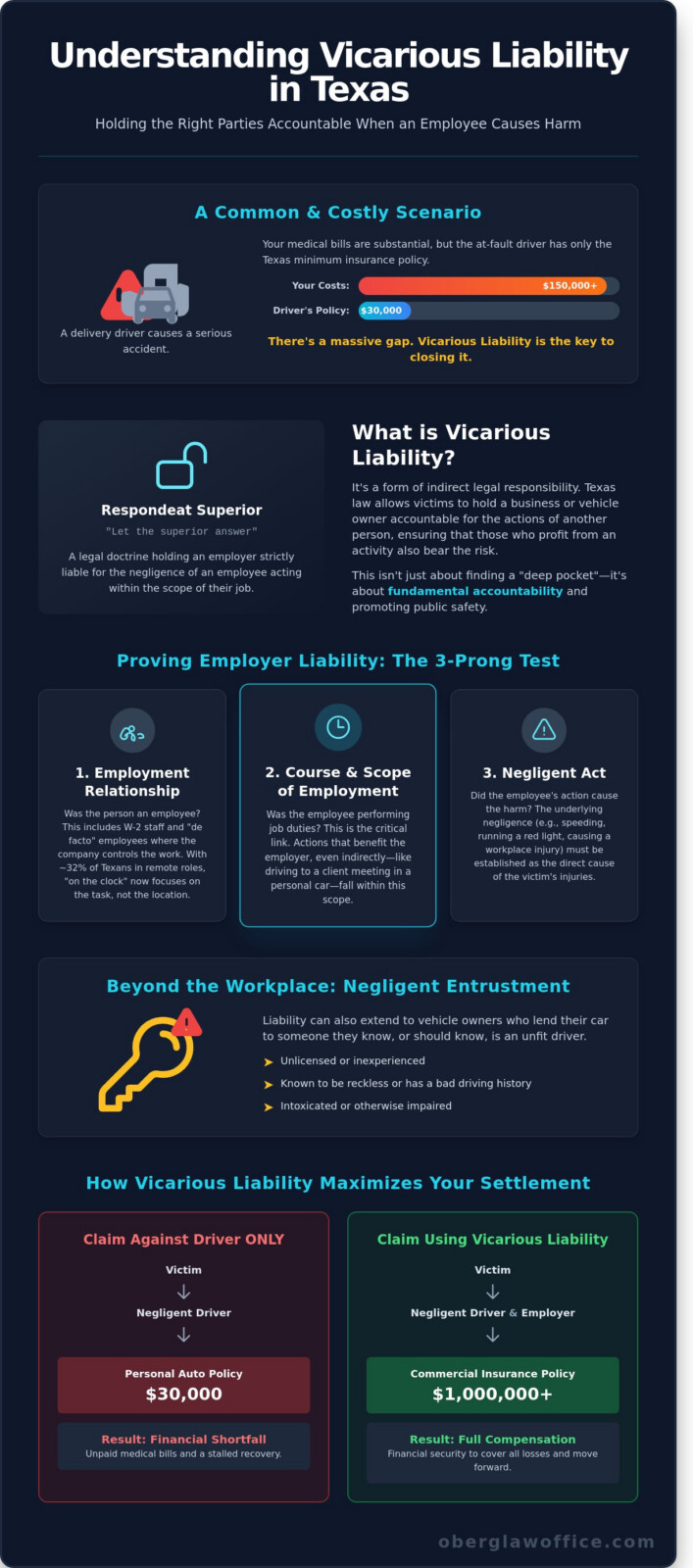
Vicarious liability is a legal doctrine that holds one party responsible for the actions of another, even if the first party didn’t physically cause the injury. Think of it as indirect legal responsibility. While direct negligence focuses on what the driver did wrong, imputed liability focuses on why their employer or a vehicle owner should be held accountable. Texas courts allow this because it ensures that those who profit from an employee’s labor also bear the risk when that employee causes harm to a neighbor in our community.
Some people mistakenly believe this doctrine is just about finding a “deep pocket” to pay for an accident. At the Oberg Law Office, we know it’s actually about fundamental accountability. If a company puts a driver on the road to make a profit, that company must be responsible for the safety of our Mesquite streets. It isn’t just about the money; it’s about making sure the entire chain of command is held to a high standard of care for everyone’s protection.
Respondeat Superior: “Let the Superior Answer”
This doctrine has deep roots in Texas common law, established through decades of court rulings that define the relationship between masters and servants, or employers and employees. By holding companies responsible, the law creates a safer environment for all of us by forcing businesses to train staff better and monitor safety protocols more closely. Under respondeat superior, an employer is held strictly liable for the torts of an employee committed within the course and scope of their employment. This means if a delivery driver or a technician causes an accident while performing their job duties, the business they represent is legally tied to the outcome.
Why Vicarious Liability Matters for Your Texas Personal Injury Claim
In many cases, an individual defendant might be “judgment proof,” which is a legal way of saying they don’t have the personal assets or high-limit insurance needed to cover a life-changing injury. Relying solely on a driver’s personal policy can leave you with unpaid bills and a stalled recovery. By identifying third-party liability, we can often access commercial insurance policies that provide the full compensation you deserve. You have a limited window to act, so it’s important to understand the Texas personal injury statute of limitations to ensure all responsible parties are named in your claim before the 2026 deadlines pass. Identifying these parties early is the best way to protect your family’s future.
When is an Employer Liable for an Employee’s Actions in Texas?
You’re dealing with medical bills and physical pain after an accident, and it’s frustrating when the person who caused the harm doesn’t have enough insurance to cover your recovery. In many cases, Texas law allows you to look beyond the individual and hold their employer accountable. This process relies on the legal doctrine of vicarious liability, which establishes that a company is responsible for the negligence of its staff. Understanding vicarious liability texas rules is essential because it shifts the financial burden from you to the entity that allowed the negligence to happen.
First, we must establish that an employment relationship existed at the time of the injury. This includes formal W-2 employees and “de facto” employees where the company maintains the right to control the details of the work. By 2026, the definition of being “on the clock” has evolved. With approximately 32% of the Texas workforce operating in remote or hybrid roles, courts now look at whether an employee was performing a work task rather than where they were sitting. If a worker causes a crash while driving a personal vehicle to a client meeting or while distracted by a work-related notification, the employer may still be on the hook for your damages.
The “Course and Scope of Employment” Test
Texas courts use a specific three-prong test to decide if an employer must pay for an employee’s mistake. We look for evidence to answer these three questions:
- Authority: Was the act within the general authority the employer gave the employee?
- Furtherance of Business: Was the act performed to move the employer’s business goals forward?
- Object of Employment: Was the act done to accomplish the specific task the employee was hired to do?
Frolic vs. Detour: When the Employer Is Not Liable
Liability often hinges on whether the employee’s actions were a “detour” or a “frolic.” A detour is a minor departure from work duties. If a delivery driver stops for gas or a quick meal between Mesquite and Dallas, they’re still working; the employer remains liable. A frolic is a major departure for purely personal reasons. If that same driver travels 30 miles out of their way to visit a friend or go to a bar, the legal connection to the employer is broken. We dig into GPS data and time logs to prove the driver was still serving their company when they hurt you.
Vicarious Liability in Texas Trucking Accidents
In serious wrecks involving 18-wheelers, the trucking company is almost always the primary target for a lawsuit. These companies are responsible for the actions of their drivers under both Texas state law and strict federal safety regulations. Because commercial trucks can weigh up to 80,000 pounds, the stakes are incredibly high. If you’ve been injured by a commercial vehicle, you need a truck accident lawyer in Texas who can untangle the web of vicarious liability texas statutes and federal carrier rules. If you’re feeling overwhelmed by the legal process, you can reach out to Oberg Law Office to discuss how we can protect your family’s future.
Other Common Forms of Imputed Liability in Texas
Liability doesn’t end at the office door. It reaches into our neighborhoods and onto our local roads. When someone acts on behalf of another person, an “agency” relationship forms. This means you can hold the person in charge accountable for the harm their representative caused. The State Bar of Texas on Vicarious Liability provides deep insight into how these doctrines protect victims after a crash. Understanding vicarious liability texas is about ensuring every responsible party contributes to your recovery and justice.
Negligent Entrustment: Loaning a Vehicle to an Unsafe Driver
If you’re hurt by a driver who shouldn’t have been behind the wheel, the vehicle owner might be at fault. We see this often when people lend cars to friends or family members who have a history of recklessness. To win a negligent entrustment case, you must prove five specific elements:
- The owner entrusted the vehicle to the driver.
- The driver was unlicensed, incompetent, or known to be reckless.
- The owner knew or should have known about the driver’s unfitness.
- The driver was negligent during your specific accident.
- The driver’s negligence was the proximate cause of your injuries.
Vehicle owners have a duty to protect the community by being careful about who they trust with a heavy machine. When they ignore a suspended license or a history of DUIs, they share the blame for the aftermath.
Parental Liability for the Actions of Minors
Parents often worry about their teen’s driving habits. Texas law generally limits parental liability for a minor’s negligence, but there are vital exceptions. Under the Texas Family Code, parents can be held liable for up to $25,000 in property damage for willful and malicious conduct. However, for personal injuries, we often look for direct negligence. If a parent knowingly lets an unlicensed teen drive or fails to supervise a child with known dangerous tendencies, they can be held fully responsible. While many states use the “Family Purpose Doctrine” to hold car owners liable for any family member’s crash, Texas courts have largely rejected this broad rule. We focus instead on specific evidence of negligent entrustment to secure the compensation your family needs.
Dram Shop Liability: When Alcohol Vendors Share the Blame
Bars and restaurants have a legal obligation to stop serving people who are “obviously intoxicated.” The Texas Dram Shop Act of 1987 allows you to hold alcohol providers vicariously liable if they serve a patron who is a clear danger to themselves and others. Proving this requires showing the alcohol service was a proximate cause of the accident. It’s a high burden of proof that often requires expert testimony or bar surveillance footage. Our team works to hold these businesses accountable because they shouldn’t profit while putting our Mesquite neighbors at risk. Linking the intoxication directly to the crash is a complex process, but it’s a necessary step for full protection after a drunk driving injury.
Proving Vicarious Liability: Challenges and Misconceptions
Securing justice after an accident involves more than just identifying who hit you. It requires holding the powerful entities behind the scenes accountable. Insurance companies often fight tooth and nail to deny that a vicarious liability texas claim exists. They want to isolate the driver, leaving you to settle for a policy that might not even cover your ER bill. We don’t let them get away with that. Our team starts an immediate investigation to secure logs and records before they “disappear” into a corporate shredder.
The Independent Contractor Loophole
One of the most common tactics we see involves the “independent contractor” defense. A company might point to a 1099 tax form and claim they aren’t responsible for a driver’s negligence. In Texas, a tax form isn’t the final word. We apply the “Right to Control” test to see the truth. This test asks whether the company dictated the “how” of the work, not just the “what.” If the business controlled the driver’s route, schedule, or equipment, they’re likely an employer in the eyes of the law, regardless of what the contract says.
Evidence Needed to Establish a Vicarious Relationship
Building a strong case requires a paper trail that connects the worker to the business. We look for pay stubs, employment contracts, and internal handbooks. Technology often provides the most honest testimony. GPS data and cell phone records can prove a driver was actively completing a delivery or heading to a job site when the impact occurred. Securing internal company communications can often reveal that a driver was under pressure to meet a deadline at the time of the crash. This evidence turns a “simple accident” into a clear case of corporate negligence.
Identifying All Liable Parties Early
You can’t afford to wait. Texas generally provides a two-year window to file a personal injury claim, but finding hidden defendants takes time. If you realize a parent company is liable after the statute of limitations passes, you’re out of luck. A skilled Texas personal injury lawyer uses the discovery process to peel back the layers of shell companies and subcontractors. While vicarious liability makes an employer responsible for an employee’s actions, it differs from “Joint and Several Liability,” which involves multiple parties sharing different percentages of fault. We make sure every person or business that contributed to your pain is named in your suit.
If you’re struggling with mounting medical bills and a stubborn insurance company, you don’t have to fight alone. Reach out to the Oberg Law Office at oberglawoffice.com for a free consultation to discuss your recovery options.
How Vicarious Liability Impacts Your Personal Injury Settlement
Applying the principle of vicarious liability texas is often the deciding factor between a partial recovery and a settlement that truly covers your needs. When an employer is held responsible for an employee’s negligence, the legal focus shifts from an individual’s limited personal assets to a corporation’s robust resources. This shift is vital for families facing long-term medical bills or permanent lifestyle changes.
Accessing Higher Insurance Policy Limits
Most individual drivers in Texas carry the state minimum 30/60/25 liability coverage. This provides only $30,000 for injuries per person. In a serious collision, $30,000 might not even cover the first 48 hours of hospital care. Corporate entities, however, usually carry commercial policies with limits of $1,000,000 or more. This allows for a much more comprehensive recovery, including:
- Full Medical Coverage: Payment for extensive surgeries, hospital stays, and years of physical therapy.
- Wage Replacement: Recovery of lost income that isn’t artificially capped by a small policy limit.
- Umbrella Policies: Access to secondary layers of insurance that commercial businesses often carry for catastrophic events.
Negotiating with Corporate Insurance Carriers
Commercial insurers are notoriously aggressive. They use high-pressure tactics to minimize payouts because they have significant financial interests to protect. You shouldn’t have to navigate these traps while you’re trying to heal. Working with an accident lawyer in Texas gives you a shield against these adjusters. We understand their playbooks and we don’t back down. Our firm provides the formidable representation needed to stand up to big-city law firms and multi-billion dollar carriers that represent these businesses.
How Oberg Law Office Fights for Full Compensation
We believe you deserve a personal connection during such a stressful time. At Oberg Law Office, you won’t be shuffled off to a paralegal or a junior staff member. You’ll speak directly with your attorney about your case. We take the burden of the legal fight off your shoulders so you can focus on your family and your physical recovery.
Our “No Fee Unless We Win” promise ensures that you can pursue a high-level claim against a giant corporation without any financial risk. We’re your neighbors in Mesquite, and we’re dedicated to ensuring you aren’t treated like just another claim number. You don’t have to face a massive corporation or their insurance company alone. We’re here to lead the way and protect your future.
Take the Next Step Toward Your Recovery
You shouldn’t have to navigate the aftermath of a serious accident alone. Understanding vicarious liability texas is a vital step in ensuring you receive the full compensation required for your medical bills and lost wages. When a company’s employee causes harm during their work duties, the law allows you to seek justice from the employer. This legal path often leads to more substantial settlements because it opens doors to corporate insurance policies that individuals simply don’t carry.
Our firm believes in a personal touch. You’ll speak directly with your attorney throughout the entire process because your story matters to us. We’ve spent over 25 years helping Texans hold these third parties accountable for their actions. We take on the stress of the legal battle so you can focus on healing. There’s no fee unless we win your case; our success is tied directly to yours. Let’s work together to protect your future and get your life back on track.
Get Your Free Case Strategy Session With Gregg Oberg Today
You have the strength to get through this, and we’re here to provide the legal support you need every step of the way.
Frequently Asked Questions
Is an employer always liable if an employee crashes a company car in Texas?
An employer isn’t automatically liable for every crash involving a company vehicle. In Texas, the employee must have been acting within the scope of their employment at the precise moment of the collision. If a driver for a local Mesquite delivery company hits you while on their assigned route, the company likely shares responsibility. However, if they took the van for a personal errand, the business might avoid liability under the “frolic and detour” rule.
Can I sue a parent if their child caused my injury in Texas?
You can sue a parent in Texas if their child’s willful or malicious conduct causes your injury, though recovery is often limited. Under Texas Family Code Chapter 41, parental liability for a child’s property damage is capped at $25,000 per occurrence. For personal injuries, you must typically prove the parent was personally negligent in supervising the child or that the child was acting as the parent’s agent at the time of the incident.
What is the difference between direct negligence and vicarious liability?
Direct negligence occurs when a party’s own actions, like a company failing to fix a broken stair, cause you harm. In contrast, vicarious liability texas laws hold a third party responsible for someone else’s actions based on their legal relationship. You don’t have to prove the employer did something wrong themselves; you only need to prove the employee was negligent while doing their job to seek justice.
Does vicarious liability apply to Uber or Lyft drivers in Texas?
Vicarious liability generally doesn’t apply to Uber or Lyft because Texas law classifies these drivers as independent contractors rather than employees. This distinction, codified in Texas Transportation Code Chapter 2402, protects the tech giants from direct responsibility for driver errors. However, you can still seek recovery through the $1 million liability insurance policies these companies are required to carry when a passenger is in the vehicle or a ride is accepted.
How does “negligent entrustment” differ from vicarious liability?
Negligent entrustment happens when an owner gives a vehicle to a driver they know is incompetent, reckless, or unlicensed. This is a form of direct negligence because the owner made a poor choice that led to your injury. Vicarious liability focuses on the employer-employee relationship and applies even if the employer had no reason to believe the employee was a dangerous driver, providing an extra layer of protection for your family.
Can a bar be held vicariously liable for a drunk driver in Texas?
A bar can be held responsible for a drunk driver’s actions under the Texas Dram Shop Act found in the Alcoholic Beverage Code. If a Mesquite establishment serves an “obviously intoxicated” person who then causes a crash, the bar may be liable for your damages. While this is a specific statutory liability rather than traditional vicarious liability texas, it’s a vital way our team helps you hold all responsible parties accountable.
What happens if the employee was “off the clock” at the time of the accident?
Employers are typically not liable for accidents that occur while an employee is off the clock or commuting to work. Texas courts follow the “coming and going” rule, which states that travel to and from a job site is outside the scope of employment. If a worker hits you while driving home after their shift ends at 5:00 PM, you generally cannot pursue a claim against their employer unless they were performing a work task during the drive.
Can I still sue the driver if I also sue their employer under vicarious liability?
You can absolutely sue both the individual driver and their employer in the same personal injury lawsuit. Naming both parties ensures that all available insurance coverage is on the table to help pay for your medical bills and lost wages. Our office often pursues both the driver and the company to reach the larger commercial insurance policies that businesses carry, ensuring the financial recovery you deserve.