
Imagine it’s January 15, 2026, and you’re finally feeling like yourself again after a devastating car wreck on Main Street in Mesquite back in 2024. You decide it’s time to hold the at-fault driver accountable, only to discover the courthouse doors are legally locked because you missed a single date on the calendar. This heartbreaking scenario happens to thousands of Texans who wait too long to act. Understanding the texas personal injury statute of limitations isn’t just about following rules; it’s about protecting your family’s financial future before the clock runs out.
You’ve likely felt the heavy weight of medical bills piling up while you’re just trying to focus on healing. It feels unfair that the law puts a strict timer on your recovery while you’re still in pain. We believe you shouldn’t lose your right to justice because of a technicality. In this guide, you’ll learn the exact 2-year deadlines for your 2026 filing, the critical exceptions that could save your case, and a concrete plan to secure an attorney. We will break down the confusing differences between insurance notice periods and legal filing dates so you can move from uncertainty to total empowerment.
Key Takeaways
- Understand the standard two-year window you have to file a lawsuit under the texas personal injury statute of limitations to ensure your right to recovery is protected.
- Learn about the critical “tolling” exceptions and the Discovery Rule that could potentially pause the clock if your injuries weren’t immediately apparent.
- Uncover the truth about the “insurance claim trap” and why negotiating with an adjuster doesn’t legally protect your deadline for filing a suit.
- Identify the specialized, much shorter notice periods required for claims against the City of Mesquite or the State of Texas to avoid losing your case on a technicality.
- Discover how to immediately gather essential evidence and partner with a local advocate who will personally guide you through the legal process.
Understanding the Texas Personal Injury Statute of Limitations in 2026
You are likely dealing with the physical pain and emotional stress that follows a serious accident. While your primary focus is on your medical recovery and your family, the legal system operates on a strict, unforgiving timeline. In legal terms, the statute of limitations is a legislative act that sets the maximum time you have to initiate legal proceedings from the date of an alleged offense. For your specific situation, this is the deadline to file a lawsuit in a Texas civil court.
Under the Texas Civil Practice and Remedies Code Section 16.003, the general rule is clear and direct. You have exactly two years from the day the incident occurred to file your claim. This law exists for two practical reasons. First, it ensures that cases move through the court system with reasonable speed. Second, it protects the integrity of the trial by ensuring that physical evidence is still available and witness memories haven’t faded into uncertainty. At the Oberg Law Office, we believe that understanding this clock is the first step toward protecting your future.
Think of this two-year deadline as a hard wall. If you attempt to file your lawsuit on the two-year anniversary plus one single day, the court will almost certainly dismiss your case regardless of its merits. It doesn’t matter how severe your injuries are or how clearly the other party was at fault. Once that 730-day window closes, your legal right to seek financial compensation for your medical bills and lost wages is lost forever. This is why the texas personal injury statute of limitations is the most critical date in your entire legal journey.
When Does the Two-Year Clock Actually Start?
The “accrual” of a claim refers to the specific moment your injury happened. For a car wreck on North Galloway Avenue in Mesquite, the clock starts the second the collision occurs. The date listed on the Texas Peace Officer’s Crash Report, known as Form CR-3, becomes the definitive anchor for your timeline. Some cases involve delayed-onset medical issues where the injury isn’t immediately obvious. In these rare instances, the clock might start when you discovered the harm. Establishing this date requires precise medical records and expert testimony to satisfy the court’s requirements.
Why Waiting Until the Deadline Is a Dangerous Strategy
Waiting until the final months of the two-year period is a gamble that rarely pays off for victims. Evidence decays quickly; skid marks on the road wash away after a few heavy North Texas rainstorms, and surveillance footage from local businesses is often deleted on 30-day cycles. Your legal team needs time to build a case that can withstand the pressure of insurance company lawyers. Preparing a filing isn’t a 24-hour process. It often takes 90 days to gather medical records, interview witnesses, and draft the necessary legal documents. A last-minute rush increases the risk of clerical errors. If a filing is rejected because of a small mistake on the very last day, you won’t have time to fix it before the texas personal injury statute of limitations expires.
Exceptions to the Rule: When Does the Texas Clock Stop Ticking?
Life is rarely predictable. While the two year deadline is a firm pillar of the law, Texas recognizes that certain situations make it impossible to file a claim on time. This is where the concept of tolling comes into play. Tolling essentially pauses the countdown, giving you the breathing room needed to seek justice when the standard texas personal injury statute of limitations would otherwise bar your recovery. It acts as a legal safety net for victims who face extraordinary hurdles.
One common reason the clock might stop is the physical absence of the person who caused your harm. If a negligent driver hits you in Mesquite and then leaves the state of Texas for a period of 90 days or more, that time away usually doesn’t count toward the two year limit. The law ensures that defendants cannot escape their responsibilities simply by crossing state lines. We believe in holding people accountable, no matter where they try to hide. You deserve a protector who understands these nuances and can help by discussing your specific timeline during a free consultation.
The Discovery Rule in Texas Injury Cases
Texas courts apply the Discovery Rule with a high degree of scrutiny. This rule applies when an injury is inherently undiscoverable, meaning a reasonable person wouldn’t have known they were hurt. Imagine a scenario from 2022 where a patient undergoes surgery, but a small piece of medical equipment is left behind. If the pain doesn’t start until 2025, the clock might start on the date of discovery rather than the date of the surgery. According to the Texas Civil Practice and Remedies Code, you must provide clear evidence that you couldn’t have known about the injury earlier. This often requires expert testimony to prove the latent nature of the harm, such as toxic chemical exposure that takes 5 years to manifest as a respiratory illness.
Tolling for Minors and Incapacitated Persons
The law provides special protections for those who cannot legally represent themselves. Children are a primary example. In Texas, the texas personal injury statute of limitations typically doesn’t begin to run for a minor until they reach the age of majority. This means if a 10 year old is injured in 2024, their two year clock usually doesn’t start until their 18th birthday in 2032. They would then have until they turn 20 to file a lawsuit.
Mental incapacity offers similar protections. If an accident leaves a victim in a coma or with a traumatic brain injury that prevents them from understanding their legal rights, the clock pauses. It only resumes once they regain their mental faculties. For families in Mesquite, this means you don’t have to choose between focusing on your child’s recovery and rushing to a courthouse. We handle the heavy lifting so you can focus on healing. Our firm treats your family like our own, ensuring that every day of tolling is correctly calculated to preserve your right to compensation.
- Minors: The clock is paused until the individual turns 18.
- Unsound Mind: Tolling applies if the person is legally incapacitated at the time of the injury.
- Military Service: Federal law may also pause state deadlines while a plaintiff is on active duty.
Every case has a unique rhythm. Whether your situation involves a hidden injury or a defendant who fled the state, these exceptions are complex. We don’t let insurance companies use the calendar as a weapon against you. Our team is dedicated to uncovering every legal avenue to keep your claim alive and moving toward a successful recovery.
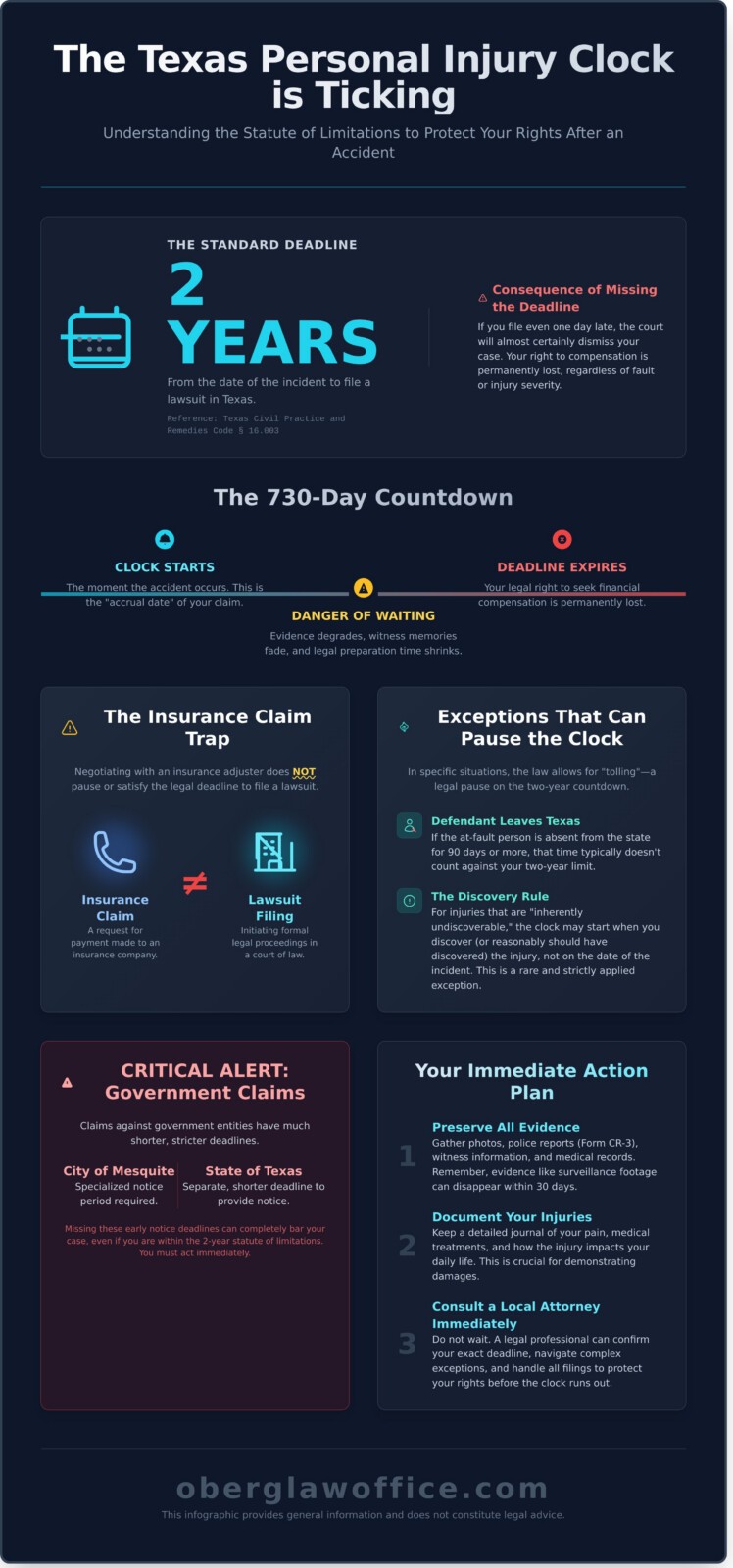
The Insurance Claim Trap: Filing vs. Suing in Texas
You have been communicating with an insurance adjuster for months. They have been polite, perhaps even empathetic, as you describe your recovery process. You might feel that because your claim is open and active, your legal rights are secure. This is the single most dangerous misconception regarding the texas personal injury statute of limitations. Many people confuse the act of filing an insurance claim with the act of filing a lawsuit. These are two entirely different legal actions with different consequences for your future.
An insurance claim is an administrative process between you and a private company. A lawsuit is a formal legal proceeding filed in a Texas civil court. While adjusters are required to negotiate in good faith, they have no legal obligation to remind you that the clock is ticking. In fact, the law is very clear on this point. According to the Texas Civil Practice & Remedies Code § 16.003, you generally have exactly two years from the date of the incident to bring a suit for personal injury. If that two-year window closes and you have not filed a formal Petition in court, your right to recover compensation is usually lost forever, regardless of how long you have been “negotiating” with an adjuster.
At Oberg Law Office, we treat your case with the urgency it deserves from day one. We understand that a “Notice of Claim” is just the beginning of the conversation. It does not protect you from the statutory deadline. Only a filed Petition, stamped by the court clerk, provides that protection. We manage this transition by keeping a constant eye on the calendar, ensuring that the insurance company’s internal delays never become your legal downfall.
Adjuster Tactics and the Looming Deadline
Insurance companies are businesses focused on their bottom line. One common tactic involves dragging out settlement talks as the 24-month mark approaches. They might request “just one more medical record” or ask for a follow-up statement 18 months after the accident. These requests can feel like progress, but they often serve to eat up the remaining time on your texas personal injury statute of limitations.
We have seen situations where an adjuster makes a “final offer” 23 months after the accident. This puts you in a desperate position. You are forced to choose between a low-ball settlement or rushing to find a lawyer who can file a lawsuit in a matter of weeks. To prevent this, our firm sets a “litigation trigger” date. If the insurance company has not offered a fair settlement by a specific milestone, we stop talking and start filing. This proactive approach ensures you are never backed into a corner by a ticking clock.
Internal Link Opportunity: Why You Need an Attorney
Navigating these deadlines alone is a heavy burden to carry while you are trying to heal. This is why you need a Mesquite car accident lawyer who acts as your steadfast protector. We take the lead in all communications, allowing you to focus on your family and your health. Our team utilizes a detailed “Demand Letter” in the pre-litigation phase to clearly outline your damages and set a firm deadline for the insurer to respond. This letter signals to the insurance company that we are prepared for trial if they refuse to treat you with the respect you deserve. We don’t just ask for a settlement; we demand justice, and we have the experience to back it up in court.
Special Deadlines for Government Claims and Wrongful Death
Most people assume they have a full two years to file a claim after an accident. While that’s the standard texas personal injury statute of limitations, several specific scenarios force you to act much faster. If your injury involves a government employee or a defective product, the clock might be ticking louder than you realize. Missing these unique deadlines doesn’t just delay your case; it usually ends it entirely. Our team at Oberg Law Office believes you deserve to know these traps before they catch you off guard.
Suing a Government Entity in Texas
The City of Mesquite and the State of Texas operate under a different set of rules known as the Texas Tort Claims Act. This law provides a limited waiver of sovereign immunity, but it comes with strings attached. You must provide a formal “notice of claim” long before you ever file a lawsuit. While the state level allows six months for this notice, local municipalities are much stricter. For example, the City of Mesquite Charter, Section 11.02, requires you to file a written notice of injury within 30 days of the incident. If a city-owned vehicle hits you on Town East Boulevard, you have exactly one month to alert the city in writing or you lose your right to sue.
Sovereign immunity acts as a shield for the government. It protects them from many types of lawsuits unless you follow their procedures perfectly. These cases often involve city-owned buses, police car collisions, or poorly maintained public roads that cause serious wrecks. Because the window to act is so small, you can’t afford to wait for an insurance adjuster to call you back. We see many neighbors lose their chance at justice simply because they didn’t realize the 30-day clock was running.
Wrongful Death Timelines
Losing a family member is a devastating experience that leaves you focused on grief, not paperwork. However, the law requires you to pivot to legal matters relatively quickly. In a wrongful death case, the two-year texas personal injury statute of limitations typically begins on the date of the individual’s death. This is a vital distinction because the death might occur weeks or months after the initial accident. If the deceased person lived for 60 days after a car crash, the clock for the wrongful death claim starts the day they passed away, not the day of the impact.
The law differentiates between wrongful death claims and survival actions. A wrongful death claim compensates the family for their loss of support and companionship. Only the surviving spouse, children, or parents can file this. A survival action is different; it’s a claim the deceased person could have filed themselves had they lived, covering their medical bills and pain before they died. If the family doesn’t file a wrongful death suit within three calendar months of the death, the executor or administrator of the estate must do it instead, unless all beneficiaries request otherwise.
Texas also enforces “statutes of repose,” which serve as absolute deadlines regardless of when you discovered your injury. For product liability cases involving defective machinery or household goods, you generally cannot file a claim more than 15 years after the date the product was originally sold. Medical malpractice follows a similar harsh logic. While you generally have two years to sue a doctor, Texas Civil Practice and Remedies Code Section 74.251 sets an absolute 10-year limit from the date of the medical error. Even if you don’t discover a surgical tool was left inside you until 11 years later, the law bars you from recovery. You need a steadfast protector who understands these nuances to ensure your rights remain intact.
Don’t let a hidden deadline destroy your chance at recovery. Contact the Oberg Law Office today to protect your family’s future.
What to Do if Your Statute of Limitations Is Approaching
Realizing your deadline is only weeks or days away creates a heavy weight in your chest. You don’t have to carry that alone. If the two-year texas personal injury statute of limitations is closing in, your first priority is an immediate consultation with a dedicated attorney. Professional legal teams can often mobilize in less than 24 hours to prevent your case from being permanently barred by the court. We have seen cases where victims waited until the final 30 days, only to find that the complexities of their accident required weeks of investigation before a suit could be drafted. Don’t let that happen to you.
The most effective way to protect your rights is through an emergency filing. When an attorney files an Original Petition with the court, it effectively stops the clock. Even if your trial doesn’t happen for another 18 months, the act of filing satisfies the legal requirement and preserves your right to seek justice. You shouldn’t let financial worries stop you from making this call. Our firm operates on a contingency fee model, often called the “No Fee Unless We Win” approach. This removes every financial barrier to entry. We take on the risk of filing fees, which can range from $200 to $400 in Texas, and we cover the costs of securing expert testimony or accident reconstruction. You pay nothing out of pocket to get your case into the court system before the deadline expires.
Gathering Evidence Under Pressure
The police report, initial medical intake forms, and witness contact information are the foundation of a late-stage filing. These documents provide the basic facts needed to satisfy the court’s initial requirements. You can use our comprehensive guide on What to Do Immediately After a Car Crash in Mesquite as a checklist to ensure you haven’t overlooked a vital piece of the puzzle. Speed is vital because digital evidence is the most fragile part of your case. For example, many commercial security cameras and doorbell systems overwrite data every 7 to 14 days. If we don’t send a preservation letter to the camera owner immediately, that 1080p proof of the defendant’s negligence could be gone forever.
The Oberg Law Office Approach to Urgent Cases
We understand the panic that sets in when you realize time is running out. At Oberg Law Office, we provide direct attorney access to ensure your concerns are heard immediately. You won’t be passed off to a paralegal or a distant intake center. Gregg Oberg personally reviews urgent cases to determine the fastest path to filing. We’ve spent years serving Mesquite residents as neighborly advocates who aren’t afraid to stand up to aggressive insurance companies. Our goal is to provide a steady hand and a clear plan when you feel overwhelmed by the texas personal injury statute of limitations. We treat your family like our own, fighting for the compensation you need for medical bills and lost wages. Time is your most valuable asset right now, so don’t wait another hour. Schedule your free strategy session before time runs out.
Protect Your Right to Recovery Before Time Runs Out
Navigating the texas personal injury statute of limitations doesn’t have to be a solo journey. The 2026 deadlines are strict. Once that two-year window closes, your chance to hold negligent parties accountable usually disappears forever. Whether you’re dealing with a complex government claim or a sensitive wrongful death case, every day counts toward securing the compensation your family needs. You’ve already been through enough stress; you don’t need the added weight of missing a legal deadline that could jeopardize your financial future.
At Oberg Law Office, we’ve spent over 25 years protecting our Texas neighbors from being silenced by insurance companies. You deserve a legal partner who treats you like a person, not a case number. When you reach out, you’ll speak directly with Attorney Gregg Oberg to discuss your specific situation. We operate on a contingency model, so there’s no fee unless we win. We’re here to be your steadfast guide and formidable advocate during this difficult chapter.
Don’t let the clock run out on your justice; contact Oberg Law Office for a free consultation. Your recovery is our top priority, and we’re ready to stand by your side today.
Frequently Asked Questions
Is the Texas personal injury statute of limitations exactly two years?
Yes, the Texas personal injury statute of limitations is generally two years from the day your accident occurred under Texas Civil Practice and Remedies Code Section 16.003. This means if you were injured on October 1, 2023, you must file your lawsuit by October 1, 2025. While this 730 day window seems long, gathering evidence and negotiating with insurance companies takes time. Our team in Mesquite works quickly to ensure your rights are protected before this strict legal deadline passes.
Can I sue after 2 years in Texas if I just found out I was injured?
You might be able to file a claim under the Discovery Rule if your injury wasn’t immediately apparent at the time of the accident. This rule pauses the clock until the date you actually discovered, or should have discovered, the harm. Texas courts apply this exception narrowly in about 5 percent of cases, such as medical malpractice involving foreign objects. Because these exceptions are rare, you should contact us the moment you suspect an injury to avoid missing your window for justice.
What happens if the 2-year deadline falls on a weekend or holiday in Texas?
If your filing deadline falls on a Saturday, Sunday, or legal holiday, Texas law extends the date to the next business day. Under Texas Rule of Civil Procedure 4, if your two year mark is a Sunday, you have until the following Monday at 5:00 PM to get your paperwork to the courthouse. We don’t recommend waiting until the final 24 hours. Filing early prevents technical glitches or travel delays from ruining your chance at a fair recovery for your family.
Does filing an insurance claim stop the statute of limitations clock?
No, filing an insurance claim does not stop or toll the texas personal injury statute of limitations. You can spend 18 months negotiating with an adjuster, but that doesn’t change the 24 month deadline to file a formal lawsuit in court. Insurance companies often use long delays to push you closer to that two year mark. We step in to ensure a lawsuit is ready well before that clock hits zero, keeping the pressure on the negligent parties.
How long do I have to file a claim against a city or government in Texas?
You often have as little as 90 to 180 days to provide formal notice if your claim involves a government entity. Under the Texas Tort Claims Act, the state requires notice within six months, but cities like Mesquite have specific charters requiring written notice in 90 days. Missing this initial Notice of Claim deadline can bar your recovery entirely, even if the two year statute hasn’t expired. We help you navigate these accelerated timelines to protect your right to compensation.
Can the statute of limitations be extended if the defendant leaves the state?
Yes, the clock stops during any period the defendant is physically outside the state of Texas. Under Civil Practice and Remedies Code Section 16.063, if a negligent driver leaves Texas for 30 days to work elsewhere, those 30 days aren’t counted toward your two year limit. We use investigators to track these timelines. This ensures every day the defendant was absent is added back to your window, giving you the full time allowed by law to seek protection.
What is the difference between a statute of limitations and a statute of repose?
A statute of limitations starts when you’re injured, while a statute of repose is an absolute deadline based on a specific event like a product’s sale date. In Texas, products liability cases have a 15 year statute of repose. Even if a defective tool breaks and hurts you today, you cannot sue if that tool was sold more than 15 years ago. These rules provide a final cutoff date that exists regardless of when your specific injury actually happened.
Do I need a lawyer to file a lawsuit before the deadline expires?
While you aren’t legally required to have an attorney, filing a texas personal injury statute of limitations compliant lawsuit involves complex procedural rules. One small mistake in your petition can lead to a dismissal, meaning you can never file again. At the Oberg Law Office, you’ll speak directly with an attorney who manages these deadlines for you. We work on a contingency basis, so you pay $0 unless we win your case and secure the recovery you deserve.


