
Imagine sitting at your kitchen table, looking at a stack of medical bills that grows larger with every mail delivery. It’s exhausting to feel like just another claim number when your life has been turned upside down. You likely feel that the insurance company is undervaluing your experience, and the stress of mounting debt only makes your physical recovery harder. You aren’t alone in feeling confused about how to “price” something as personal as physical pain or lost time with your family. This guide is here to help you understand exactly how personal injury damages in texas work in 2026, so you can move from a state of uncertainty to a feeling of empowerment.
We’ll walk you through a clear list of recoverable damages, from economic losses to non-economic suffering. You will also learn how the state’s 51% fault rule could affect your settlement and discover how working directly with an experienced advocate can help you secure the fair restoration you deserve. By the time you finish reading, you’ll have the knowledge needed to value your claim accurately and the confidence to seek a settlement that truly reflects your losses. You deserve a partner who understands the Texas legal landscape and treats your recovery with the personal attention it requires.
Key Takeaways
- Identify the three distinct pillars of recovery that help restore your financial security after an unexpected injury.
- Learn how to document measurable costs like medical debt and lost wages so you can present a clear picture of your financial losses.
- Discover the methods used to value non-economic personal injury damages in texas, ensuring your physical pain and emotional distress aren’t overlooked.
- Understand how the state’s 51% bar rule affects your eligibility for compensation and what’s required to pursue exemplary damages.
- Gain insight into a personalized approach to advocacy that focuses on uncovering hidden damages through direct partnership with an experienced legal guide.
What Are Personal Injury Damages in Texas?
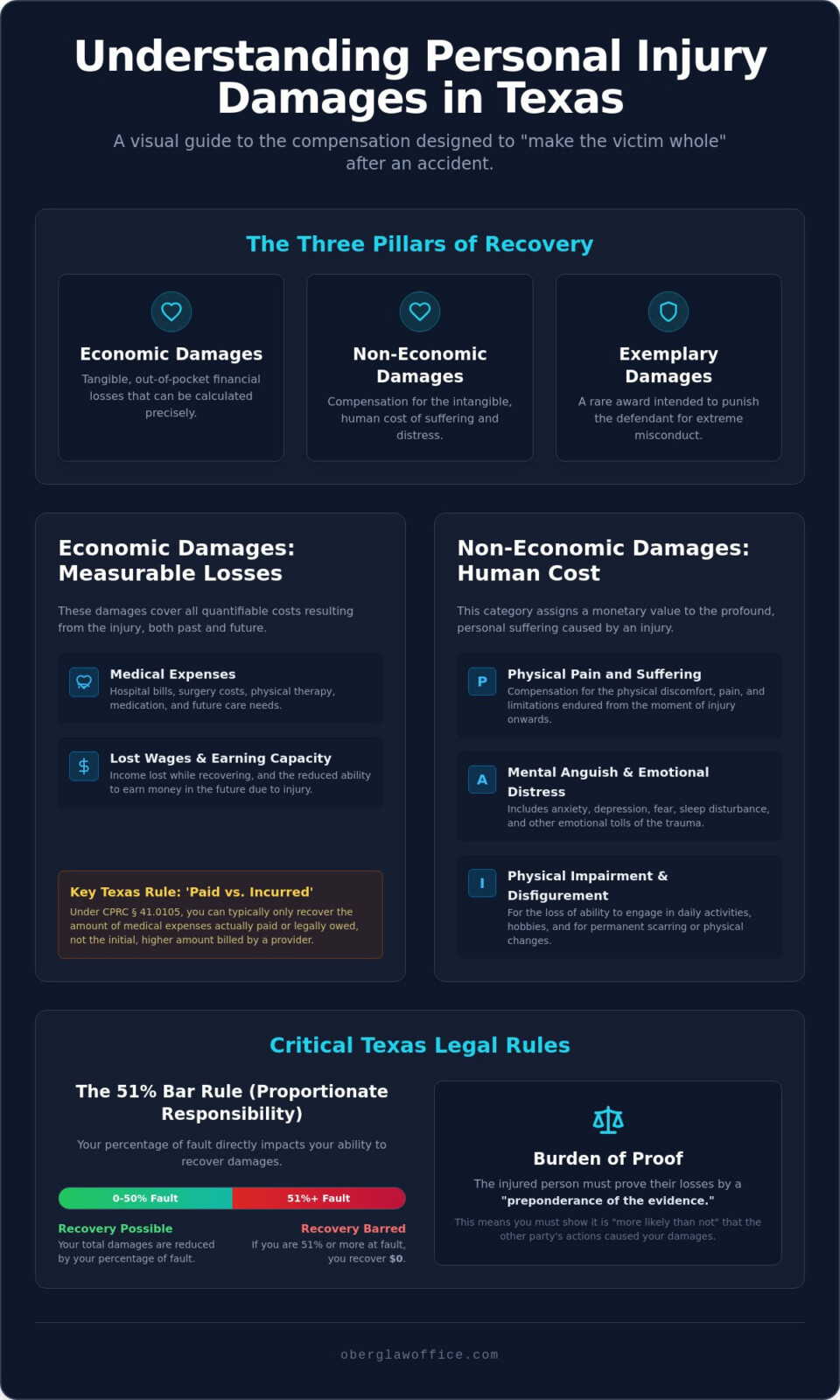
When you’ve been hurt in an accident, your life can feel fractured. The legal system uses the word “damages” to describe the financial compensation meant to piece things back together. In our state, the core philosophy behind personal injury damages in texas is restoration. The law doesn’t just want to hand you a check; it aims to “make the victim whole” again. This means returning you, as much as money can, to the financial, physical, and emotional state you were in before the incident occurred.
This process isn’t arbitrary. It’s governed strictly by the Texas Civil Practice and Remedies Code. Under this framework, we look at three main pillars of recovery. First, there are economic damages for your bills. Second, there are non-economic damages for your human suffering. Finally, in rare cases, there are exemplary damages. Each category serves a specific purpose in your journey back to stability. We’re here to help you identify every way the accident has touched your life so nothing is left off the table.
Compensatory vs. Exemplary Damages
Most of your claim will center on compensatory damages. These are designed to cover your actual, tangible losses. They are the foundation of your recovery. On the other hand, exemplary damages, often called punitive damages, function differently. These aren’t about your losses; they’re about the defendant’s behavior. If someone acted with gross negligence or malice, the court might use these damages to punish them and deter others from doing the same. While these make headlines, most Texas cases focus on the compensatory side to ensure your security and restoration.
The Burden of Proof in Damage Claims
Understanding the legal concept of damages is the first step, but proving them is where the real work begins. In a Texas civil court, the burden of proof rests on you. You must show that your injuries and financial losses are a direct result of the accident. The standard used is a “preponderance of the evidence.” This essentially means you must prove it’s more likely than not that your claims are true. It’s a lower bar than a criminal trial, but it still requires a mountain of clear, organized facts.
This is why immediate documentation is so vital. Every receipt, medical record, and photo serves as a building block for your case. When we sit down together to value your personal injury damages in texas, we rely on this evidence to stand firm against insurance companies that want to pay as little as possible. Your story deserves to be told with facts that can’t be ignored. We’ll guide you through the process of gathering this proof so you can focus on healing while we focus on the details.
Economic Damages: Recovering Your Measurable Financial Losses
Economic damages are the tangible, out-of-pocket costs that follow an injury. They represent the financial hit your bank account takes when someone else’s negligence causes a crash or a fall. When calculating personal injury damages in texas, we start with these quantifiable numbers because they are the foundation of your recovery. They aren’t based on feelings; they are rooted in math. To secure these funds, we use a mountain of evidence including hospital bills, pay stubs, and pharmacy receipts to prove exactly what the accident has cost you.
These damages cover several specific areas, divided into past and future losses. Past economic damages cover everything you’ve already paid or lost up until the day of your settlement or trial. Future economic damages are an estimate of what you’ll continue to lose. This includes ongoing medical care, specialized equipment, and the income you won’t be able to earn because of your physical limitations. Every dollar is meant to restore the financial security you had before the incident occurred.
The ‘Paid vs. Incurred’ Rule in Texas
Texas law has a specific rule under CPRC § 41.0105 that often surprises victims. You can only recover medical expenses that were actually paid or are legally owed. This means if a hospital bills $50,000 but accepts $15,000 from your insurance as full payment, your claim is generally limited to that $15,000. Navigating these billing adjustments is complex, which is why having a Texas truck accident advocate is vital. We work to ensure the insurance company doesn’t use these technicalities to shortchange your total recovery.
Loss of Earning Capacity vs. Lost Wages
There is a significant difference between a missed paycheck and a lost career. Lost wages cover the money you didn’t earn while you were in the hospital or recovering at home. Loss of earning capacity is different; it looks at your future potential. If your injury prevents you from returning to your previous job or limits your promotion path, you’ve lost a lifelong asset.
We calculate this by looking at your age, your career trajectory, and your life expectancy. We often bring in vocational experts to testify about how your physical limitations will impact your lifetime earnings. While the Texas Civil Practice & Remedies Code Chapter 41 is frequently cited regarding punitive limits, it also provides the framework for how we categorize these compensatory losses. If you’re struggling to understand the full scope of your losses, we can help you with valuing your claim to ensure no bill goes unpaid. Accurately documenting personal injury damages in texas is about more than just adding up numbers; it’s about protecting your family’s financial future.
Non-Economic Damages: Quantifying Your Pain and Suffering
While medical bills have a clear number at the bottom, the human cost of an accident is often much higher. Non-economic damages represent the pain, anguish, and loss of enjoyment that follow a traumatic event. These aren’t just abstract concepts; they are the reality of your daily life after an injury. Whether it’s the inability to pick up your child or the fear that grips you when you get back behind the wheel, these experiences are just as real as a broken bone. Under the Texas Civil Practice and Remedies Code, you have the right to seek compensation for these intangible losses. We believe your suffering deserves recognition, and we’re committed to ensuring the insurance company sees the person behind the file.
Common categories of personal injury damages in texas include physical pain, mental anguish, disfigurement, and physical impairment. Each of these addresses a different way your life has changed. Physical impairment, for example, focuses on the loss of function, like no longer being able to walk or use your hands as you once did. Disfigurement addresses the emotional and social impact of permanent scarring. These damages aim to provide a sense of justice for the things money can’t truly fix. We’re here to help you articulate these losses so they aren’t ignored during settlement talks.
How Texas Courts Calculate Pain and Suffering
Insurance adjusters and juries use several methods to put a price on pain. Many attorneys use the “Multiplier Method,” where your total economic damages are multiplied by a number between 1.5 and 5, depending on the severity of the case. Others prefer the “Per Diem” approach, assigning a daily dollar value to your suffering for every day from the accident until you reach maximum medical improvement. Juries consider how deeply the injury has altered your daily routine and whether your recovery has been particularly grueling. Non-economic damages are often the largest part of a catastrophic injury recovery.
Proving Mental Anguish and Disfigurement
Proving mental anguish in Texas requires more than just showing you were upset. The legal standard is high; you must demonstrate a substantial disruption of your daily routine or a high degree of mental pain. Disfigurement is handled similarly, focusing on permanent alterations to your appearance that cause distress or embarrassment. To build a strong case for these personal injury damages in texas, we often recommend keeping a “pain journal.” Documenting the emotional toll of your recovery, the days you couldn’t sleep, or the events you missed provides the concrete details a jury needs to understand your experience. This personal record helps us turn your private struggle into a powerful argument for restoration and fairness.
Exemplary Damages and the 51% Rule: Texas Legal Hurdles
Texas law is designed to help you recover, but it also contains specific hurdles that can reduce or even eliminate your compensation. The most significant of these is the “Modified Comparative Fault” rule, often called the 51% Bar Rule. This means that if you are found to be 51% or more responsible for the incident that caused your injuries, you are legally barred from recovering any personal injury damages in texas. It’s a harsh reality that underscores why documenting the facts of your case is so critical from the very beginning. Even if you are 50% at fault, you can still recover half of your damages, but crossing that 51% threshold stops your claim in its tracks.
Proportionate Responsibility: How Your Fault Affects Your Check
The math of proportionate responsibility is straightforward but impactful. If you are found to be 20% at fault and a jury awards you $100,000, your final check will be reduced by that 20%, leaving you with $80,000. This is why every percentage point matters. When an insurer tries to pin even a small amount of blame on you, they are essentially trying to discount your recovery. We don’t let those attempts go unchallenged, especially when you are already dealing with the stress of medical debt and physical recovery.
When Are Punitive Damages Possible?
Exemplary damages, also known as punitive damages, are a separate category designed to punish particularly egregious behavior. These are not common and require a higher burden of proof than standard compensatory claims. You must show clear and convincing evidence that the harm resulted from malice, fraud, or gross negligence. This might apply in cases involving a drunk driver or a trucking company that intentionally ignored safety laws to save time. To secure these, a jury’s decision must be unanimous.
Texas law places strict caps on these awards. Generally, the limit is the greater of $200,000 or two times the amount of economic damages plus an amount equal to non-economic damages, with that non-economic portion capped at $750,000. If you believe your case involves extreme neglect, speaking with a knowledgeable guide is the best way to determine if exemplary personal injury damages in texas are a viable path for your recovery.
The Oberg Approach: Maximizing Your Recovery Through Advocacy
Seeking justice after an accident shouldn’t feel like a distant, cold transaction. At Oberg Law Office, we treat your case with the personal investment it deserves. When we look at personal injury damages in texas, we don’t just see numbers on a page; we see a life that needs to be put back together. Our approach focuses on identifying “hidden” damages that victims often overlook, such as the long-term impact on your career or the subtle ways your physical limitations change your family life. We build a comprehensive damage model for every client to ensure no loss is left uncounted.
Evidence Preservation: The Foundation of Your Claim
A strong claim for personal injury damages in texas starts with the facts. We take immediate action to secure vital evidence before it disappears. This includes downloading black box data from vehicles, securing witness statements, and preserving physical evidence from the scene. This early intervention is the best way to protect your right to full compensation. If you’ve just been in an accident, we encourage you to review our Texas personal injury guide for the specific steps you should take right now to protect your future claim.
Your Free Strategy Session: Valuing Your Case
You don’t have to guess what your case is worth or struggle with insurance companies alone. During your free initial strategy session, we’ll sit down together to discuss your situation and provide a realistic assessment of your claim’s value. This is a low-pressure conversation designed to reduce your anxiety and move you toward a state of empowerment. We’ll listen to your story, explain your rights, and outline a clear path forward. You deserve a steadfast protector who will fight for the fairness you are owed. Schedule your free damage assessment today and take the first step toward reclaiming your security and peace of mind.
Reclaim Your Financial Security and Peace of Mind
You now have a clearer understanding of how personal injury damages in texas are calculated and protected. From documenting every hospital bill to articulating the emotional weight of your recovery, you know that your claim is about more than just a settlement; it’s about total restoration. You also understand how the state’s fault rules can impact your final check, making early legal guidance a critical step in your journey toward fairness. Knowledge is the first step toward moving from a state of uncertainty to a feeling of empowerment.
You don’t have to navigate this complex legal path alone. With over 25 years of Texas personal injury experience, Gregg Oberg is here to act as your steadfast protector and knowledgeable guide. You’ll communicate directly with your attorney throughout the process, ensuring your story is never lost in a shuffle of support staff. Our contingency fee structure means there’s no financial risk to you; we only get paid when we win your case. This shared commitment ensures we’re as invested in your results as you are.
Contact Oberg Law Office for a Free Strategy Session today. Let’s work together to value your claim accurately and secure the future you deserve. You’ve been through enough; let us carry the legal burden while you focus on your healing and your family.
Frequently Asked Questions
What is the average settlement for a personal injury case in Texas?
There is no universal average settlement because every case depends on your unique injuries, insurance limits, and the clarity of fault. A minor fender bender will naturally result in a different award than a catastrophic truck accident. We focus on building a personalized damage model that reflects your specific medical bills, lost wages, and pain rather than relying on generic estimates. This ensures your final recovery is based on the actual restoration you need.
Can I recover damages if I was partially at fault for the accident?
Yes, you can still recover compensation as long as your share of the responsibility is 50% or less. Under the state’s modified comparative fault rule, your total award is reduced by your percentage of fault. For example, if you’re 20% responsible, you’ll receive 80% of the total damages. However, if you’re found to be 51% or more at fault, Texas law bars you from any recovery. We work to protect you from unfair blame-shifting by insurance companies.
How are future medical expenses calculated in a Texas injury claim?
Future medical expenses are calculated using expert testimony from doctors and life care planners who estimate the cost of your ongoing care. They look at your life expectancy and the likely cost of future surgeries, physical therapy, and medications. These calculations are vital for ensuring you aren’t left paying for accident-related care out of your own pocket years down the road. We ensure these projected costs are a core part of your personal injury damages in texas.
What is the ‘Paid vs. Incurred’ rule and how does it affect my medical bills?
The ‘Paid vs. Incurred’ rule limits your recovery to the medical expenses actually paid or legally owed rather than the initial “sticker price” on the bill. If a hospital bills $20,000 but accepts $8,000 from your insurance as full payment, your claim is generally limited to that lower amount. This rule can significantly lower the value of your case if you don’t have an advocate who understands how to navigate complex healthcare billing adjustments.
Are there caps on the amount of damages I can receive in Texas?
Texas does not place a general cap on compensatory damages in most personal injury cases, but strict limits apply to punitive awards and medical malpractice. Punitive damages are capped at the greater of $200,000 or two times your economic damages plus an amount equal to non-economic damages up to $750,000. In medical malpractice cases, non-economic damages are typically capped at $250,000 per claimant against physicians. We help you understand which specific limits might apply to your situation.
Can I sue for ‘loss of consortium’ in a Texas personal injury case?
Yes, your spouse or children may be able to seek damages for “loss of consortium” if your injuries have severely impacted your relationship. This compensates your family for the loss of companionship, affection, and emotional support you provided before the accident. While these are non-economic and subjective, they are a recognized part of personal injury damages in texas. We include these claims when an accident has fundamentally altered your family’s daily life and connection.
Does Texas law allow for damages related to emotional distress?
Texas law allows you to recover for emotional distress, which is legally categorized as mental anguish. To qualify, you must show that your distress is more than just being upset; it must be a substantial disruption of your daily routine. This often requires evidence of high degrees of mental pain, such as clinical depression or post-traumatic stress. We help you document these internal struggles through journals and expert testimony to ensure they are recognized by the court.
How long do I have to file a claim for damages in Texas?
You generally have two years from the date of the accident to file a personal injury lawsuit in Texas. This deadline is set by Texas Civil Practice & Remedies Code § 16.003 and is strictly enforced. If you miss this window, you lose your legal right to seek compensation forever. There are very few exceptions to this rule, so it’s vital to start the legal process as soon as possible to preserve evidence and your right to recovery.