
Last Tuesday, a Mesquite resident named Sarah stood on the shoulder of I-635, clutching a small yellow slip of paper while her car was loaded onto a tow truck. She believed that simple “Information Exchange” form was everything she needed to start her claim, but her insurance adjuster just informed her it lacks the legal weight to prove the other driver’s negligence. It’s a common, heart-wrenching realization that leaves many local families feeling vulnerable and unheard. You shouldn’t have to fight for the truth while you’re trying to heal from your injuries.
You’re likely feeling that same knot of anxiety as you try to make sense of government portals and confusing police jargon. Obtaining your official mesquite accident report shouldn’t feel like a second collision. You deserve a clear path to justice and the full compensation required for your recovery. In this guide, I’ll show you exactly how to secure your official CR-3 peace officer’s report and how to interpret the specific fault codes that insurance companies often use to deny valid claims. We will walk through the Texas Crash Records Information System together so you can move from a state of uncertainty to a position of strength.
Key Takeaways
- Secure the foundation of your insurance claim by learning exactly how to request your official mesquite accident report from the responding law enforcement agency.
- Stop guessing what the complex numerical codes on your Texas CR-3 form mean and start identifying the specific factors that establish liability for the collision.
- Learn the vital steps to take if your report contains factual errors or missing witnesses that could jeopardize your path to a fair recovery.
- Discover how a professional legal review can turn a standard police record into a powerful tool for identifying every available source of insurance coverage.
- Empower yourself with the knowledge to move from uncertainty to a position of strength, ensuring your rights are protected throughout the legal process.
Why the Mesquite Accident Report is the Foundation of Your Claim
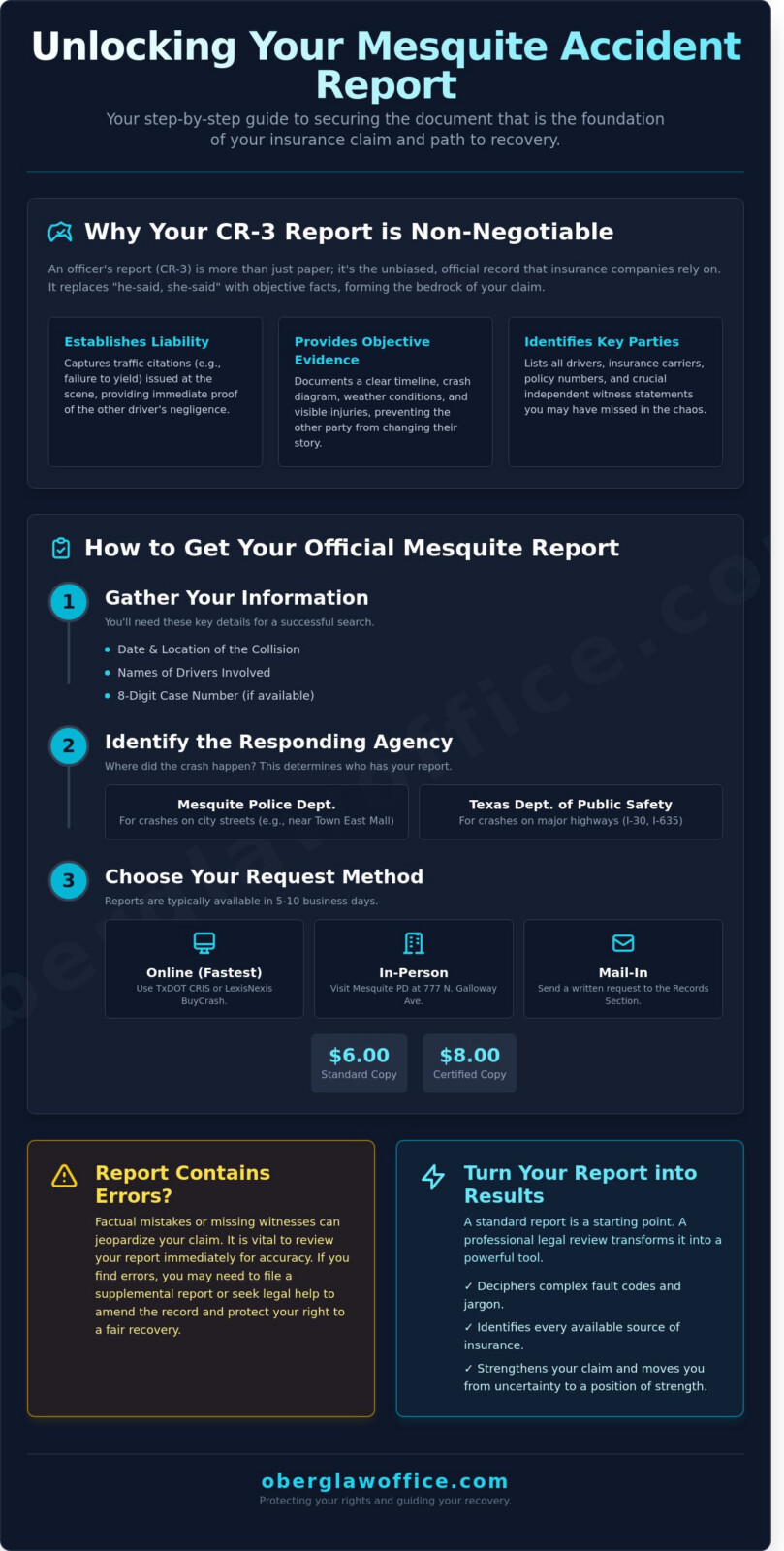
You’ve just experienced a collision on I-30 or near Town East Mall. Your heart is racing, and your vehicle is mangled. In these chaotic moments, your memory can be fuzzy, which is why a mesquite accident report serves as the definitive, unbiased account of what happened. Insurance adjusters prioritize this document because it comes from a neutral third party: the Mesquite Police Department. Without it, your version of events is just one of many conflicting stories.
When an officer arrives at the scene, they look for violations of the Texas Transportation Code. If they cite the other driver for failure to yield or following too closely, that establishes immediate liability. You shouldn’t wait to secure this document. Under Texas Transportation Code § 550.062, an officer must submit a crash report if the accident resulted in injury or property damage exceeding $1,000. Securing your report within the first 10 days ensures the facts remain fresh and prevents insurance companies from twisting the narrative. This report also documents visible injuries and the extent of property damage right when it happens, providing a baseline for your medical and repair claims.
Establishing an Objective Timeline
“He-said, she-said” arguments often fail when a professional report exists. The officer documents the exact time of the crash, road conditions, and lighting. They include a detailed diagram that acts as a blueprint of the collision. This sketch shows the point of impact and the final resting positions of the vehicles. It turns a chaotic event into a clear sequence of facts that we use to hold negligent parties accountable.
Identifying Key Parties and Witnesses
Adrenaline makes it hard to remember to ask for insurance details. The report captures everything for you; it lists the other driver’s carrier, policy number, and contact info. If a commercial truck was involved, the report identifies the parent company and the DOT number. Officers also record statements from independent witnesses. These are people who don’t have a financial stake in the outcome. Their testimony is often the evidence that proves you weren’t at fault.
- Official Record: Prevents the other driver from changing their story later.
- Liability: Captures citations issued at the scene for traffic violations.
- Evidence: Documents weather and road conditions that contributed to the crash.
Step-by-Step: How to Request Your Official Accident Report
Securing your mesquite accident report is a vital step toward physical and financial recovery. This document serves as the official record of what happened; it’s the evidence insurance companies use to determine fault and compensation. Most collisions within city limits are handled by the Mesquite Police Department. However, if your accident occurred on a major highway like I-30 or I-635, the Texas Department of Public Safety might have filed the report instead.
Before you begin the request process, gather your facts. You’ll need the date of the collision, the specific location or cross streets, and the names of the drivers involved. Having the 8-digit case number provided by the officer at the scene will make the search much faster. Texas law sets the cost for these records. You should expect to pay a $6.00 administrative fee for a standard copy, while a certified version typically costs $8.00.
- Verify the agency: Confirm if Mesquite PD or State Troopers responded.
- Check the timeline: Reports usually take 5 to 10 days to become available in the system.
- Prepare payment: Have a credit card ready for online orders or exact cash for in-person visits.
If the process feels confusing while you’re dealing with injuries, speaking with a local attorney can help take the weight off your shoulders.
Using the Online Purchase Systems
The fastest way to get your report is through the Texas Department of Transportation’s Crash Report Online Purchase System (CRIS). You can also use third-party sites like LexisNexis BuyCrash, which often hosts reports for local municipalities. If you don’t have a case number, don’t worry. You can search using the date of the accident and the driver’s last name. Always double-check the spelling of names to avoid “no record found” errors that delay your claim.
In-Person and Mail-In Requests
If you prefer a face-to-face interaction, visit the Mesquite Police Department Records Section at 777 North Galloway Avenue. They’re open Monday through Friday during standard business hours. For mail-in requests, include a written letter with the crash details and a self-addressed stamped envelope. If you’re heading to court, request a certified copy. This version includes an official seal that proves the document’s authenticity for legal proceedings, providing an extra layer of protection for your case.
Understanding the Data: How to Read Your Official Crash Report
Holding your mesquite accident report for the first time can feel like looking at a coded message. The Texas CR-3 form, used by Mesquite Police and state troopers, relies on a complex system of numerical values that insurance adjusters use to settle claims. Understanding these codes is the first step in protecting your right to fair compensation.
The Codes for Injuries and Damage
You’ll find injury severity marked in field 23 using a specific letter system. A ‘K’ indicates a fatal injury, while ‘A’ represents a suspected serious injury that often requires immediate hospitalization. Codes ‘B’ and ‘C’ signify non-incapacitating or possible injuries; however, don’t let a ‘C’ rating discourage you from seeking medical care, as many spinal injuries don’t show symptoms for 48 hours.
Vehicle damage is assessed on a scale from 0 to 7. An officer might mark a “2” for a fender bender, but this number is just an initial estimate. Insurance companies frequently use low damage ratings to argue that your physical injuries couldn’t be severe. Always check the ‘Charges’ section at the bottom of the page. If the officer wrote a citation for a violation like Texas Transportation Code 545.060, it provides powerful evidence that the other driver broke the law.
The Officer’s Narrative and Diagram
The hand-drawn diagram on page two is often the most vital piece of evidence in your mesquite accident report. It illustrates the point of impact and the final resting positions of every vehicle involved. This visual evidence makes it difficult for the other driver to change their story later. The ‘Contributing Factors’ section serves as the primary indicator of fault, where the officer links specific driver actions to the cause of the collision.
It’s important to distinguish between specific codes. Code 22, ‘Disregard Stop Sign,’ means the driver blew through the intersection without stopping. Code 40, ‘Failed to Yield Right of Way,’ suggests they stopped but moved forward when it wasn’t safe. The written narrative summary provides the officer’s final word on the event. If the officer mentions that a driver was “inattentive” or “distracted,” it creates a clear path for your legal recovery. We look for these specific details to ensure the official record reflects the truth of what happened to you on the road.
What to Do When an Accident Report Contains Errors
Finding an error on your mesquite accident report can feel like a secondary collision. These documents often serve as the foundation of your insurance claim; therefore, accuracy is vital for your recovery. Common mistakes include transposed digits in a driver’s license number, incorrect insurance policy details, or the complete omission of a key witness who spoke to the police at the scene on North Galloway Avenue. You shouldn’t ignore even a minor typo. Small errors give insurance adjusters an excuse to delay your settlement or question your credibility during a vulnerable time.
It’s important to distinguish between a simple clerical mistake and a disagreement over who caused the wreck. A misspelled street name is a factual error. A statement claiming you failed to yield right-of-way is a judgment call. Both can impact your case, but they require different approaches to fix. We’ve helped many families in the Mesquite community navigate these frustrations, and we know that a proactive approach is always best.
Correcting Factual Errors
Clerical mistakes are generally the easiest to resolve. If the officer recorded the wrong insurance policy number or misidentified your vehicle make, you can request a correction. You should contact the Mesquite Police Department officer who authored the report directly. Providing concrete proof, such as a photo of your registration or a copy of your insurance card, makes the officer’s job easier. Most officers are willing to update objective facts that don’t change their professional assessment of the crash dynamics.
Challenging the Officer’s Conclusion
Changing an officer’s opinion on fault is a much steeper hill to climb. Police rarely rewrite their narrative or change a citation once the report is filed with the Texas Department of Transportation. If the official mesquite accident report contains a biased or incorrect conclusion, you have the right to submit a supplemental statement. In Texas, you can file a ‘Driver’s Crash Report’ (Form CR-2) to ensure your version of events is attached to the official record. This becomes essential evidence when we negotiate with insurance companies that are trying to shift blame onto you.
How Professional Legal Representation Turns a Report Into Results
Holding your mesquite accident report is a vital first step, but that document is rarely the final word on your recovery. Insurance adjusters often use the initial police narrative to find reasons to deny or devalue your claim. You shouldn’t hand over your statement to an adjuster before an attorney reviews the officer’s findings. A lawyer looks for what isn’t there, such as signs of distracted driving or mechanical failure that the officer might have overlooked during a busy shift on I-30 or Highway 80.
Legal advocacy shifts the focus from simple data to strategic recovery. While a report identifies the primary drivers, an experienced attorney uses it to dig deeper into additional insurance layers. This might include commercial umbrella policies or employer liability if the other driver was working at the time of the crash. We also move beyond the written word by subpoenaing 1080p high-definition body cam or dash cam footage from the Mesquite Police Department. This visual evidence often captures admissions of guilt or environmental factors that a standard report misses.
Building the Case Beyond the Report
A police report is a starting point, not a closed file. In approximately 20% of cases, officers may misattribute fault due to limited witness statements at the scene. We work with accident reconstruction experts who use physics and skid mark data to challenge or reinforce these findings. If you left the scene without a formal mesquite accident report being filed, don’t panic. We help you file a CR-2 Blue Form to ensure your side of the story is officially documented for the Texas Department of Transportation.
Your Free Strategy Session
You deserve a legal eye that sees the nuances in your specific crash data. At Oberg Law Office, we treat you like a neighbor, not a case number. You’ll speak directly with an attorney who understands the local Mesquite court system. We operate on a contingency basis, meaning there’s a zero-dollar cost to you unless we successfully secure your settlement. This “No Fee Unless We Win” model ensures you have access to high-quality legal protection regardless of your current financial situation. Schedule your free strategy session with Oberg Law Office today to start your path toward justice.
Take Control of Your Recovery Today
Securing your mesquite accident report is the first vital step toward protecting your family’s future. This document serves as the backbone of your insurance claim, proving the facts when a negligent driver tries to change their story. If you find errors in the report or feel overwhelmed by the process, remember that you have the right to professional support. Accurate evidence is the only way to ensure the insurance company treats your injuries with the respect they deserve.
The Oberg Law Office has spent over 25 years navigating Texas law to help our neighbors find justice. We don’t believe in passing you off to a paralegal; you’ll communicate directly with your attorney from start to finish. Our team is dedicated to turning complex paperwork into tangible results for you. We take on all the financial risk, so there are no fees unless we win your case. Let us handle the legal hurdles while you focus on getting back on your feet.
Get a Free Case Review with a Personal Injury Advocate
You’ve already shown great strength by taking these first steps, and we’re here to make sure you don’t have to walk the rest of the path alone.
Frequently Asked Questions
How long does it take for an accident report to be available?
You can typically expect your Mesquite accident report to be available within 10 business days of the incident. The Texas Department of Transportation requires officers to submit these reports within 10 days of the crash. If your accident involved a fatality or serious injury, the investigation might take 30 days or longer to finalize. We understand waiting for this document is stressful when you’re trying to move forward with your recovery.
What is the difference between an Information Exchange Form and a Crash Report?
An Information Exchange Form is a preliminary document provided at the scene, while a Crash Report (CR-3) is the official state document filed by the officer. The exchange form only lists the 2 drivers’ names and insurance policies. In contrast, the official report contains the officer’s diagrams, weather conditions, and contributing factors. You need the full CR-3 report to pursue a formal insurance claim or legal action against a negligent party.
Can I get a report if the accident happened on private property?
You can still document an accident on private property, but the Mesquite Police Department won’t file a formal CR-3 report unless there’s an injury or $1,000 in property damage. If the officer doesn’t file a report, you should complete the CR-2 Blue Form yourself. This self-reported document provides 1 way to record your version of the events for your insurance company and legal counsel. Our team can help you navigate these specific filing requirements.
How much does it cost to get a copy of my accident report?
A standard copy of your accident report costs $6.00 through the Texas Department of Transportation or the local police department. If you need a certified copy for court proceedings, the fee increases to $8.00. We recommend getting the certified version to ensure it’s admissible in legal hearings. Small fees like these shouldn’t stand in the way of your family’s right to seek justice after a collision.
Is the police report the final word on who was at fault for the crash?
The police report isn’t the final legal determination of fault for your accident. While insurance adjusters rely heavily on the officer’s findings, a jury or judge makes the ultimate decision in a civil case. Officers sometimes miss details or misinterpret the 2 or 3 seconds leading up to a crash. Our team works to uncover additional evidence, like dashcam footage, to correct any factual errors in the report.
What if the other driver’s insurance information on the report is wrong?
You should contact the reporting officer immediately if you find incorrect insurance information on your mesquite accident report. Errors happen in about 15 percent of reports due to outdated insurance cards or clerical mistakes. If the information can’t be updated, we can help you track down the correct policy or explore an Uninsured Motorist claim. We’ll handle the investigative work so you can focus on healing.
Do I need a lawyer if the police report clearly says the other driver was at fault?
You still need a lawyer because insurance companies frequently deny claims even when the police report favors you. Adjusters often try to shift 10 or 20 percent of the blame to you to reduce their payout. We protect your interests by ensuring the insurance company respects the facts of the case. You won’t pay us a single cent unless we win your case and recover compensation for your injuries.
Can I get an accident report if the police did not come to the scene?
You cannot get an official police report if an officer didn’t investigate the scene, but you can file a Driver’s Crash Report (CR-2). Texas law previously required this for all accidents, but now it’s primarily used for your personal records and insurance claims. It’s vital to file this within 10 days if the crash caused injuries or over $1,000 in damage. We can guide you through this process to protect your rights.