
On a rainy Tuesday morning in March, a driver in Mesquite found herself staring at a screen of error messages while her insurance adjuster demanded the official paperwork before they’d pay a dime. Getting your txdot accident report shouldn’t feel like a second collision. You’re likely feeling frustrated by the technical jargon and the pressure from insurance companies to settle quickly for less than you deserve. It’s exhausting to deal with government websites when you’re just trying to recover and focus on your family’s health.
We understand that this document is the most critical piece of evidence for your injury claim. This guide shows you exactly how to bypass the confusion, download your digital CR-3 report immediately, and decode the police officer’s shorthand. We’ll walk through the updated 2026 retrieval process and explain how these 22 specific data fields can protect your right to fair compensation. You don’t have to face the insurance giants alone; we’re here to help you move from a state of uncertainty to a feeling of empowerment.
Key Takeaways
- Learn why the CR-3 is the heart of your recovery and the specific damage threshold that makes a police report mandatory for your protection.
- Follow our simple guide to secure your official txdot accident report online so you have the evidence needed to hold negligent parties accountable.
- Understand the Texas privacy laws that protect crash records and learn if you meet the legal requirements to access these sensitive documents.
- Identify the critical “Contributing Factors” in Section 14 to ensure the officer’s report accurately reflects the truth of what happened on the road.
- Discover why even a favorable report is just the beginning of your journey and how to stand firm against insurance companies trying to minimize your claim.
Understanding the Texas Peace Officer’s Crash Report (CR-3)
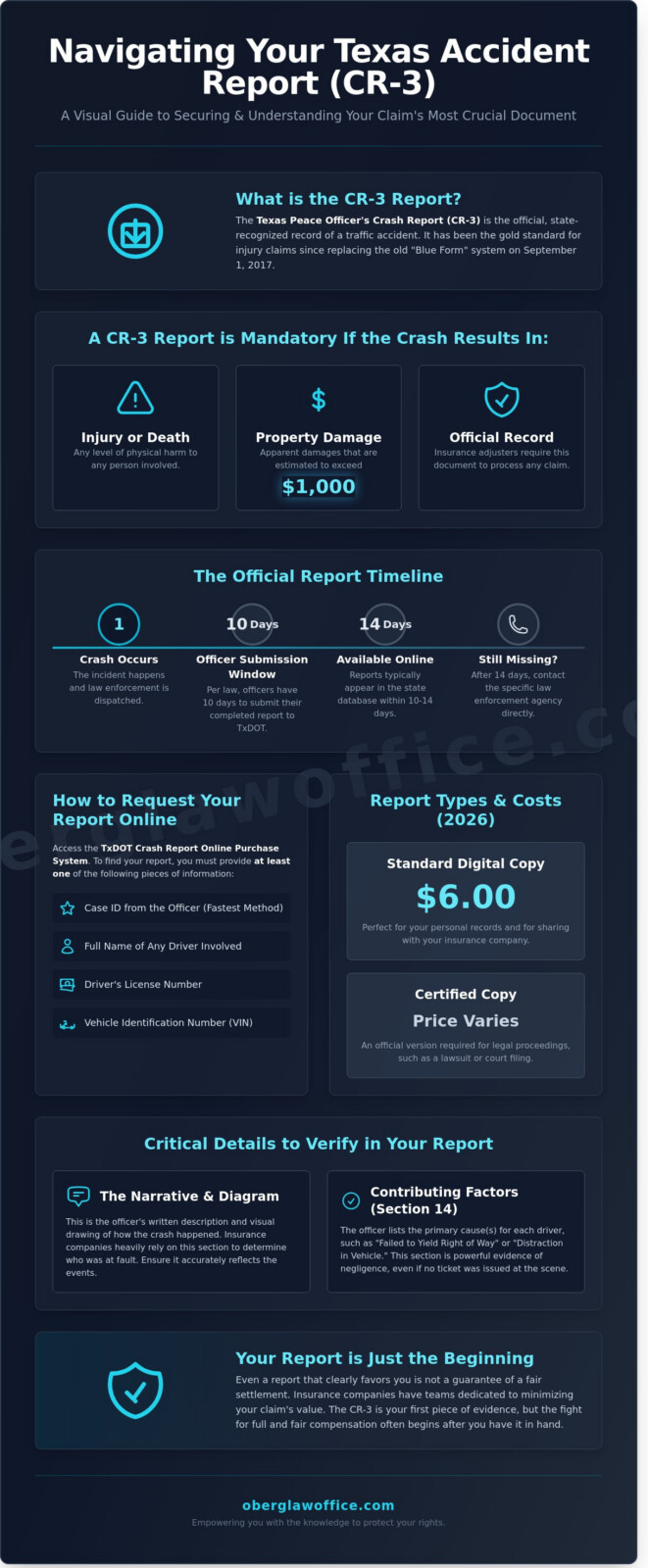
You just survived a frightening moment on a Texas highway. Once the sirens fade and the tow truck leaves, you are left with physical pain and a mountain of questions. The most important document in your recovery process is the Texas Peace Officer’s Crash Report, commonly known as the CR-3. This isn’t just a piece of paper; it is the official account of your traffic collision as recorded by law enforcement. In Texas, an officer must file this report if the accident resulted in injury, death, or property damage that appears to exceed $1,000.
Many drivers remember the old “Blue Form” or CR-2. You used to fill these out yourself and mail them to Austin. However, the law changed on September 1, 2017. The state no longer retains or provides these driver-filed reports. Today, the CR-3 is the only gold standard for your claim. Your insurance adjuster will ask for this document before they even consider a settlement. They use it to verify the date, time, and parties involved. Securing your official txdot accident report is the first step toward getting the justice and compensation you need to heal.
The 10-Day Rule for Law Enforcement
You might feel anxious to get your hands on the report immediately. It’s common to search the state database the day after a wreck and find nothing. Texas Transportation Code Section 550.062 gives officers exactly 10 days to submit their completed report to TxDOT. This delay happens because officers must balance their time on the streets with hours of paperwork. If your txdot accident report is still missing after 14 days, it’s time to take action. You should contact the records department of the specific agency that responded to your call, whether it was the Mesquite Police Department or the Dallas County Sheriff.
Why a “Narrative” Matters
The heart of the CR-3 is the narrative section. This is where the officer provides a written description and a visual diagram of the sequence of events. This narrative is a powerful tool because it directly influences how insurance companies determine fault. The officer will list “contributing factors” for each driver. These factors might include things like “failure to yield right of way” or “distraction in vehicle.”
It’s vital to understand that a contributing factor is not the same as a criminal citation. An officer might decide not to write a ticket at the scene, but they can still list a driver’s actions as the primary cause of the crash. Our team looks at these narratives to build a shield around your rights. We ensure that the insurance company doesn’t twist the officer’s words to avoid paying what they owe your family. We are kind to our neighbors in the community, but we remain formidable against negligent parties who refuse to take responsibility.
Step-by-Step: How to Request Your TxDOT Report Online
Getting your txdot accident report shouldn’t feel like another hurdle after a crash. You can access the official Crash Report Online Purchase System directly from your home computer. It’s the most efficient way to see what the reporting officer wrote about the incident. To start, you’ll need specific details like the full name of a driver involved, the Vehicle Identification Number (VIN), or a Driver’s License number. If the officer provided a Case ID at the scene, that’s the fastest way to narrow your search.
The legal basis for these records is found in the Texas Transportation Code, which dictates how accidents are documented and who can access the resulting files. We know that dealing with state systems can feel cold and impersonal. Our team at the Oberg Law Office believes you deserve a clear, supportive understanding of your rights during this recovery period. We’re here to help you make sense of the data once you have it in hand.
Using the Online Purchase System
The search interface allows you to filter by date, county, and city. If you don’t have a Case ID, don’t worry. You can still locate the file by entering the date of the crash and the name of any person involved. Accuracy is vital. A single digit error in a VIN or a misspelled last name will result in a “No Results Found” message. If you’re searching within 48 hours of the collision, the report likely isn’t ready. Most Texas agencies take 10 to 14 days to finalize and upload these documents into the state database.
Certified vs. Non-Certified Copies
You must choose between two types of documents when purchasing your txdot accident report. A standard digital copy costs $6.00 in 2026. This version is perfect for sharing with your insurance company to move your vehicle repair claim forward. A certified copy costs $8.00 and includes an official state seal. You’ll need the certified version if your case proceeds to a formal legal hearing or trial. Most drivers find the $6.00 version sufficient for initial claims and personal records.
After your purchase is complete, you’ll receive an instant email with a download link. This link is temporary. It expires exactly 7 days after the purchase date. Save the PDF to your phone and a cloud drive immediately so you don’t lose access. If you find errors on the report or the insurance company is using it against you, a quick conversation with a dedicated advocate can help protect your family’s future and ensure the truth is told.
Who Can Legally Access Texas Crash Records?
After a collision, your privacy is just as important as your physical recovery. Texas law treats crash reports as confidential documents. You won’t find your personal details sitting on a public website for everyone to see. Under Texas Transportation Code §550.065, only people with a “proper interest” in the accident can view the full, unredacted record. This law helps shield you from prying eyes during a vulnerable time.
To get your txdot accident report, you must fall into one of these specific categories:
- Drivers involved in the collision.
- Passengers who were in the vehicles at the time of the crash.
- Owners of the vehicles or property damaged in the incident.
- Authorized legal representatives, such as your attorney.
- Insurance companies providing coverage for the involved parties.
The general public cannot browse these records online. This restriction was strengthened by the Texas Legislature in June 2015 to stop companies from harvesting your data for marketing. You can verify your eligibility and purchase your document through the Crash Report Online Purchase System, which is the official portal for these sensitive files. This system ensures that only those who truly need the information can access it.
The Role of the Driver’s License Number
Providing your driver’s license number is the most efficient way to prove you were involved. It acts as a digital key for the state’s database. This verification step keeps “ambulance chasers” from getting your home address or phone number. If you were a passenger and don’t have the driver’s info, you can still request the report. You’ll need to provide the exact date, the county or city, and the name of at least one person involved to confirm your right to the record.
Legal Representatives and Your Rights
You don’t have to handle the paperwork alone while you’re trying to heal. A personal injury lawyer can handle this entire process for you. When our team pulls your txdot accident report, we ensure the version we receive is the complete “CR-3” form. This version contains the full officer narrative and diagrams that are often missing from basic summaries.
Having an attorney manage this protects you from unauthorized data mining. We act as a barrier between you and aggressive insurance adjusters who might try to use the report against you. Our firm focuses on your justice so your family can focus on getting life back to normal. We’ve seen how a complete report can change the outcome of a claim; we’re here to make sure every detail is accurate and your rights are upheld.
Critical Details to Verify in Your 2026 Crash Report
Once you receive your txdot accident report, your first instinct might be to file it away and focus on your physical recovery. Don’t make that mistake. Every single character on those four pages can impact your ability to get the justice you deserve. Start by verifying the basics: the date, the exact minute of the collision, and the precise GPS coordinates or street address. In 2025, inaccurate location data led to significant delays in 15% of personal injury claims across North Texas. You also need to confirm that your vehicle’s VIN and your insurance policy number are recorded correctly. A simple typo in these fields can lead to an automatic claim denial from an adjuster who is looking for any reason to save their company money.
Decoding the Officer’s Short-Hand
Texas peace officers use a standardized system of numeric codes in Section 14, titled “Factors and Conditions,” to explain why the crash happened. For example, Code 22 stands for “Failed to Control Speed,” while Code 45 means “Disregarded Stop Sign or Signal.” These codes are the primary data used by adjusters to determine who is at fault. If the officer assigned you a code, it suggests you’re at least partially responsible for the wreck. Under Texas law, if you’re found more than 50% responsible, you can’t recover any damages. We help you look at these codes alongside the “Investigator’s Narrative” to ensure the officer’s summary actually matches the witness statements and the physical evidence left at the scene.
What to Do if the Report is Wrong
Officers are humans and they sometimes miss critical details, especially at a busy intersection in Mesquite or on a crowded highway. If you find a mistake, understand that officers are often reluctant to change a report once it’s submitted to the state database. They won’t usually erase the original document. Instead, they may file a “Supplemental Report” if you provide clear, objective evidence like dashcam footage or a new witness statement. When the official record doesn’t reflect the truth, we act as your steadfast protector. Our firm gathers independent evidence to challenge a faulty txdot accident report and hold the negligent party accountable. If you notice errors in your crash documentation, contact our team for a free report review so we can start setting the record straight together.
Why Your Report is Just the Beginning of Your Recovery
Holding your txdot accident report in your hands might feel like the final step in a stressful journey. If the officer clearly listed the other driver as at fault, you likely expect a smooth claims process. However, a favorable police report doesn’t guarantee a fair settlement. Insurance companies often view these documents as a starting point for negotiations rather than a final verdict. They have teams of adjusters who specialize in finding loopholes to protect their bottom line, even when the evidence seems clear.
You need a steadfast protector who understands that your recovery involves more than just fixing a car. It’s about your health, your lost wages, and your peace of mind. We handle the heavy lifting of legal paperwork so you can spend your energy on physical therapy and being with your family. Our team treats you like a neighbor, not a case number, ensuring you never feel alone against a massive corporation. We’ve seen how these companies operate in 2026, and we know how to counter their strategies to ensure you aren’t left paying for someone else’s mistake.
Combating Insurance Company Tactics
Adjusters might ignore the txdot accident report if the officer’s findings don’t fit their narrative. They often use “internal assessments” to claim you contributed to the crash, even by as little as 10% or 15%. This small percentage can strip thousands of dollars from your final payout under Texas law. Consulting a car accident attorney allows you to push back with professional authority. Because we use a “no fee unless we win” model, you get high-level legal protection without any financial risk to your household budget. We only get paid when we successfully secure your compensation.
Your Next Steps for Justice
Your first priority is downloading the report, but your second must be caution. Avoid signing any documents from an insurance company within the first 14 to 30 days of your accident. These “quick cash” offers frequently fail to account for delayed medical symptoms like soft tissue damage or concussions, which can take weeks to fully manifest. Professional legal advocacy provides the shield you need during this vulnerable time. We are here to guide you through the Texas legal landscape with integrity and decades of experience. Schedule your free strategy session with Oberg Law Office today.
Take the Next Step in Your Recovery
Securing your txdot accident report is the first critical move toward protecting your family’s future after a crash. You now understand how to navigate the 2026 digital system and why every detail on that CR-3 form impacts your insurance settlement. While this document provides the facts, it doesn’t automatically guarantee the compensation you deserve. Insurance adjusters often look for any reason to devalue your claim; having an advocate who knows their tactics is vital.
At the Oberg Law Office, we provide the steady guidance you need during this stressful time. With over 25 years of Texas legal experience, Gregg Oberg works personally on your case to ensure you aren’t just another file number. You’ll speak directly with your attorney, and you’ll never pay a fee unless we win your recovery. We’re committed to being your steadfast protector against negligent parties and big insurance companies. When choosing the right legal representation for your case, consider reading our comprehensive guide to hiring a car accident lawyer in Mesquite to ensure you make an informed decision about your legal advocate.
Get a Free Case Review with a Texas Injury Attorney to discuss your options. You’ve handled the paperwork; now let us handle the fight for your justice.
Frequently Asked Questions
How long does it take for a TxDOT accident report to be available?
It typically takes 10 to 14 days for a txdot accident report to appear in the CRIS system after an officer files it. This processing time ensures the Texas Department of Transportation verifies all data before making it public. If you’re waiting on this document to start your recovery, check the portal daily after the 10th day. Our Mesquite team often sees reports finalized faster in minor fender benders.
Can I get a Texas crash report for free?
You generally cannot get a crash report for free through the official state portal; TxDOT charges a $6 fee for a standard copy or $8 for a certified version. While some local police departments might provide a basic public information sheet at their station for a smaller fee, the comprehensive CR-3 requires payment. We believe you shouldn’t have to pay for justice, so we often pull these records for our clients during our investigation.
What is the difference between a CR-3 and a CR-2 form?
A CR-3 is a formal peace officer’s crash report, while a CR-2 is the Blue Form drivers fill out themselves when police don’t respond. Texas law changed in September 2017, meaning the state no longer retains CR-2 forms, so you must keep your own copy for insurance. The CR-3 is much more powerful for your claim because it contains the officer’s professional observations about fault and road conditions.
What if the police did not show up to my accident?
You must file your own report if the police don’t arrive and the crash resulted in injury or property damage exceeding $1,000. Use the CR-2 form to document the 100 percent factual details of the event while they’re fresh in your mind. This protects your family’s right to seek compensation later. We recommend taking at least 15 photos of the scene to support your personal statement and prove what happened. Understanding what to do when you get in a car crash can help you protect your rights even when officers don’t respond to the scene.
Is a police report required for an insurance claim in Texas?
Texas law doesn’t strictly require a txdot accident report to file an insurance claim, but most adjusters won’t settle without one. Without this official document, the insurance company might only offer 50 percent of what your claim is actually worth. It serves as the foundation for your recovery. Having this report helps us hold negligent parties accountable for the harm they caused you and your loved ones.
How do I read the codes on my Texas crash report?
You need to download the CR-100 code sheet from the TxDOT website to decipher the numeric codes listed in the Factors and Conditions section. For example, a code 14 indicates a driver failed to yield the right of way. These numbers tell the story of your accident to the insurance company. If the codes seem confusing, we can walk you through every line to ensure you understand the officer’s findings.
Can I change a police report if I disagree with the officer?
You can request an amendment for factual errors, like an incorrect date or a misspelled name, by contacting the reporting officer directly. However, changing an officer’s opinion on who caused the crash is extremely difficult and requires substantial new evidence. If the report contains 1 or 2 major inaccuracies, we can help you submit a supplemental statement. This ensures your side of the story is officially documented for the record.
Who is allowed to see my accident report under Texas law?
Under Texas Transportation Code Section 550.065, only authorized persons like the drivers, their legal representatives, and insurance companies can access the full report. This privacy law protects your personal information from being sold to third party solicitors. You’ll need to provide your 8 digit driver’s license number or the VIN of a vehicle involved to download the document. We respect your privacy and handle these sensitive records with care.