
That friendly voice on the other end of the phone isn’t there to ensure your medical bills are paid. They’re there to protect a multi-billion dollar bottom line. If you feel like you’re being lowballed, you aren’t imagining things. It’s a frustrating reality for many neighbors across our state. You’re likely facing the “delay, deny, defend” strategy, which is a calculated business move designed to create financial pressure until you’re desperate enough to accept less than you deserve. Understanding how insurance companies devalue claims in Texas is the first step toward reclaiming control over your recovery.
We know the stress of mounting medical debt and the confusion of legal jargon can feel overwhelming. You shouldn’t have to fear being blamed for an accident you didn’t cause, especially when Texas laws like proportionate responsibility are used as weapons against you. This guide will teach you how to counter adjuster tactics and replace their algorithmic low-ball offers with high-value evidence. We’ll break down the specific strategies used in 2026 to safeguard the true value of your personal injury claim and help you secure the settlement you need to restore your life.
Key Takeaways
- Understand the “Three D’s” strategy of delay, deny, and devalue that insurance adjusters use to prioritize corporate profits over your physical recovery.
- Discover how insurance companies devalue claims in texas by using algorithmic software like Colossus to turn your unique personal injury into a series of minimized data points.
- Learn how to protect your settlement value by documenting the daily impact of your injuries through a pain journal and consistent medical treatment.
- Recognize the danger of “quick-cash” lowball offers designed to settle your case before you realize the true extent of your long-term medical needs.
- Find out how direct representation from a steadfast legal protector can counter adjuster tactics while ensuring you pay nothing unless your case is won.
Why Insurance Companies Devalue Claims in Texas (The Business Reality)
Insurance companies often present themselves as a safety net for your family. They use warm imagery and slogans about being “on your side,” but the internal business reality is much colder. These are multi-billion dollar corporations with a primary fiduciary duty to their shareholders, not to the people they insure. Every dollar they keep in their pockets is a dollar of profit. Understanding how insurance companies devalue claims in texas starts with recognizing that your injury is viewed as a liability to be minimized, rather than a person to be restored.
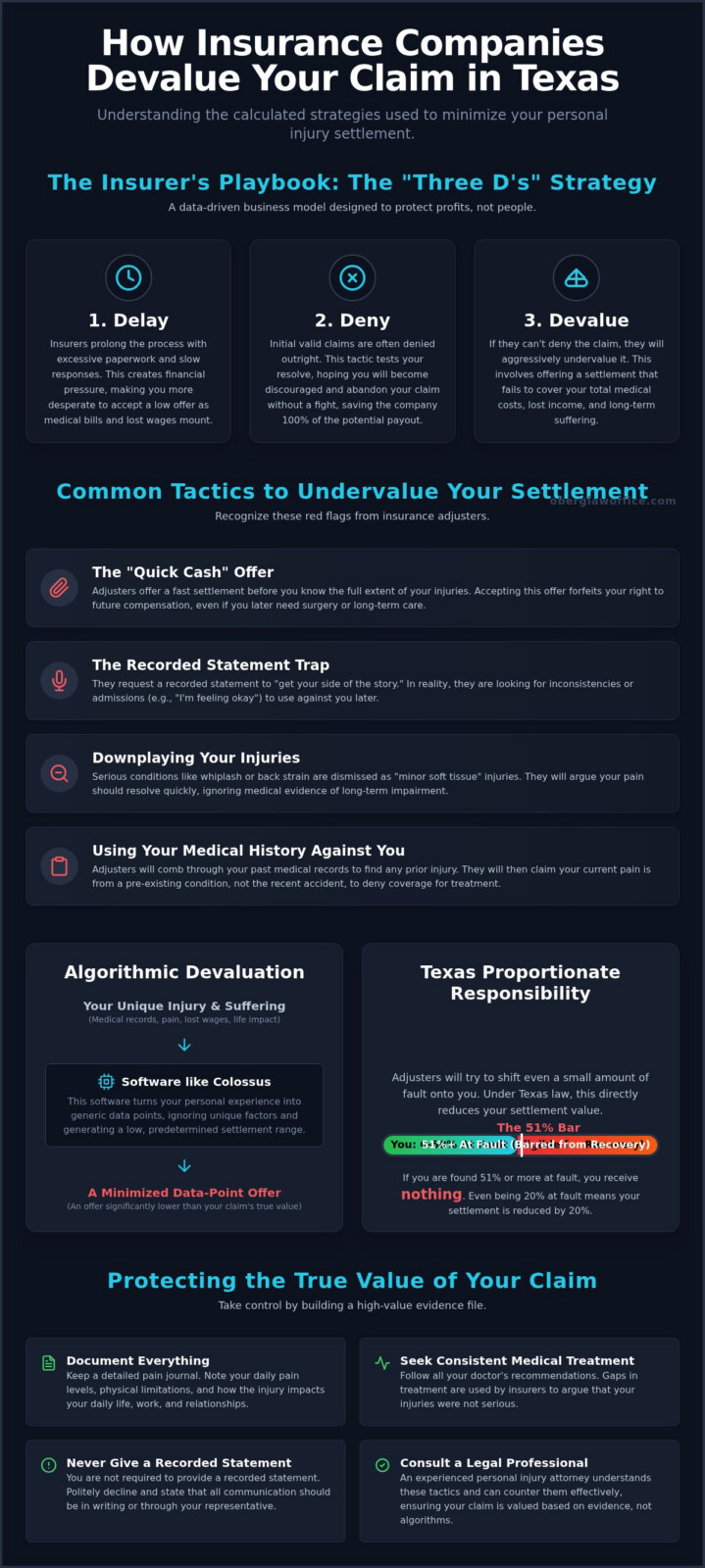
Most major carriers rely on a strategy often called the “Three D’s”: Delay, Deny, and Devalue. They delay the process with endless paperwork to wait for your medical bills to become unbearable. They deny valid claims initially to see if you’ll simply walk away. Finally, they devalue the claim by offering a settlement that doesn’t even cover your basic expenses. This isn’t a personal attack on you; it’s a data-driven business model that thrives on the fact that most people don’t know their rights under Texas law.
The insurance adjuster assigned to your case is a professional negotiator. They may sound empathetic, but they’re trained to find inconsistencies in your story. In Texas, where the 51% bar for proportionate responsibility can completely bar you from recovery, adjusters look for any reason to shift even a small amount of fault onto you. They use the complexity of our state’s legal landscape as a tool to lower the price tag on your physical pain and emotional suffering.
The Adjuster’s Performance Metrics
Adjusters aren’t rewarded for being fair; they’re rewarded for efficiency and “claims leakage” control. This term refers to any money paid out that the company thinks could have been saved. If an adjuster’s payout average is too high, it reflects poorly on their performance. They often use psychological pressure, acting as though a lowball offer is a “one-time favor” or suggesting that you won’t get a better deal if you hire a lawyer. This early sympathy is usually a tactic to gain your trust before they try to settle your case for pennies on the dollar.
The Difference Between Denied and Devalued
A denied claim is a clear “no,” which often prompts victims to seek legal help immediately. Devaluation is far more insidious because it feels like progress. The company admits some level of responsibility but argues that your injury isn’t worth what you’re asking. They might claim your medical treatment was “excessive” or that your back pain was a pre-existing condition. If they refuse to offer a fair amount based on the evidence, they may be crossing into the territory of insurance bad faith. Spotting these subtle tactics is difficult when you’re focusing on your physical recovery, which is exactly what the insurer counts on.
Common Tactics Used to Undervalue Your Injury Settlement
You’ve just been through a traumatic event, and the phone starts ringing almost immediately. It’s often an adjuster offering a “quick settlement” to help with your immediate needs. This is one of the most effective ways how insurance companies devalue claims in texas. By catching you before you’ve even seen a specialist or understood the long-term impact of your injuries, they can close the file for a fraction of its true worth. If you accept that check now, you’re usually signing away your right to ask for more later, even if you discover you need surgery six months down the road.
Adjusters also frequently label serious injuries as “minor soft tissue” issues. They’ll claim whiplash or back strains are just temporary aches that should heal in a week with over-the-counter medication. If you’ve ever had a back injury ten years ago, they’ll weaponize that history. They’ll argue your current pain is just a flare-up of an old problem, completely ignoring the force of the recent crash. They may even question the necessity of your treatment, suggesting your doctor is overcharging or providing unnecessary care. The Texas Department of Insurance has clear guidelines regarding unfair claim settlement practices, yet these tactics remain standard operating procedure for many large carriers.
The Recorded Statement Trap
An adjuster might call and say they just need a quick recorded statement to “get your side of the story.” It sounds helpful, but it’s a minefield. They’ll ask “How are you doing today?” and if you politely answer “I’m okay,” they’ll use that as evidence that you weren’t actually hurt. They use leading questions to coax you into admitting partial fault, which can trigger the 51% bar rule that prevents you from recovering any damages at all. Never provide a statement until you have a full medical diagnosis. It’s often best to let a steadfast legal advocate handle these communications for you to ensure your words aren’t twisted against you.
The “Medical Authorization” Overreach
To “verify” your injuries, the insurance company will ask you to sign a medical authorization form. These are rarely limited to the accident at hand. Instead, they’re often blanket releases that give the insurer access to your entire medical history. This is a fishing expedition. They’re looking for any unrelated health issue or old sports injury they can use to devalue your current claim. These authorizations are a subtle but powerful way how insurance companies devalue claims in texas by finding excuses in your past to ignore your current needs. You have rights concerning your privacy. You should never sign a broad release without having it reviewed to ensure it only covers records relevant to your current injury.
The Role of Software and Texas Proportionate Responsibility
In 2026, your claim isn’t just being reviewed by a person; it’s being processed by a machine. Most major insurance carriers now rely on sophisticated algorithms like Colossus to determine what your recovery is worth. This is a primary method for how insurance companies devalue claims in texas. The software takes your medical records, assigns them “value points,” and spits out a settlement range. It treats your pain like a commodity, ignoring the fact that a back injury for a construction worker is devastatingly different than the same injury for someone with a desk job.
These programs are designed to look for reasons to lower that final number. They don’t account for the sleepless nights or the missed family milestones that follow a serious accident. At Oberg Law Office, we know that robotic calculations can’t capture the full scope of your loss. We challenge these “black box” settlements by providing the specific, human evidence that software is programmed to ignore. We ensure the insurer sees the person behind the claim, not just the data points on a screen.
Texas Chapter 33: Proportionate Responsibility
Texas law uses a system called proportionate responsibility, which adjusters frequently exploit to protect their bottom line. Under Texas Civil Practice & Remedies Code Chapter 33, any percentage of fault assigned to you directly reduces your compensation. If an adjuster can “invent” reasons to say you were 20% responsible for the crash, your check is automatically cut by 20%. The real danger is the “51% Bar Rule.” If they can convince a jury that you were 51% or more at fault, you recover nothing at all. This high-stakes math is why adjusters dig for any minor mistake you made during the accident. They aren’t just looking for the truth; they’re looking for a way to use the Texas Administrative Code guidelines to justify a lower payout or a total denial.
The “Gap in Treatment” Devaluation
Consistency is your best defense against devaluation software. Algorithms are programmed to flag any “gap in treatment” as a sign that your injuries aren’t serious. If you miss an appointment or wait too long to see a specialist, the software automatically lowers your claim’s value. A 48-hour delay in treatment can be used to argue an injury happened elsewhere. To protect the true value of your recovery, you must follow your doctor’s orders exactly and document every step of your medical journey. When you show a steady history of professional care, you take away the insurer’s ability to claim you’re exaggerating your pain.
How to Protect the Value of Your Texas Personal Injury Claim
You’ve seen the strategies used to minimize your recovery, but you don’t have to be a passive participant in the process. Protecting your claim starts with a shift in mindset. You’re no longer just an accident victim; you’re a gatherer of evidence. Every photo of the scene, every witness phone number, and every police report acts as a shield against the methods of how insurance companies devalue claims in texas. By being proactive, you replace the adjuster’s assumptions with undeniable facts.
One of the most powerful tools in your arsenal is a daily pain journal. While medical records show your diagnosis, a journal captures the human cost. It documents the nights you couldn’t sleep, the times you couldn’t pick up your children, and the physical struggle of simple tasks like getting dressed. This turns your “subjective” pain into a detailed timeline that software algorithms can’t easily dismiss. Simultaneously, you must protect your digital footprint. Insurance adjusters are trained to scour social media for any photo or comment they can twist to suggest you aren’t as injured as you claim. Staying offline until your case is resolved is a simple but vital way to safeguard your settlement.
Wait for Maximum Medical Improvement (MMI)
Patience is often your greatest asset. Maximum Medical Improvement, or MMI, is the point where your doctor determines your condition has stabilized and isn’t expected to improve significantly further. Settling your claim before you reach MMI is the most common way victims accidentally devalue their own recovery. If you sign a release early, you’re responsible for any future surgeries or chronic care costs that arise. We understand the financial pressure of mounting bills. Instead of rushing into a low settlement, we can help you navigate bill collectors and explore options to keep your credit safe while your health stabilizes.
Communicating with the Adjuster
When the insurance company calls, remember the “Less is More” rule. You aren’t required to be their friend or provide a life story. Keep every conversation strictly focused on the basic facts of the crash, such as the time, date, and location. If they ask for a recorded statement, you have the right to politely decline. These recordings are often used to find small inconsistencies that can be used to trigger the 51% bar rule. The most effective way to level the playing field is to direct all communication through a personal injury lawyer who understands the local courts and adjuster tactics.
Taking these steps ensures that your recovery is built on a foundation of truth rather than corporate shortcuts. If you’re feeling pressured to settle before you’re ready, it’s time to speak with a steadfast legal protector who can manage the adjusters while you focus on healing.
Countering Insurance Devaluation with Oberg Law Office
You shouldn’t have to go toe-to-toe with a multi-billion dollar corporation while you’re trying to recover from a traumatic event. It’s an unfair fight from the very beginning. We’ve spent decades observing how insurance companies devalue claims in texas, and we’ve built our practice around stopping those tactics in their tracks. Gregg Oberg brings over 25 years of Texas legal experience directly to your side. You won’t be passed off to a junior assistant or a support staffer. Instead, you’ll have a steadfast protector who understands our local community and the specific games adjusters play to save their company money.
Our firm provides the personalized, neighborly touch that large “settlement mills” simply cannot offer. We take the time to understand your specific pain points, from the financial stress of medical debt to the emotional toll on your family. By taking the burden of insurance harassment off your shoulders, we give you the space you need to heal. We handle the aggressive phone calls, the complex filings, and the constant demands for information, allowing you to focus on your physical restoration while we focus on your financial security.
Leveling the Playing Field
We replace the insurer’s data points with human stories backed by hard evidence. To do this, we work with medical experts and accident reconstructionists to prove the full extent of your damages. This is especially critical for a complex truck accident claim, where corporate lawyers often try to bury victims in paperwork. We know that the mere threat of a trial can change an adjuster’s tone. When they realize we’re prepared to present your case to a jury, those “take it or leave it” offers often begin to climb toward a fair value. We ensure the insurer accounts for your future needs, not just your past bills.
Your Free Strategy Session
Your path to restoration starts with a Free Initial Strategy Session. In this meeting, we’ll review the facts of your case and show you exactly how insurance companies devalue claims in texas so you can avoid their traps. Because we work on a contingency fee basis, we share the risk with you. You don’t pay any upfront costs; we only get paid if we secure a recovery for you. This partnership ensures that everyone in our community has access to high-quality legal representation, regardless of their current bank balance. It’s time to take the first step toward securing your future and reclaiming your peace of mind.
Secure Your Path to Restoration Today
Navigating the aftermath of an accident is exhausting enough without having to fight an insurance adjuster who views your pain as a data point. By recognizing the business reality of the “Three D’s” and the limitations of claims-handling software, you’ve already taken a major step toward protecting your future. Remember that your physical healing and financial recovery depend on seeking continuous medical care and refusing to settle before you reach your maximum medical improvement. Understanding how insurance companies devalue claims in texas gives you the power to push back against lowball offers and algorithmic shortcuts.
You deserve a steadfast protector who sees you as a neighbor rather than a case number. Gregg Oberg brings over 25 years of experience fighting for Texas families, providing direct access to senior legal expertise without any upfront costs. We work on a contingency fee basis, so we only win when you win. Don’t let corporate tactics stand in the way of the fairness you deserve. Schedule Your Free Strategy Session with Oberg Law Office Today and let us handle the heavy lifting while you focus on getting better. You’ve got this, and we’re here to help you every step of the way.
Frequently Asked Questions
Why did the insurance company offer me a settlement so quickly?
The insurance company wants to close your case before you realize the true cost of your recovery. Offering a “quick-cash” settlement is a common way how insurance companies devalue claims in texas by catching victims before they reach maximum medical improvement. If you accept this early offer, you’re likely signing away your right to seek additional funds if you later discover you need surgery or long-term physical therapy.
Can I still get a fair settlement if I had a pre-existing back injury?
Yes, you’re entitled to compensation if an accident aggravated or worsened an existing condition. Adjusters often use your medical history as a “fishing expedition” to claim the accident didn’t cause your current pain. We counter this by using medical experts to clearly distinguish between your old injury and the new damage caused by the crash, ensuring your settlement reflects the actual harm you’ve suffered.
What happens if the insurance company says I am partially at fault in Texas?
Your final settlement will be reduced by your assigned percentage of fault under the state’s proportionate responsibility laws. For example, if your damages are $10,000 but you’re found to be 20% at fault, you’ll only receive $8,000. Adjusters often “invent” fault to lower their payout, which is why it’s vital to have a steadfast protector who can challenge these unfair assessments of blame.
How does an insurance company calculate pain and suffering?
Most insurers use robotic algorithms like Colossus to assign a dollar value to your physical pain and emotional distress. These programs treat your life like a series of data points and often fail to account for the real-world impact on your family or career. We fight these “robotic” calculations by presenting human evidence, such as your pain journal, to show the jury the true depth of your loss.
Should I sign the medical authorization form the adjuster sent me?
You should never sign a blanket medical authorization without a professional legal review. These forms often give the insurance company unlimited access to your entire medical history, not just the records related to your accident. They use this access to look for unrelated health issues from years ago to devalue your current claim. It’s much safer to provide only the specific records relevant to your recent injury.
What is the “51% rule” in Texas personal injury cases?
The “51% rule” is a legal bar that prevents you from recovering any money if you’re found to be mostly at fault. Under Texas Civil Practice & Remedies Code §33.001, if your responsibility for the accident is 51% or higher, you lose the right to collect any damages from the other party. Adjusters fight hard to push your fault over this threshold to completely “zero out” your claim value.
How long do I have to file a lawsuit if the insurer keeps devaluing my claim?
In Texas, the statute of limitations for personal injury cases is generally two years from the date the injury occurred. While you have two years to file a lawsuit, you must be careful not to miss shorter insurance policy deadlines for reporting the claim. Waiting too long to take action can make it harder to preserve evidence and allows the insurer more time to use delay tactics against you.
Will hiring a lawyer actually increase my final take-home amount?
Hiring an experienced attorney often results in significantly higher settlements because we know the specific tactics adjusters use to lower payouts. We handle the aggressive negotiations and legal filings so you don’t have to. Since we operate on a contingency fee basis, we’re personally invested in maximizing your recovery. We only get paid if we successfully secure money for you, making justice accessible regardless of your financial status.