
Last Tuesday, a driver heading home to Mesquite on US-80 realized they couldn’t remember passing the last three exits. That unsettling gap in memory is often the first sign of highway hypnosis, a trance-like state where your brain operates on autopilot while your eyes remain fixed on the road. It’s a terrifying sensation to lose several minutes of your life while behind the wheel of a two-ton vehicle.
We understand that you take safety seriously, yet the monotony of a long Texas commute can dull even the sharpest reflexes. You deserve to feel secure every time you buckle up. This guide explains the neurological science behind these trances and provides five specific techniques to keep you alert. We also break down how insurance companies view liability in these cases. You’ll gain the knowledge needed to protect your physical safety and your legal rights if a lapse in focus leads to a serious accident.
Key Takeaways
- Understand how your brain enters a trance-like state behind the wheel and why “losing time” on the road is a major safety warning sign.
- Learn why highway hypnosis is legally considered a breach of duty, even if the driver didn’t realize they were zoning out.
- Discover simple, proactive habits like the “Scan and Focus” technique to keep your mind engaged and your family safe during long drives.
- Find out how we use electronic data to prove a driver was in a trance, helping you hold negligent parties accountable for their actions.
- Identify the essential steps to take after a crash to protect your legal rights and move toward the recovery you deserve.
Understanding Highway Hypnosis: Why You ‘Lose Time’ Behind the Wheel
You are driving down US-80 toward Mesquite after a long day when you suddenly realize you don’t remember the last three miles. Your hands were on the wheel. Your eyes were open. You maintained your lane and speed perfectly, yet your conscious mind was completely elsewhere. This frightening experience is known as highway hypnosis. It is a trance-like mental state where a driver functions as a capable operator but lacks any active memory of the drive itself.
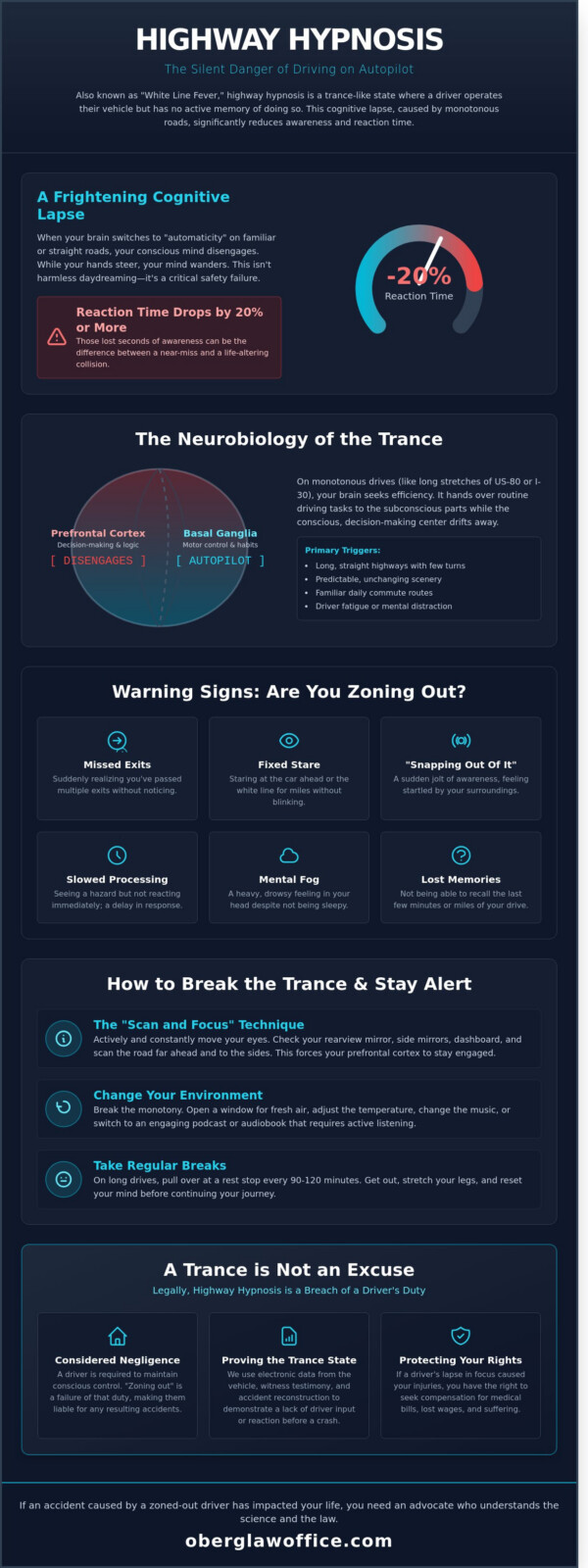
Many people call this “White Line Fever.” It isn’t just a problem for long-haul truckers; it affects both seasoned drivers and teenagers alike. When you’re on a familiar or monotonous route, your brain switches to a state of “automaticity.” This means your subconscious takes over the mechanical tasks of steering and braking while your conscious mind drifts. While this might feel like a harmless “flow state,” it is actually a dangerous cognitive lapse. Your reaction times can drop by 20% or more because your brain isn’t actively processing new information. If a car suddenly stops on I-635, those lost seconds of awareness can result in a life-altering collision.
At the Oberg Law Office, we understand that these accidents aren’t just “bad luck.” They happen because of specific physiological triggers. We’ve seen how a single moment of “zoning out” leads to physical and emotional trauma for Mesquite families. You deserve a legal guide who looks at the science behind the crash to ensure you receive the compensation you need for your recovery.
The History of the ‘Velocitization’ Concept
The study of this phenomenon isn’t new. Researchers first identified “road hypnotism” in a 1921 study by G.W. Williams, who observed drivers staring fixedly at a single point. By the early 1950s, aviation experts began studying how pilots lost their sense of speed and time during long, high-altitude flights. They called this “velocitization.” Modern Texas highway designs, featuring long and straight stretches with minimal visual interruptions, inadvertently encourage this state. Your brain craves stimulation; when it doesn’t get it from the environment, it simply turns inward.
Signs You Are Entering a Driving Trance
Recognizing the warning signs can save your life or the lives of others on the road. You might notice your eyes becoming glassy or realize you’ve been staring at the bumper of the car ahead for miles without blinking. Other common indicators include:
- A sudden realization that you’ve passed multiple Mesquite exits without noticing them.
- Slowed cognitive processing where you see a hazard but don’t immediately react.
- Frequent wandering thoughts that take your focus entirely off the driving task.
- A heavy, “foggy” feeling in your head despite being physically awake.
If you find yourself “snapping out of it” and feeling startled by your surroundings, you’ve likely been experiencing highway hypnosis. This mental detachment is a form of negligence when it leads to an accident. We’re here to hold responsible parties accountable when their lack of focus causes you harm. Our team provides the unwavering determination needed to fight insurance companies while offering the neighborly support you need during this difficult time.
The Neurobiology of the Drive: How Your Brain Enters a Trance State
Human biology is designed for efficiency. When you perform a task repeatedly, your mind looks for ways to save energy by shifting that task from active focus to a background process. This is where the concept of automaticity comes into play. Automaticity is the brain’s ability to perform complex actions, like steering a vehicle, without conscious thought through repetitive habituation. While this helps you multitask in daily life, it creates a dangerous vulnerability during your afternoon commute through Mesquite.
During a state of highway hypnosis, a specific shift occurs in your neural activity. The basal ganglia, a group of subcortical nuclei responsible for motor control and routine behaviors, takes over the physical mechanics of driving. Meanwhile, the prefrontal cortex; the part of your brain responsible for complex decision making and logic; begins to disengage. It drifts away into internal thoughts or daydreams. This neurological handoff is why you might suddenly realize you’ve traveled five miles on I-20 without any memory of the journey. To better understand the clinical side of this phenomenon, you can read more about What Is Highway Hypnosis and how it impacts your reflexes.
Texas highways like I-30 or the long stretches of Highway 80 provide a low cognitive load environment. There are fewer stoplights, predictable curves, and consistent speeds. According to a 2023 study on driver behavior, these monotonous conditions can lead to a 25% decrease in reaction times. When your brain isn’t being challenged by the environment, it effectively powers down its active monitoring systems. If a car suddenly brakes in front of you near the Town East Boulevard exit, your brain must scramble to re-engage the prefrontal cortex, costing you precious milliseconds that could prevent a collision. This delay is often the difference between a near-miss and a devastating multi-car pileup.
The Selective Attention Trap
Your brain constantly filters the world to prevent sensory overload. In the familiar surroundings of a daily commute, your mind begins to categorize lane lines and engine noise as redundant information. This creates a gap between looking and seeing. Research shows that 40% of drivers have experienced this mind-wandering state, where the internal map of a familiar route overrides the actual visual input of the road.
Environmental Triggers of White Line Fever
Environmental factors like the rhythmic hum of tires on Texas pavement create an auditory anchor that lulls the brain into a trance. The strobe effect of dashed white lines passing at 70 mph reinforces this hypnotic rhythm. While features like cruise control offer convenience, they often lower your cognitive engagement. If you’ve been injured by a distracted driver, a dedicated Mesquite car accident attorney can help you seek justice.
Highway Hypnosis vs. Drowsy Driving: A Critical Legal Distinction
You might think that highway hypnosis and drowsy driving are the same thing. They aren’t. While both lead to devastating collisions on Texas roads like I-635 or Highway 80, the biological states are different. Drowsy driving happens when your brain is actively trying to shut down for sleep. In contrast, this trance-like state involves an awake brain that has entered a phase of automaticity. You’re technically conscious, but your mind has detached from the physical task of driving. This distinction matters deeply when you’re seeking justice after a wreck.
Insurance adjusters often try to conflate these two states to minimize your settlement. They might argue that the driver was simply tired, suggesting a level of unavoidable human error. However, Wertheim’s hypothesis on highway hypnosis suggests that this state is triggered by predictable factors like road monotony and low cognitive load. Because it’s predictable, it’s preventable. Under Texas law, “zoning out” is still a breach of the duty of care. Every driver has a legal obligation to remain vigilant. If they feel their focus slipping, the “reasonable person” standard requires them to pull over before they enter a trance. When they don’t, they’re responsible for the harm they cause your family.
The Dangers of Delayed Reaction Time
An alert driver typically reacts to a hazard in 1.5 seconds. A driver experiencing highway hypnosis may take 3.0 seconds or longer to process a threat. In many Mesquite accidents we investigate, there are zero skid marks at the scene. This indicates the driver never even hit the brakes before the impact. According to 2023 crash data, these high-speed, no-brake collisions are significantly more likely to result in catastrophic injuries. When a driver finally snaps out of the trance right before a crash, the startle response often causes them to jerk the wheel. This over-correction is a leading cause of rollovers and multi-vehicle pileups on our local highways.
Is Highway Hypnosis a Valid Defense?
Some defense attorneys try to use “unconscious negligence” as a shield. They claim their client shouldn’t be held liable because they don’t remember the minutes leading up to the crash. This is a myth that we don’t accept at the Oberg Law Office. Memory loss doesn’t equate to a lack of liability. In Texas, we hold drivers accountable for the choices they made before the trance began. We frequently counter the “sudden medical emergency” defense by showing the driver ignored the clear warning signs of mental fatigue. Our team uses evidence like telematics data and electronic logging device (ELD) records for commercial trucks to prove the driver was negligent long before the collision occurred. You deserve a legal partner who understands these nuances and fights to protect your recovery. We don’t let insurance companies hide behind scientific-sounding excuses to avoid paying what they owe you.
Proactive Strategies to Break the Trance and Stay Alert
Driving through the long, flat stretches of I-20 or Highway 80 near Mesquite quickly leads to a dangerous mental fog. You can protect yourself by making small, deliberate changes to your environment. Adjust your seat angle by just 2 or 3 degrees every hour to keep your muscles engaged and your posture from becoming too relaxed. Lower the temperature to 68 degrees or crack a window to let in fresh Texas air. These physical shifts prevent your body from settling into a sedentary state that invites highway hypnosis.
Eye movement is your best defense against a wandering mind. Implement the “Scan and Focus” technique by moving your eyes every 2 seconds. Look at your rearview mirror, then the side mirrors, then the dashboard, and then the road ahead. This constant visual shifting keeps your brain from entering the “alpha state,” a relaxed mental condition where your subconscious takes over the driving duties. When your eyes stay fixed on a single point, your brain begins to tune out the world around you.
Strategic stopping is a non-negotiable safety requirement for long trips. Follow the 2-hour or 100-mile rule, which dictates a mandatory rest break regardless of how “fine” you feel. According to the National Sleep Foundation, 60 percent of adult drivers have driven while feeling drowsy. A 15 minute break at a Mesquite rest stop or gas station allows your brain to reset. Walk around, stretch your legs, and break the monotony of the pavement.
Avoid “Cruise Control Laziness” on repetitive roads. While this feature is helpful for fuel efficiency, it detaches you from the active driving process. On monotonous stretches, turn it off. Controlling your speed manually forces you to stay present and aware of the vehicles around you. This simple act of physical engagement can be the difference between staying alert and drifting into a trance.
Active Engagement Techniques
Engage your brain by singing or talking aloud to yourself. This activates the verbal processing centers, making it much harder for the mind to drift. Vary your speed by 3 to 5 miles per hour every few minutes within legal limits. This slight change requires a cognitive decision, breaking the hypnotic rhythm of the road. Stay hydrated with water rather than sugary sodas. A 2015 study from Loughborough University found that even mild dehydration can lead to as many driving errors as being over the legal alcohol limit.
Technology as a Double-Edged Sword
Newer vehicles in Mesquite often feature Driver Attention Monitoring (DMS) systems. These use infrared sensors to track your eye movements. If the system detects you’re staring blankly for too long, it triggers an audible alert. Don’t rely solely on lane-keeping assistance. These systems are safety nets, not replacements for an active driver. If you’re on a long haul, set a repeating alarm on your smartwatch for every 20 minutes to remind you to do a quick mental check-in.
If you’ve been injured by a driver who succumbed to this dangerous trance, the team at Oberg Law Office is here to help you seek justice. You deserve a Mesquite car accident lawyer who treats you like family while fighting for your recovery.
When a ‘Trance’ Leads to a Tragedy: Seeking Legal Justice
The moments following a collision on a Mesquite highway are often a blur of sirens and adrenaline. If you suspect the other driver was “zoned out” before they hit you, your observations right now are vital. Look for a lack of skid marks on the asphalt. According to 2023 data from the National Highway Traffic Safety Administration, a lack of corrective steering or braking often indicates a driver who was mentally absent. If the other motorist appears dazed or cannot explain why they didn’t see your vehicle, they may have been experiencing highway hypnosis.
You should immediately point out these behaviors to the responding officer. Eyewitness accounts from other commuters are equally precious. A witness might have seen the vehicle drifting steadily without a blinker for miles; a classic sign of a driver in a trance. We use these testimonies to build a foundation of negligence that insurance companies cannot easily dismiss. Documenting these “invisible” details early on is the first step toward securing the justice your family deserves.
Investigating the ‘Invisible’ Cause
Proving a driver was mentally checked out requires more than just a hunch. Our team collaborates with accident reconstruction experts who analyze the physics of the crash to prove a total lack of driver engagement. In commercial truck accidents, we aggressively pursue Electronic Logging Device (ELD) data. The Federal Motor Carrier Safety Administration (FMCSA) mandates these logs to prevent fatigue. If a driver exceeded their 11-hour driving limit, it’s a direct link to the cognitive fog that causes accidents. We also secure the “black box” or Event Data Recorder (EDR) from the vehicle. This device provides concrete data on throttle position and brake application, often showing that the driver didn’t even attempt to stop before the impact.
We don’t stop at the vehicle’s hardware. Our office analyzes cell phone records and telematics to rule out active distractions like texting. By eliminating other possibilities, we isolate the driver’s failure to maintain awareness as the primary cause of your suffering. This meticulous approach ensures that the “invisible” cause of your accident becomes a visible, undeniable fact in a court of law. When someone enters a state of highway hypnosis, they’re neglecting their duty to everyone else on the road, and we’re here to prove it.
Your Recovery and Your Rights
At the Oberg Law Office, we understand that a Mesquite car wreck changes everything for a family. You’re dealing with mounting medical bills, lost income, and the heavy weight of emotional trauma. You deserve a protector who treats you like a neighbor, not a case number. The Oberg Law Office promise is simple: you get personal attention from Attorney Gregg Oberg. You won’t be handed off to a paralegal or an assistant; you’ll have an experienced advocate guiding you through every step of the legal process.
We fight to secure compensation that reflects the true cost of your recovery. This includes immediate hospital costs and the long-term therapy you might need to move past the trauma. We operate on a contingency basis, which means there is no fee unless we win your case. This ensures that every Texas family has access to high-quality legal representation regardless of their current financial situation. We take on the burden of the legal battle so you can focus on healing. If you’ve been hurt by a driver who “wasn’t there,” contact Oberg Law Office for a free strategy session. We’re ready to stand by your side and hold negligent drivers accountable for the pain they’ve caused.
Take Control of Your Recovery After a Highway Accident
Staying safe on the road requires more than just keeping your eyes open; it demands total mental presence. You now understand that highway hypnosis is a physiological reality that can lead to life-altering negligence on our Texas interstates. Whether you’re struggling with mounting medical bills or the emotional weight of a collision, recognizing the distinction between a simple mistake and legal liability is the first step toward the justice you deserve.
Attorney Gregg Oberg has spent over 25 years fighting for the rights of families in Mesquite and across the state. When you choose our firm, you’ll speak directly with your attorney, ensuring your story is heard and your protection is prioritized. We operate on a contingency basis, so there’s no fee unless we win your case. You don’t have to navigate the complex world of insurance claims and liability alone. We have the experience to hold negligent parties accountable while you focus on healing.
Secure your free accident strategy session with Attorney Gregg Oberg today.
Your path to physical and financial recovery starts with a single conversation. We’re here to guide you every step of the way and help you move forward with confidence.
Frequently Asked Questions
Is highway hypnosis the same as falling asleep at the wheel?
No, highway hypnosis is a trance-like state where you continue to drive the vehicle safely but have no conscious memory of doing so. A 2021 study by the Sleep Foundation found that while drowsy driving causes 100,000 crashes annually, this trance is a distinct cognitive state where your eyes remain open. You stay awake, but your brain isn’t fully processing the environment around you.
Can I be sued if I caused a crash because of highway hypnosis?
Yes, you’re legally responsible for maintaining control of your vehicle at all times under Texas law. The Texas Transportation Code Section 545.401 defines reckless driving as a willful disregard for safety. If your trance leads to a collision, you may face a lawsuit for negligence. We help victims hold these drivers accountable to ensure families receive the compensation they deserve for their medical bills.
How do I know if I’m experiencing highway hypnosis?
You’ll notice signs like drifting over lane markers or realizing you don’t remember the last 5 miles you drove. The National Safety Council reports that a glassy-eyed stare and slow reaction times are key indicators. If you miss your exit on I-30 or Highway 80 because you were “zoned out,” you’ve likely entered this dangerous state. It’s a signal your brain needs a break immediately.
What is the best way to snap out of a driving trance?
You should pull over at a safe location, like a rest stop or gas station, and walk for 10 minutes to reset your brain. Research from the AAA Foundation for Traffic Safety suggests that a 15-minute break every 100 miles significantly reduces cognitive fatigue. Engaging your senses by drinking cold water or listening to an upbeat podcast can also help break the monotony of the road.
Are certain roads in Texas more likely to cause highway hypnosis?
Long, flat stretches of road like I-20 or Highway 80 through Mesquite are prime locations for this phenomenon. The Texas Department of Transportation recorded over 600,000 crashes in 2022, many on monotonous rural and suburban highways. These straight paths lack visual stimulation. This lack of variety triggers a trance in 20 percent of drivers during long trips across the state.
Does cruise control make highway hypnosis more likely?
Yes, cruise control can increase your risk because it removes the need for active physical engagement with the pedals. A 2013 study in the journal Accident Analysis and Prevention found that drivers using cruise control had slower reaction times by 0.5 seconds compared to those manually controlling speed. This lack of movement makes it easier for your mind to wander away from the task of driving.
What should I do if I see another driver who looks like they are in a trance?
You must maintain a safe distance of at least 300 feet and report the erratic behavior to local authorities. Call 911 if you see a vehicle drifting across lanes on the President George Bush Turnpike. Providing the dispatcher with the license plate number and a specific mile marker helps Mesquite police intervene. This simple phone call could prevent a serious multi-car accident from happening.
How long does it take for highway hypnosis to set in?
It can begin in as little as 20 minutes of driving on a monotonous or familiar road. Cognitive studies show that the brain starts to shift into a “default mode network” after 1,200 seconds of repetitive visual stimuli. This is why short commutes on familiar Mesquite streets can be just as dangerous as long hauls. We see many accidents where drivers simply stopped paying attention to their surroundings.


