
Last October, a Mesquite neighbor found themselves staring at $12,400 in unpaid medical bills, only to realize they were dangerously close to a legal deadline they didn’t even know existed. It’s a common fear that keeps many folks awake at night; the worry that a simple delay could mean you’re stuck paying for someone else’s mistake forever. You’re likely wondering how long after accident do you have to file claim while also trying to manage doctor visits and pushy insurance adjusters.
We understand that the legal system feels like a maze when you’re just trying to get back on your feet. This 2026 guide provides the clarity you need to protect your right to compensation and secure your family’s future. We’ll walk through the strict two year Texas statute of limitations and the immediate insurance notice periods you must meet to keep your claim alive. You deserve to move forward with the confidence that your recovery is protected by someone who truly cares about your outcome.
Key Takeaways
- Learn the critical difference between immediate insurance notification deadlines and the legal statute of limitations to ensure your right to compensation stays protected.
- Find out exactly how long after accident do you have to file claim before the legal clock expires and prevents you from seeking the justice you deserve.
- Understand what insurance companies really mean by “promptly” so you can navigate vague policy language without risking your financial recovery.
- Discover how the “Discovery Rule” and legal tolling can pause the countdown for injuries that were not immediately obvious following your accident.
- See how a dedicated legal advocate acts as a sentinel for your timeline, managing complex filing requirements so you can focus on healing with your family.
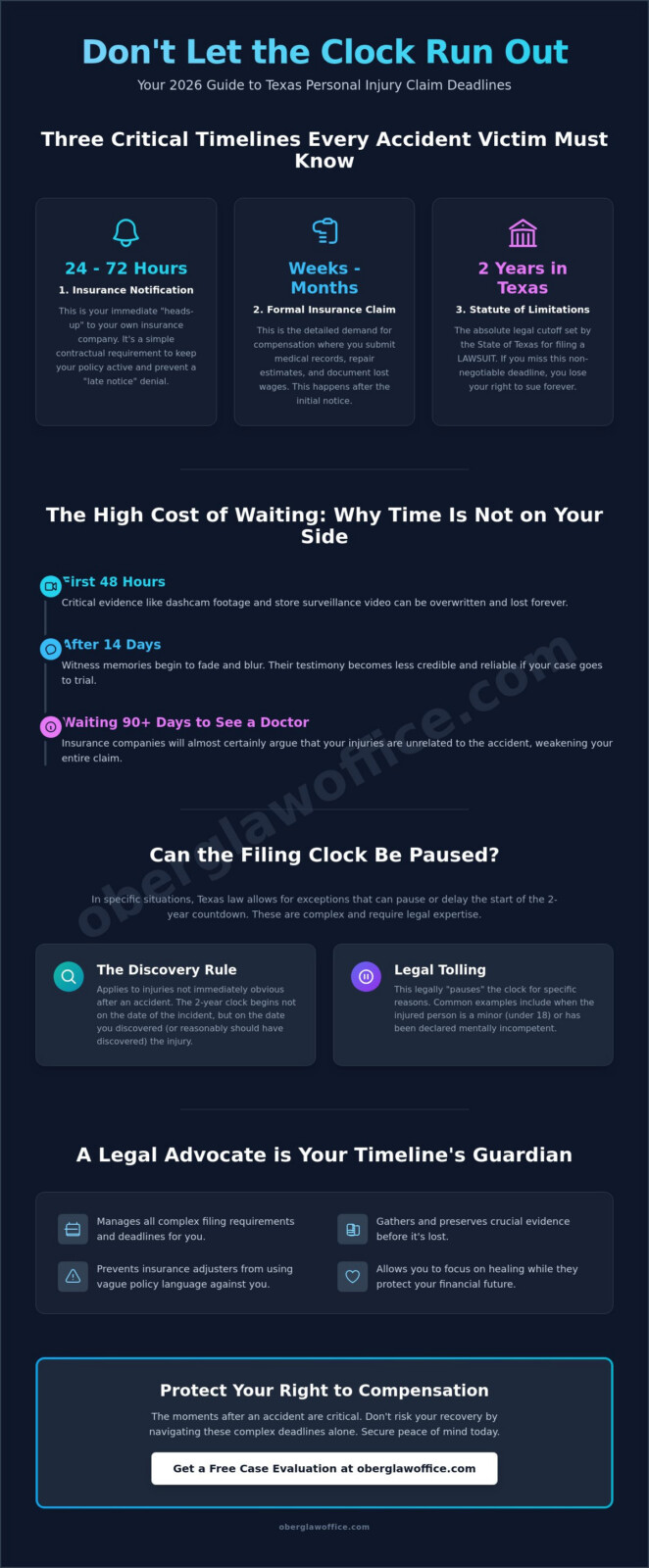
The Three Different Deadlines Every Accident Victim Must Know
After a crash in Mesquite or the surrounding DFW area, your mind is likely racing with questions about medical bills and car repairs. You need to know exactly how long after accident do you have to file claim paperwork to protect your family’s future. Most people think there is only one single deadline, but you actually have to manage three distinct timelines simultaneously to ensure you aren’t left paying for someone else’s mistake.
- Insurance Notification: This is the immediate “heads up” you give your own insurance company. Most policies require this within 24 to 72 hours of the incident.
- The Formal Insurance Claim: This is the detailed demand for compensation. While policies are often vague, you usually have weeks or months to finalize this after the initial notification.
- The Statute of Limitations: This is the hard legal cutoff set by the State of Texas for filing a lawsuit. In 2026, the law remains strict; if you miss this window, you lose your right to sue forever.
Missing one deadline doesn’t always disqualify you from the others, but it certainly makes the road to justice steeper. If you notify your insurer late, they might try to deny coverage, yet you could still potentially file a lawsuit if you’re within the legal window. We guide our neighbors through these overlapping dates so no detail slips through the cracks.
Notification vs. Filing: Why the Distinction Matters
Notification is a simple contractual requirement that tells your insurer an incident occurred. It’s not a request for money yet; it’s a procedural step that keeps your policy active and prevents the insurer from claiming “late notice” to avoid paying out. A formal claim is the actual demand where you present medical records and repair estimates to seek a specific settlement. You can often provide notice on day 1 and wait until day 60 to file the formal claim once your medical situation is clearer.
The Consequences of Waiting Too Long
Time is never on the side of the injured person. In the first 48 hours after a collision, critical evidence like dashcam footage or nearby store surveillance can be overwritten. Witness memories begin to blur after just 14 days, making their testimony less reliable if your case goes to trial. If you wait 90 days to see a doctor, the insurance company will almost certainly argue your injury was unrelated to the crash. While the law gives you a 2-year window in Texas, the “gray area” of insurance policy language means waiting even a few weeks can complicate how long after accident do you have to file claim paperwork. We act quickly to preserve evidence while it’s still fresh.
Understanding the Statute of Limitations for Personal Injury
When you’re recovering from a car wreck or a slip and fall, the last thing you want to think about is a ticking clock. However, the legal system operates on strict schedules. If you’re wondering how long after accident do you have to file claim, you’re essentially asking about the statute of limitations. This term refers to the maximum amount of time you have to initiate legal proceedings. Think of it as the ultimate expiration date for your right to seek justice. Once this window closes, you lose the ability to hold the negligent party responsible, regardless of how clear the evidence might be.
Across the United States, these timelines aren’t uniform. Most states set a window between 1 and 4 years. For instance, in Texas, the general rule for personal injury cases is 2 years from the date of the incident. It’s a common mistake to assume this deadline only applies to calling your insurance company or hiring a lawyer. In reality, the statute of limitations marks the date by which you must have a formal lawsuit filed in a court of law. Waiting until the last month to start the process is risky because gathering evidence and drafting the necessary documents takes time.
You should also be aware that different types of harm have different clocks. In many jurisdictions, the deadline to file for property damage, like a totaled vehicle, is longer than the deadline for physical injuries. While you might have 3 years to sue for the value of your car, you might only have 2 years to seek compensation for your medical bills and lost wages. Managing these overlapping dates is one of the first things we handle for our clients to ensure no opportunities for recovery are lost.
Why States Have Different Legal Deadlines
Lawmakers create these deadlines to ensure fairness for everyone involved. If someone tried to sue you for an accident that happened 15 years ago, you’d likely have no way to defend yourself. Witnesses move away, memories fade, and physical evidence disappears. By setting a 2 or 3 year limit, the law ensures that cases are decided based on fresh, reliable information. Because these rules vary so much by location and case type, you should verify your specific state’s laws immediately after your doctor’s visit. If you’re in the DFW area, a personal injury lawyer mesquite tx can help you calculate your exact deadline so you don’t have to guess.
The ‘Hard’ Deadline: What Happens if You Miss It?
Missing a statute of limitations is often a fatal blow to a personal injury case. Judges almost never grant extensions, even if your injuries were severe or you were still undergoing treatment. If you attempt to file after the date has passed, the insurance company’s lawyers will inevitably file a Motion to Dismiss. The court will look at the calendar, see the late entry, and close your case permanently. It’s a cold reality of the legal system, but it’s one we can help you avoid. If you’re worried that your deadline is approaching, don’t panic. A focused attorney can often file a protective lawsuit very quickly to stop the clock and preserve your rights while we continue to build your case. If you’re feeling overwhelmed by the paperwork, chat with us about your timeline to see where you stand.
Insurance Policy Deadlines: The ‘Promptly’ Requirement
When you sit down to read your auto insurance policy, you won’t find a clear, numbered countdown. Instead, you’ll see confusing phrases like “as soon as practicable” or “promptly.” These words are intentionally vague. They give insurance companies the wiggle room they need to deny your claim if they feel you waited too long. You might wonder how long after accident do you have to file claim before the company pushes back. In practice, “promptly” usually means within 24 to 72 hours of the collision.
Insurance adjusters want you to report the accident immediately so they can limit their liability. They’ll often ask for a recorded statement while you’re still shaken up or recovering from the initial shock. Don’t fall into this trap. They’re looking for any reason to shift the blame onto you. You’re contractually required to notify them that an accident happened, but you aren’t required to give a recorded statement on the spot. Stick to the basic facts and tell them you’ll provide more details after you’ve spoken with your doctor and legal counsel.
The Risk of Claim Denial for Late Reporting
If you wait weeks to report a crash, the insurer may claim “prejudice.” This means your delay made it harder for them to investigate the scene or inspect the vehicles. While different states have different rules, like the Deadlines to sue someone in California which vary by injury type, your insurance contract is its own set of rules. To protect your recovery, stick to the basic facts: the date, time, and location. Don’t apologize or guess about the extent of your injuries. For a more detailed strategy, check out our guide to hiring a car accident lawyer to learn how to handle these early conversations safely.
Uninsured and Underinsured Motorist (UM/UIM) Timelines
UM/UIM claims are unique because they’re based on contract law, not just the negligence of the other driver. Even if the Texas statute of limitations gives you two years to sue a negligent driver, your own policy might require notice within 30 or 60 days to trigger your UM/UIM coverage. You should pull your “Dec Page” (Declarations Page) today. It lists your specific coverage limits and reporting requirements. Missing a contractual deadline can be just as devastating as missing a court date. We see this often in Mesquite when drivers assume they have plenty of time, only to find their own insurance company turning its back on them. Your policy is a contract, and the clock starts ticking the moment the glass breaks.
Exceptions and Tolling: When the Filing Clock Pauses
Life doesn’t always follow a straight line after a crash. You might feel like you’ve missed your chance to seek justice if time has passed, but certain legal protections can pause the countdown. In the legal world, we call this “tolling.” Think of tolling as a temporary pause button on the statute of limitations clock. It exists because the law recognizes that some situations, like severe medical trauma or age, make it impossible to file a lawsuit immediately.
Texas law provides specific protections for the most vulnerable. If you were under 18 when the collision happened, the clock typically doesn’t start until your 18th birthday. This ensures that minors have a fair shot at recovery once they reach legal adulthood. We also see tolling applied in cases of “Legal Disability.” If an accident causes mental incapacity, the clock stays paused until the individual regains their capacity to handle legal matters. We believe in protecting those who cannot currently protect themselves.
The Discovery Rule and Latent Injuries
Not every injury is visible at the scene. You might walk away from a fender bender feeling fine, only to experience debilitating headaches or internal pain weeks later. Traumatic Brain Injuries (TBI) often take time to manifest clear symptoms. This is where the Discovery Rule becomes vital. It changes the starting point of your filing window. Instead of the “date of accident,” the clock starts on the “date of discovery.” This is the specific day you knew, or reasonably should have known, that you suffered an injury caused by the crash.
You must be careful with this exception. Texas courts apply the Discovery Rule with extreme strictness. You cannot simply wait to see a doctor and claim you didn’t know you were hurt. You must prove that even a diligent person wouldn’t have noticed the injury sooner. If you are wondering how long after accident do you have to file claim when your symptoms started late, you need a legal team that can document your medical timeline with precision.
Claims Against Government Entities
The rules change drastically if your accident involved a city bus, a postal truck, or a state-owned vehicle. You don’t have the luxury of a two year window in these cases. Under the Texas Tort Claims Act, you must provide a formal “Notice of Claim” to the specific government agency involved. In some Texas cities, this deadline is as short as 60 or 90 days from the date of the incident.
These cases are notoriously difficult because they involve sovereign immunity and strict administrative hurdles. If you were hit by a municipal vehicle, the question of how long after accident do you have to file claim has a much more urgent answer. This complexity is why many families seek out a truck accident lawyer texas who understands the nuances of claims against large commercial or government fleets. We make sure these short deadlines don’t stand in the way of your family’s recovery.
Don’t let a hidden deadline cost you the compensation you deserve. Contact the Oberg Law Office today for a free consultation to protect your rights.
How a Personal Injury Attorney Protects Your Recovery Timeline
When you’re hurt, your primary focus stays on your physical recovery and your family’s well-being. That’s why a dedicated legal advocate acts as a sentinel for your rights, watching every calendar date and legal deadline so you don’t have to. You might be wondering how long after accident do you have to file claim in Texas, and while the law generally allows two years, every day that passes can weaken the evidence available to support your case. Our team tracks these dates with absolute precision, ensuring no procedural error costs you the justice you deserve.
In certain complex cases, we can negotiate “tolling agreements.” These are specific legal contracts where both parties agree to pause the clock on the statute of limitations. This strategy gives us more room to negotiate a fair settlement with the insurance company without the immediate pressure of filing a formal lawsuit. Beyond just watching the clock, a firm takes immediate action to protect your interests. This includes sending formal notice to all involved parties and issuing “spoliation letters” to ensure that critical evidence, like traffic camera footage or trucking logs, isn’t destroyed or overwritten.
The best part is that you don’t have to worry about the cost of this protection. Because we operate on a contingency fee model, you get a professional team guarding your timeline immediately with no upfront costs. We only get paid when we successfully recover compensation for you, which means we share the risk and the goal of a successful outcome.
The Advantage of Early Legal Intervention
Waiting until the final months of a two-year window creates a dangerous last-minute rush. This is often when critical mistakes happen or documents go missing. When you involve a lawyer early, we handle every phone call and aggressive email from the insurance company. You won’t have to stress over saying the wrong thing to an adjuster who is trained to look for reasons to deny your claim. You focus on your healing and your doctor’s appointments while we manage the legal calendar and the heavy lifting.
Your Next Steps for a Stress-Free Recovery
It’s rarely too early to speak with a professional about your rights. Even if you’re still in the middle of treatment, getting a legal perspective provides the peace of mind you need to move forward. Follow these steps to protect your future:
- Complete a full medical evaluation to ensure every injury is documented by a professional.
- Gather your police report, scene photos, and any witness contact information.
- Schedule a consultation to confirm exactly how long after accident do you have to file claim based on your specific circumstances.
Our Mesquite-based team is ready to provide the compassionate guidance and firm representation your case requires. We treat our clients like neighbors because that’s exactly what you are. Contact Oberg Law Office for a free strategy session to ensure your recovery timeline is fully protected.
Take Control of Your Recovery Timeline Today
The clock starts ticking the moment an accident occurs. While Texas Civil Practice and Remedies Code Section 16.003 generally establishes a two-year window for personal injury lawsuits, most insurance policies require notification within just a few days. Waiting too long can jeopardize your ability to collect fresh evidence or secure the compensation you deserve. Understanding how long after accident do you have to file claim shouldn’t be a source of stress while you’re trying to heal.
You don’t have to navigate these strict legal deadlines alone. With over 25 years of Texas legal experience, Gregg Oberg provides the direct, personal guidance you need during this difficult time. At our firm, you’ll always speak directly with your attorney rather than being passed off to a paralegal. We believe in shared risk; there’s no fee unless we win your case. Let us handle the insurance companies and court filings so you can focus on getting back on your feet.
Schedule your free accident recovery strategy session with Gregg Oberg today.
Your path to justice is still open, and we’re here to help you walk it with confidence.
Frequently Asked Questions
What is the statute of limitations for a car accident?
In Texas, you have exactly 2 years from the date of the crash to file a personal injury lawsuit. This deadline is established by Texas Civil Practice and Remedies Code Section 16.003. If you miss this window, the court will likely dismiss your case regardless of your injuries. We recommend starting your claim within 30 days to ensure evidence like dashcam footage or witness memories remains fresh.
Can I still file an insurance claim if the accident was a month ago?
Yes, you can still file a claim 30 days after an accident, but you should act quickly. Most insurance policies require you to notify them of a loss promptly. While a one-month gap isn’t an automatic disqualification, it gives adjusters an excuse to question how long after accident do you have to file claim before the details become blurry. Our team helps you navigate these delays to protect your right to recovery.
What happens if I didn’t feel hurt at the scene but am in pain now?
You can still seek compensation if your symptoms appeared 48 to 72 hours after the collision. Adrenaline often masks serious issues like whiplash or internal bruising during the initial shock of the crash. You must see a doctor immediately to document these delayed symptoms. We use these medical records to prove the link between the accident and your current physical pain, ensuring the insurance company pays for your full treatment.
Is there a deadline to report an accident to the police?
Texas Transportation Code Section 550.026 requires you to report any accident involving injury or property damage exceeding $1,000 to the police immediately. If an officer doesn’t come to the scene, you must file a written report within 10 days. Having this official record is vital for your case. It prevents the other driver from changing their story 2 weeks later when they realize their insurance rates might go up.
Does the statute of limitations apply to passengers in an accident?
Yes, passengers must follow the same 2-year statute of limitations as drivers to seek justice in Texas. As a passenger, you often have a very strong case because you 100% did not cause the accident. We help passengers file claims against whichever driver was at fault. Whether it was the person you were riding with or the other motorist, we ensure your medical bills and lost wages are covered by the responsible parties.
Can an insurance company deny my claim because I waited two weeks to report it?
An insurance company might try to deny your claim for a 14-day delay, but they usually cannot do so unless the delay actually harmed their investigation. Insurers use “late notice” as a common tactic to avoid paying settlements. We step in to show that a 2-week gap didn’t change the facts of the case. Your protection is our priority, and we don’t let adjusters use minor delays to bully you.
Do I have more time to file if the other driver fled the scene (hit and run)?
The 2-year deadline typically remains the same even if the other driver fled the scene. While there are rare exceptions if the driver’s identity is concealed, you shouldn’t count on extra time. We help you file a claim through your own Uninsured Motorist coverage so you don’t have to wait for a police investigation to finish. This allows you to get the how long after accident do you have to file claim process moving toward a recovery.
How long does a wrongful death claim take to file after an accident?
Families have 2 years from the date of a loved one’s passing to file a wrongful death claim in Texas. This clock starts on the day of death, which might be different from the actual accident date if the victim survived for several days. It’s a devastating time for any family. We take the legal burden off your shoulders by handling the paperwork and deadlines so you can focus on healing and being together.