
Catastrophic Injuries
Catastrophic Injury Attorney: Securing a Lifetime of Care and Dignity (2026 Guide)
By Gregg Oberg ·

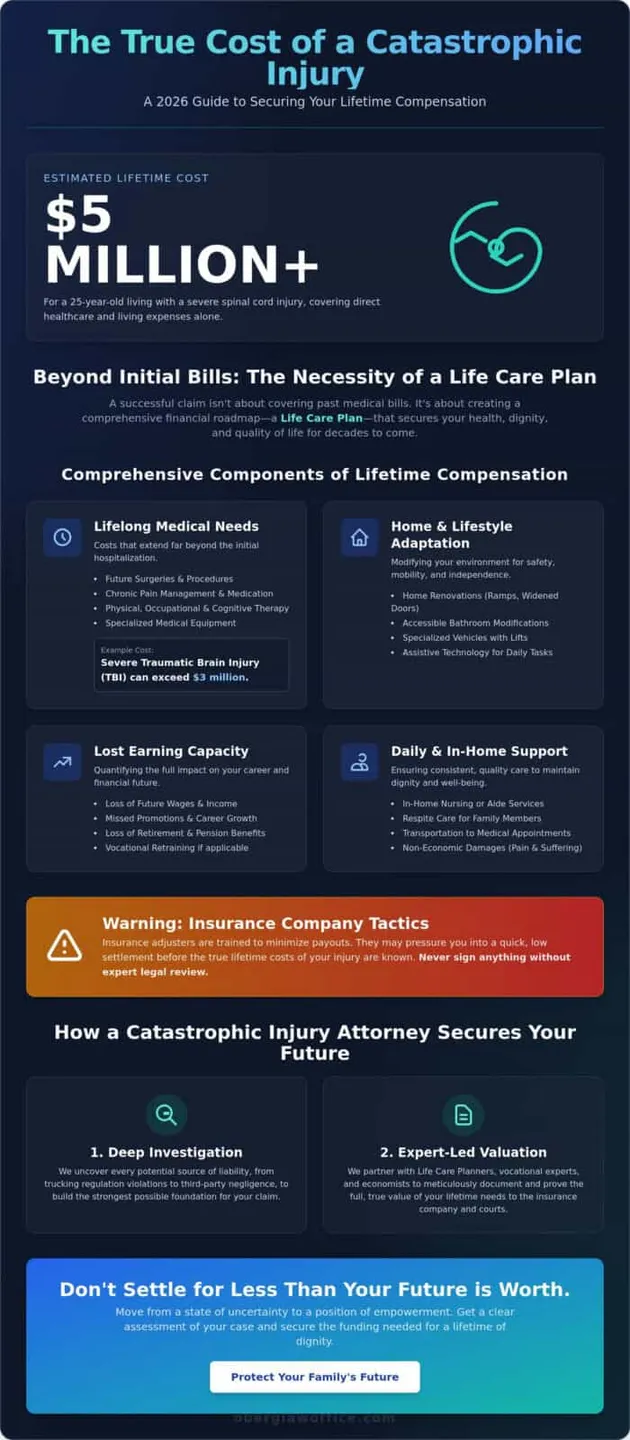
Did you know that for a 25-year-old living with a severe spinal cord injury, the estimated lifetime costs can exceed $5 million in direct healthcare and living expenses? You’re likely feeling the weight of this reality right now. It’s exhausting to face complex medical jargon and aggressive insurance adjusters while you’re simply trying to heal. You deserve to feel secure about your future, not pressured into a quick settlement that won’t even cover your basic needs five years from now.
We understand that you’re looking for more than just legal advice; you need a steadfast protector to ensure your family’s stability. Partnering with a dedicated catastrophic injury attorney is about more than filing a claim. It is about creating a specialized funding strategy that guarantees a lifetime of dignity and care. We’re here to help you move from a state of uncertainty to a position of empowerment, ensuring that large institutions don’t dictate the quality of your recovery.
This 2026 guide will show you how to secure the comprehensive compensation required for a full lifetime of recovery. We’ll break down the true costs of long-term care, explain how new 2026 federal regulations like the updated FTCA rules affect your claim, and outline the steps we take to handle the complex legal heavy lifting so you can focus on your health.
Key Takeaways
-
Learn the critical difference between temporary injuries and life-altering impairments so your legal strategy matches your long-term needs.
-
Discover how a comprehensive Life Care Plan acts as the foundation for securing the funding you need for decades of specialized medical care and lost income.
-
Understand why an experienced catastrophic injury attorney investigates every potential source of liability, from complex trucking regulations to third-party negligence.
-
Identify common insurance tactics designed to pressure you into low settlements and learn how to protect your rights during the recovery process.
-
See the value of direct advocacy and personal partnership when navigating high-stakes litigation for your family’s future.
Table of Contents
-
Understanding Catastrophic Injuries: When an Accident Changes Everything
-
Beyond Medical Bills: Calculating the True Lifetime Cost of Care
-
Establishing Liability in Complex Catastrophic Injury Cases
-
Overcoming Insurance Tactics: Why a Quick Settlement is a Risk
-
Securing Your Future with Oberg Law Office: Direct Advocacy
Understanding Catastrophic Injuries: When an Accident Changes Everything
Life changes in a heartbeat. One moment you’re planning for the weekend; the next, you’re facing a future that looks entirely different. A catastrophic injury isn’t just a medical diagnosis. It’s a permanent shift in how you move through the world. While a standard personal injury claim might involve a broken bone that heals in months, these cases involve life-altering impairments. We’re talking about Traumatic Brain Injuries (TBI), spinal cord damage, amputations, and severe burns that leave lasting scars, both visible and invisible.
In the legal world, the “catastrophic” designation is a powerful tool during settlement negotiations. It signals to insurance companies and juries that your needs aren’t temporary. This label shifts the focus from simple medical bills to a lifetime of required support. When a catastrophic injury attorney takes your case, they aren’t just looking at the past. They’re forecasting the next forty years of your life to ensure you never run out of the resources you need for dignity and care.
The Legal Threshold for Life-Altering Impairment
The legal system often measures the severity of an injury by its impact on your ability to maintain “gainful employment.” If you can no longer work in your chosen field or perform basic daily tasks like dressing or cooking, the law recognizes this as a profound loss. These cases require specialized legal expertise because they involve proving future losses that haven’t happened yet. You need a catastrophic injury attorney who understands how to quantify the loss of a career and the cost of permanent physical limitations through expert testimony and detailed evidence.
Immediate Steps After a Life-Changing Diagnosis
Your first priority is always medical stabilization. Documentation is your strongest ally during this time. Keep every record, even if it feels overwhelming. Once you’re stable, be extremely careful with insurance adjusters. They often push for quick signatures on waivers before you even know your full prognosis. Don’t sign anything without professional review. It’s also helpful to designate one family spokesperson to handle all administrative and legal inquiries. This keeps the message consistent and lets you focus on the grueling work of rehabilitation while we handle the legal heavy lifting.
Beyond Medical Bills: Calculating the True Lifetime Cost of Care
When you’re facing a permanent disability, your financial needs extend far beyond the immediate horizon of hospital rooms and initial surgeries. Many families make the mistake of focusing only on the bills currently sitting on their kitchen table. However, a successful claim must account for the next twenty, thirty, or even fifty years of your life. This is where a catastrophic injury attorney steps in to build a “Life Care Plan.” This document serves as the foundation of your case; it’s a comprehensive roadmap that details every penny you’ll need to maintain your health and dignity for the rest of your life.
Calculating these costs requires more than just a calculator. We look at the often-overlooked expenses that transform a house into a home again. This includes structural modifications like widened doorways and custom ramps, as well as specialized vehicles equipped with advanced lifts. We also account for the loss of “gainful employment.” Vocational experts help us determine your lost earning capacity by looking at your career trajectory, expected promotions, and inflation. They ensure the settlement reflects what you would’ve earned if the accident had never happened.
If you’re feeling overwhelmed by these complex projections, reaching out to the Oberg Law Office for a clear assessment can provide the peace of mind you deserve.
The Role of the Life Care Planner
Life care planners are specialized professionals who project the costs of future surgeries, medications, and daily therapies. For instance, someone living with a Traumatic Brain Injury (TBI) may face lifetime costs exceeding $3 million for severe cases. These experts are essential for countering the low-ball estimates that insurance companies typically offer. We work with top-tier medical and financial experts to ensure every future need is documented and defended with scientific precision.
Quantifying Economic vs. Non-Economic Damages
Your recovery consists of two distinct categories. Economic damages are the tangible losses we can track with receipts, such as hospital bills and lost wages. Non-economic damages represent the human cost of the event. This includes your physical pain, emotional suffering, and the loss of consortium or companionship with your loved ones. We use established methods like “multipliers” to put a fair value on these intangible losses. It’s about more than just numbers; it’s about restoring a sense of fairness to your life after a devastating event.
Establishing Liability in Complex Catastrophic Injury Cases
Determining who’s responsible for a life-altering event is rarely a simple task. In a standard car wreck, it might just be one driver’s mistake. In a catastrophic case, however, the web of liability often stretches much further. You might be dealing with a combination of driver error, corporate negligence, and even equipment failure. A catastrophic injury attorney must act as a private investigator to uncover every party that contributed to your harm. This thorough approach is the only way to ensure there’s enough insurance coverage to fund a lifetime of care.
Liability can hide in unexpected places. For example, a catastrophic fall on commercial property might involve the property owner, a maintenance contractor, and the manufacturer of a faulty handrail. If a defective safety device failed during an accident, we may also pursue a product liability claim. We look beyond the surface to find the “why” behind your injury. This ensures that every institution that prioritized profits over your safety is held accountable for the resulting damages.
Commercial Trucking and Vicarious Liability
If you’ve been injured by a commercial vehicle, suing the driver is rarely enough to cover your long-term needs. Trucking companies are often held responsible for their employees’ actions through a legal concept called vicarious liability. This means if a company pushed a driver to exceed federal hours-of-service limits or failed to maintain a truck’s braking system, the corporation itself is on the hook. You can learn more about these specific challenges in our truck accident lawyer Texas guide, which details how we fight back against big trucking interests.
Negligence and the Burden of Proof
To win your case, we must prove negligence using a “preponderance of evidence” standard. This means we show it’s more likely than not that the other party is at fault. Our catastrophic injury attorney builds this proof on four essential pillars:
-
Duty: The defendant had a legal obligation to act with reasonable care.
-
Breach: They failed to meet that obligation through action or inaction.
-
Causation: Their specific failure directly caused your life-altering injury.
-
Damages: You suffered actual physical, emotional, and financial losses.
We often bring in accident reconstruction experts who use digital modeling to recreate the scene. This high-tech evidence makes it difficult for insurance companies to deny the facts of what happened to you.
Overcoming Insurance Tactics: Why a Quick Settlement is a Risk
Insurance companies are businesses first. When they see a claim involving a life-altering injury, their primary goal isn’t to ensure your comfort for the next thirty years. It’s to close the file as cheaply as possible. They often use a “delay, deny, defend” strategy. They delay payments to increase your financial stress. They deny parts of your claim to see if you’ll settle for less. Finally, they defend their low-ball offers with aggressive legal teams. It’s a high-pressure environment designed to make a quick settlement look like a lifeline when it’s actually a risk.
Many victims find themselves insolvent within five years of taking a fast settlement. That initial check might look like a fortune when you’re staring at a stack of immediate bills, but it rarely accounts for the compounding effect of lost wages or the rising costs of specialized healthcare. Fast money disappears quickly. If you’re being pressured to sign a release today, you should speak with a catastrophic injury attorney to ensure your future is actually protected.
The “Helpful Adjuster” and the Pre-Settlement Trap
An insurance adjuster might call you shortly after the accident. They’ll sound empathetic and neighborly, offering to “take care of everything” so you don’t have to hire a lawyer. Don’t be fooled. They represent the company’s bottom line, not your family’s security. They’re often looking for early statements they can use to diminish the perceived severity of your injury later. You have the right to remain silent regarding the legal and medical specifics of your case until you’ve consulted with a professional who is on your side.
Wait for Maximum Medical Improvement (MMI)
Settling your case before you reach Maximum Medical Improvement (MMI) is a catastrophic financial mistake. MMI is the point where your doctors determine your condition is unlikely to improve further. Until you reach this plateau, you can’t possibly know the true cost of your future care. Before you consider any offer, use this checklist to see if it covers a 20+ year horizon:
-
Does the amount account for at least 2% to 3% annual inflation for medical services?
-
Are future surgeries or replacement of assistive devices (like wheelchairs) included?
-
Does it cover the loss of employer-sponsored benefits and retirement contributions?
-
Is there a provision for home health care if your condition worsens as you age?
If the answer to any of these is “no,” the settlement isn’t enough to sustain you.
Securing Your Future with Oberg Law Office: Direct Advocacy
Choosing the right legal partner is the most consequential decision you’ll make after a life-altering event. You don’t need a massive law factory where you’re passed off to junior associates or support staff. You need a catastrophic injury attorney who is personally invested in your restoration. At our firm, Attorney Gregg Oberg brings more than 25 years of high-stakes litigation experience directly to your case. This level of leadership ensures that your family’s future isn’t just another file on a desk; it’s a mission we’re determined to complete.
We believe in a neighborly approach that combines professional authority with genuine empathy. This means when you have a question about your case or your future, you speak directly with your attorney. We’ve seen how large institutions try to overwhelm families with paperwork and complex terminology. Our job is to act as your steadfast protector, handling the administrative burdens so you can focus on the grueling work of physical and emotional recovery.
A Compassionate Partner in Your Recovery
Our commitment to you goes beyond a simple transaction. We view our work as a collaborative partnership. The Oberg Law Office manages every detail of your claim, from gathering medical evidence to negotiating with aggressive insurance adjusters. We understand the fear of long-term financial ruin that often follows a permanent impairment. By taking over the legal heavy lifting, we provide the breathing room your family needs to find a new sense of normalcy while we maintain unwavering determination against those responsible for your harm.
The Advantage of Decades of Trial Experience
Insurance companies know which lawyers are willing to go to court and which ones prefer to settle quickly. Our philosophy is simple: we prepare every case as if it is heading to a jury trial. This preparation forces insurance giants to take your claim seriously and often leads to significantly higher settlement offers. We aren’t afraid of a fight; we’re built for it. If you’re ready to demand the resources you need for a lifetime of care, we invite you to take the first step toward accident recovery justice.
Financial barriers should never stand in the way of high-quality legal representation. That’s why we operate on a contingency-based fee structure. You won’t pay us a single dime unless we recover money for you. We share the risk because we believe in the merit of your case and the importance of your recovery. We offer a free initial strategy session for families facing catastrophic loss, providing you with a clear roadmap for your legal journey without any upfront cost or pressure.
Take the First Step Toward Your New Future
You’ve learned that a catastrophic injury claim is much more than a standard lawsuit. It’s a specialized funding strategy designed to protect your dignity and security for decades. By establishing clear liability and utilizing a detailed Life Care Plan, we ensure that every future medical need is documented and defended before any settlement papers are signed. Partnering with a dedicated catastrophic injury attorney means you don’t have to face aggressive insurance adjusters or complex medical-legal terminology by yourself.
At Oberg Law Office, we provide the professional authority you need and the compassionate advocacy you deserve. With over 25 years of legal experience and a no-recovery, no-fee guarantee, we’re here to carry the legal burden while you focus on healing. You’ll always have direct access to Attorney Gregg Oberg, making this a collaborative partnership rather than a distant transaction. We’re ready to stand as your steadfast protector against large institutions.
Schedule Your Free, Compassionate Strategy Session Today. You’ve been through enough; let’s start building a secure path forward together.
Frequently Asked Questions
What qualifies as a catastrophic injury in a legal claim?
A catastrophic injury is legally defined as a permanent impairment that prevents you from performing gainful work or maintaining your previous quality of life. This includes severe traumatic brain injuries, spinal cord damage, and loss of limb. Unlike standard injuries where a full recovery is expected, these cases focus on the permanent nature of the disability and the extensive long-term support required for you to live with dignity.
How much is a catastrophic injury case worth?
The value of a catastrophic injury case depends on your specific needs, but settlements in 2026 typically range from $500,000 to over $25 million. These figures account for a lifetime of medical expenses, lost earning capacity, and non-economic damages like pain and suffering. Because every case is unique, your recovery is calculated based on your individual life expectancy and the specific severity of your physical or cognitive limitations.
Can I sue for a catastrophic injury if it happened at work?
You can often file a personal injury lawsuit for a work-related catastrophic injury if a third party’s negligence caused the accident. While workers’ compensation provides basic benefits, it rarely covers the full scope of a life-altering event. If a defective machine or a negligent contractor was involved, you may be able to pursue a much larger recovery through a separate legal claim against those responsible parties.
How long do I have to file a catastrophic injury lawsuit?
Most states, including Texas, California, and Georgia, maintain a two-year statute of limitations for filing a personal injury lawsuit as of 2026. However, if your claim is against a government entity, you may have as little as six months to file an initial notice. It’s vital to consult with a professional early so you don’t miss these strict legal deadlines that could permanently bar your recovery.
What if the insurance company denies my catastrophic injury claim?
If an insurance company denies your claim, it doesn’t mean your case is over. Insurers often use denials as a tactical move to see if you’ll give up or settle for a significantly lower amount. We review the denial letter to identify their reasoning, gather additional evidence to counter their claims, and prepare to take the matter to court if they refuse to act in good faith.
Do I really need an attorney for a catastrophic injury case?
You absolutely need a catastrophic injury attorney because the legal and medical complexities of these cases are overwhelming for anyone to handle alone. Insurance companies employ teams of adjusters and lawyers dedicated to minimizing your payout. Without a steadfast protector on your side, you risk accepting a settlement that fails to cover your medical needs just a few years down the road.
How are future medical costs calculated in a settlement?
Future medical costs are calculated by combining expert medical testimony with economic data regarding healthcare inflation. In 2026, for example, the Medicare Outpatient Prospective Payment System saw a rate increase of 1.63%, which reflects the rising costs of care. We analyze your life expectancy and the expected frequency of surgeries, therapies, and medications to ensure your settlement doesn’t run out prematurely as you age.
What is a Life Care Plan and why do I need one?
A Life Care Plan is a comprehensive document that serves as the foundation for your financial recovery. It details every anticipated expense, such as home modifications, specialized vehicles, and 24/7 nursing care. You need this plan because it provides a scientific, data-driven basis for your claim. This makes it much harder for insurance companies to argue against the compensation you need to sustain your quality of life.
This article provides general information. For advice about your circumstances, contact Oberg Law Office.